
I got a call yesterday evening that went roughly like this.
"Deepesh, inflation is 5.5% now. RBI will hike again in December, no? Should I just lock my home loan at a fixed rate and stop worrying?"
I understand the feeling. Nobody likes opening an SMS from the bank and finding the EMI has gone up again. But "stop worrying" is an expensive thing to buy, and I want to show you what it actually costs.
See your real payoff date in 60 seconds
Banks calculate remaining EMIs by simple subtraction. See your actual payoff date and discover how much interest a balance transfer can save.
What happened on Monday
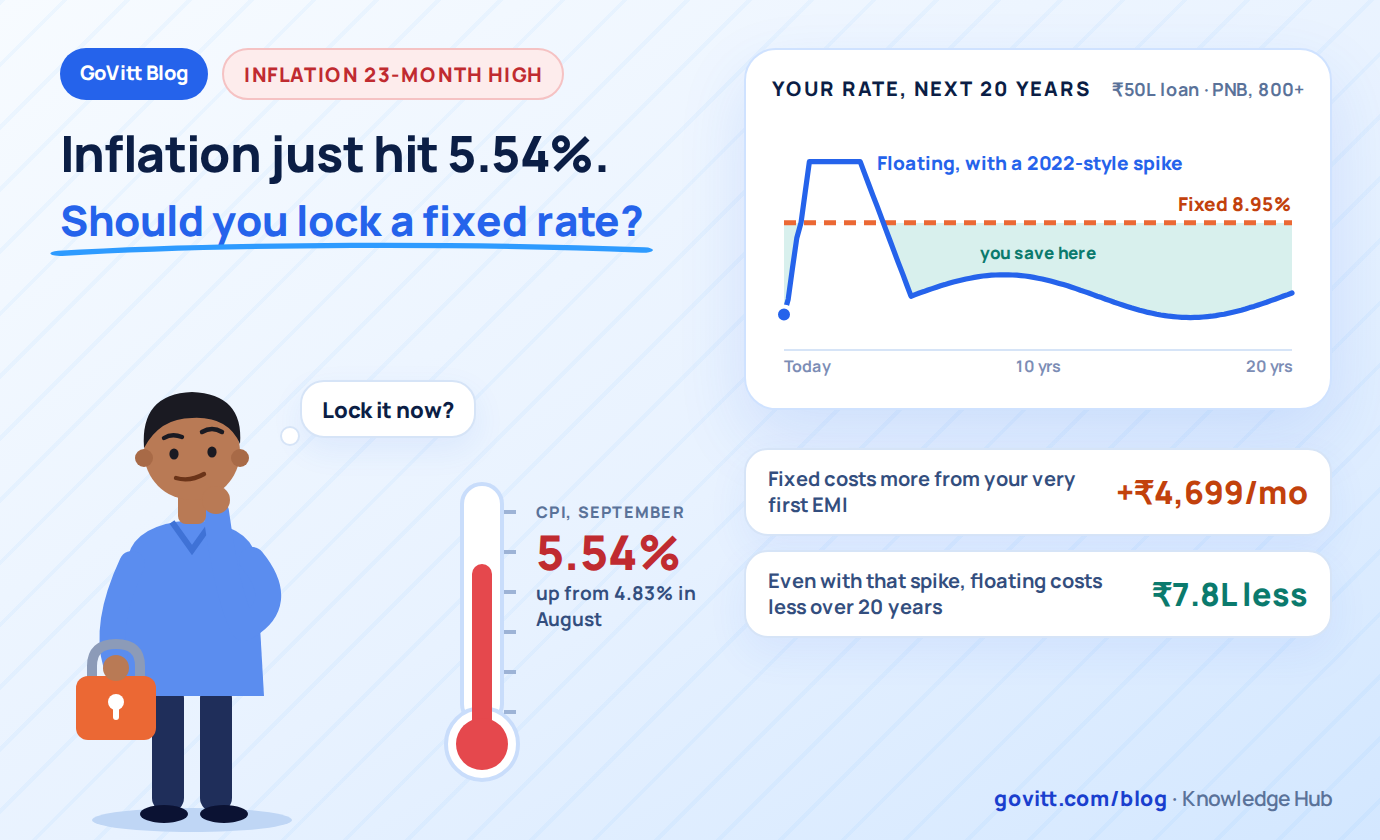
The September inflation number came out on October 12. Retail inflation was 5.54%, up from 4.83% in August, and the highest in 23 months. Food inflation jumped to 7.74%. Onions alone were up 108% from a year ago, which tells you a lot of this is vegetables, not everything.
RBI had already raised the repo rate to 5.50% on October 7 and said it's now in "calibrated tightening" mode. A number like this makes a second hike at the December meeting more likely. SBI's research team had already said it expects the repo rate at 6% by December.
So yes, the next move in your floating rate is probably up. The question is whether a fixed rate is the answer to that.
What "fixed" costs you on day one
Fixed rates are always higher than floating to start with. The bank is taking the risk of rates going up, and it charges you for it upfront.
Here's PNB's own rate card as of this week, for a borrower with a CIBIL score above 800. Floating: 7.45%. Fixed for tenures up to 10 years: 8.45%. Fixed for tenures above 10 years: 8.95%.
On a ₹50 lakh loan over 20 years, that's an EMI of ₹40,127 on floating and ₹44,826 on fixed. You start paying ₹4,699 more every month, from the first EMI, to protect yourself against hikes that may or may not come.
For context, RBI's last hike added about ₹781 a month to the same loan.
How bad would things have to get?
I ran a few scenarios on that ₹50 lakh loan. Total interest over 20 years, if you stay floating and rates do different things, compared with fixing today.
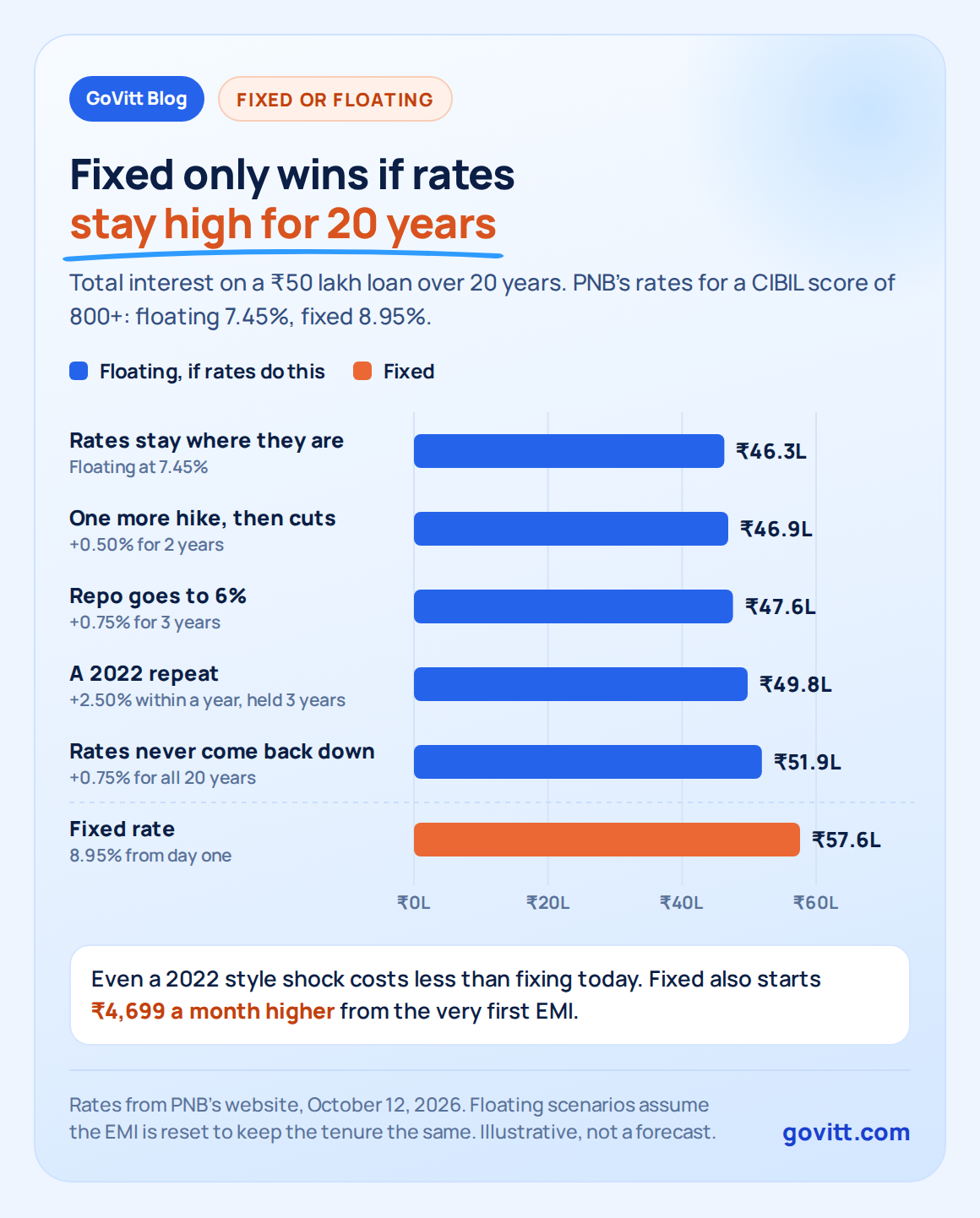
Every floating scenario here costs less than fixing today. For fixed to win, rates would have to stay 1.50% higher for the entire loan.
Look at the fourth bar. In 2022 and 2023, RBI took the repo rate from 4% to 6.50% in under a year. That's about as bad as it's been in recent memory, and lots of borrowers saw their EMIs jump or their loans stretch by years. Even if that happens again right now and lasts three years, floating still comes out about ₹7.8 lakh cheaper than fixing at 8.95%.
For the fixed rate to actually save you money, your floating rate would need to sit 1.50% above today's level for the whole 20 years. Not for a year or two. For the whole loan.
Can that happen? Sure. But it hasn't been how Indian rate cycles have worked. They go up, they come down.
The fine print on fixed rates
This is the part nobody puts on the banner.
A lot of "fixed" home loans aren't fixed for the whole loan. Some are fixed for the first two or three years and then turn floating. Some have a clause that lets the bank revise the rate every few years. Ask the bank one direct question: is this rate fixed until my last EMI? Get the answer in the sanction letter.
Fixed loans can also carry charges if you prepay or close them early, especially if you move the loan to another bank. Floating rate loans to individuals can't have prepayment charges. Fixed ones can. So if you're planning to put your bonus into the loan every year, or think you might shift lenders later for a better rate, fixed takes that option away or makes it expensive.
And if you already have a floating loan and want to switch, check what your bank charges. RBI's rules say lenders may let you switch to a fixed rate at the time of a reset, and whatever they charge for it has to be disclosed in your sanction letter. It's not free, and the fixed rate you're offered is today's fixed rate, not the one from when you took the loan.
When fixed does make sense
I'm not saying never. There are a few cases where I'd think about it seriously.
When your budget has no room at all. If an extra ₹2,000 to ₹3,000 a month would break your household budget, the certainty might be worth paying for. Though if that's where you are, I'd also ask whether the loan is too big.
When the gap is small. If a lender offers fixed at 0.50% or less above its floating rate, and it's fixed for the full term, the maths gets a lot closer. At PNB right now it's 1.00% to 1.50%, which is a lot.
When the loan is short. Over 8 or 10 years, the extra cost of fixed has less time to add up, and PNB's fixed rate for shorter tenures is lower at 8.45%.
When your current floating rate is already high. If you're stuck at 8.90% floating on an old loan, a fixed offer at 8.95% looks very different than it does to someone at 7.45%. But in that case, the better move is usually to get your floating rate cut first, either from your bank or by moving the loan.
What I told him
Stay floating. Get the rate as low as it can go, because that's where the real money is. If your credit score has improved since you took the loan, ask for a lower spread.
Then build your own cushion instead of paying the bank for one. The ₹4,699 a month you'd spend extra on a fixed rate is real money. Put even part of that aside, or into prepayment, and you've protected yourself against the next hike without locking into a higher rate for twenty years. I went through the prepay or FD question here.
And when the hike does come, tell your bank in writing that you want the EMI to go up, not the tenure. That one letter saves more than most people realise. The full reasoning is in this post.
Not sure what's right for your loan?
WhatsApp your outstanding amount, current rate, years left, and any fixed rate offer you've received to +91 70194 17854. We'll run the same numbers for your loan and tell you whether the fixed rate is worth it, or whether a lower floating rate is available from one of our 50+ partner banks and housing finance companies. You can also try your numbers on our free Payoff & Transfer Calculator. GoVitt doesn't charge you any commission.
Rates are from PNB's website as on October 12, 2026, for salaried borrowers with a CIBIL score of 800 or above and a loan above ₹30 lakh. Scenarios are illustrative, not forecasts, and assume the EMI is reset at each rate change so the tenure stays at 20 years. Fixed rate terms, reset clauses and charges differ across lenders. Check your sanction letter.
Questions people usually ask
Should I choose a fixed or floating home loan in 2026? For most borrowers, floating still works out cheaper. At PNB's rates in October 2026, a fixed rate costs 1.00% to 1.50% more than floating for a borrower with an 800+ score. For fixed to save money on a 20 year loan, floating rates would need to stay about 1.50% higher than today for the entire tenure.
Is it a good time to switch my home loan to a fixed rate? Usually not just because rates have started rising. You'd lock in today's higher fixed rate, often pay a switching charge, and may face charges if you prepay or transfer later. Getting your floating rate reduced first usually saves you more.
Are fixed rate home loans really fixed for the whole tenure? Not always. Many are fixed only for the first few years before turning floating, or include a clause allowing the lender to reset the rate periodically. Check the sanction letter for exactly how long the rate is fixed.
Can I switch from floating to fixed rate on my existing home loan? Many lenders allow it. Under RBI's rules, lenders may offer a switch to a fixed rate at the time of a rate reset, and any charge for switching must be disclosed in the sanction letter. You'll get the lender's current fixed rate, not the one from when you took the loan.
Do fixed rate home loans have prepayment charges? They can. RBI doesn't allow prepayment charges on floating rate home loans to individuals, but fixed rate loans may carry them, particularly if you repay using a loan from another lender.
How does inflation affect my home loan EMI? High inflation makes RBI more likely to raise the repo rate. If your loan is linked to the repo rate, every 0.25% hike adds roughly ₹15 to ₹16 a month for every ₹1 lakh you owe, or stretches your tenure if the EMI stays the same.
Ready to take the next step?
Find out your loan options and check your eligibility with GoVitt today.