
The home loan spread over repo is the part of your rate you can still argue about. On the nine lenders I read between 19 and 26 November 2026, the cheapest floor adds 1.85 percentage points to the 5.50% repo and the dearest adds 3.25. On ₹50 lakh with 20 years left, that 1.40 point gap is ₹4,364 a month.
The short version: ask every lender for the spread, not the rate. Five of the nine floors sit within 0.25 points of each other, between 1.85 and 2.10. One lender's own score bands run from 1.85 to 4.10, which is 2.25 points, so your score moves the spread more than your choice of bank does. Each 0.10% of spread is ₹306 to ₹319 a month. And a repo move is the same for everyone: 0.25% adds ₹764 to ₹800 to every EMI below.
Below: what a spread is, the nine lenders, what the spread is worth in rupees, how a score band moves it, your own spread, what I couldn't verify, and what I'd do.
See your real payoff date in 60 seconds
Banks calculate remaining EMIs by simple subtraction. See your actual payoff date and discover how much interest a balance transfer can save.
What a spread is
A floating home loan rate is a benchmark plus a spread. Since 7 October 2026 the repo rate has been 5.50%. Some lenders quote the spread over the repo itself. Others quote over their own repo linked benchmark, which already carries a markup: Union Bank of India's EBLR is 8.25%, which is repo plus 2.75%, and a rate printed as EBLR minus 0.90% is 7.35%. Bank of Baroda's BRLLR is 8.15%, which is repo plus 2.65%. To compare them I take the rate on each page and subtract 5.50%. That is arithmetic on two printed numbers, and it is mine, not the lender's, unless the lender prints the spread. Only Axis and HDFC do.
If your loan is still on MCLR, it has no spread over repo and a hike reaches you later. The first move is in still on MCLR, how to move your home loan to a repo linked rate.
Nine lenders, one repo
This is each lender's floor and ceiling on a fresh loan, the spread over 5.50%, and the date I read the page. Sorted by floor spread.
| Lender | Floor | Floor spread | Ceiling | Ceiling spread | Read on |
|---|---|---|---|---|---|
| Union Bank of India | 7.35% | 1.85 | 9.60% | 4.10 | Sheet of 21 November, read 25 November |
| Bank of Baroda | 7.40% | 1.90 | 9.15% | 3.65 | 24 November, through a summary |
| Punjab National Bank | 7.45% | 1.95 | 9.25% | 3.75 | 19 November |
| Central Bank of India | 7.45% | 1.95 | 9.00% | 3.50 | 19 November, pages dated 8 and 9 October |
| Bajaj Housing Finance | 7.60% | 2.10 | 10.35% | 4.85 | 21 November, undated table |
| Tata Capital | 7.99% | 2.49 | 13.00% | 7.50 | 23 November, undated |
| Axis Bank | 8.00% | 2.50 | 9.10% | 3.60 | 24 November, through a summary |
| HDFC Bank | 8.00% | 2.50 | 13.45% | 7.95 | 25 November, my arithmetic on a printed repo of 5.25% |
| ICICI Bank | 8.75% | 3.25 | 9.90% | 4.40 | 26 November, valid till 30 November |
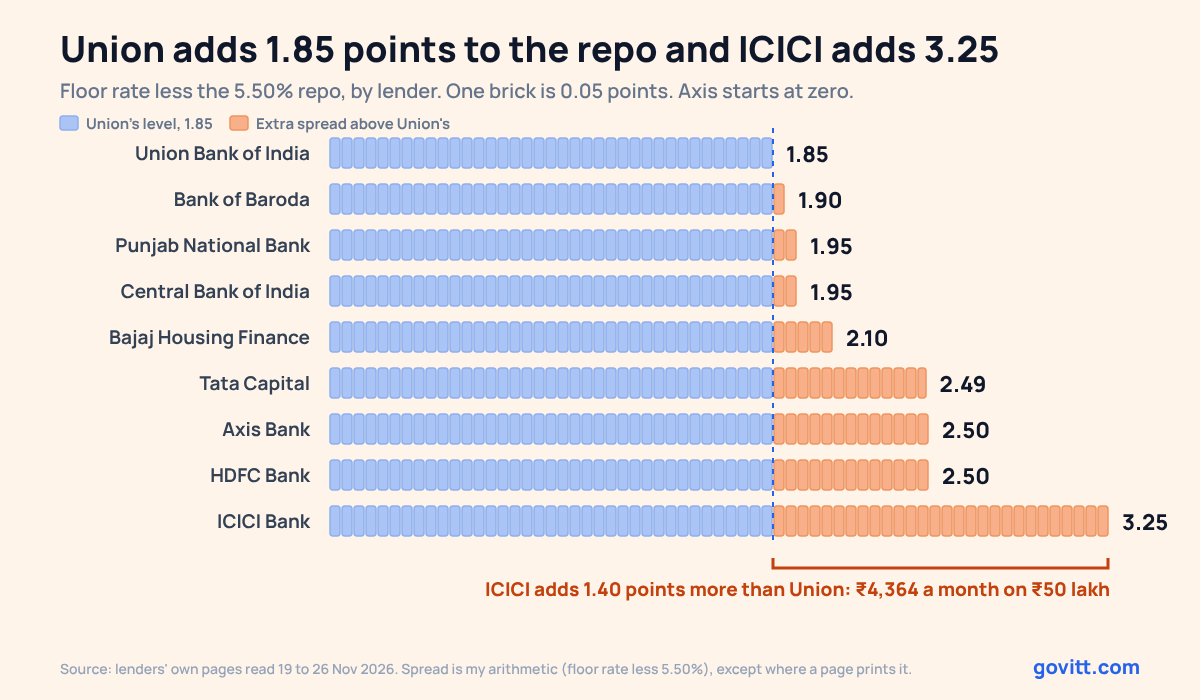
Three things stand out. The floors sit between 1.85 and 3.25, and the five public sector and housing finance floors at the top of the list are packed within 0.25 points of each other. The ceilings are far apart: Central Bank's is 3.50 and HDFC's is 7.95, which is more than twice as wide. And ICICI's floor is 1.40 points above Union's. I covered those lenders one at a time in Central Bank of India's rate post, Bajaj Housing Finance's rate post and the five public sector banks.
A floor is for the top band. Most borrowers don't get it.
What the spread is worth in rupees
This is the EMI at each floor on ₹50 lakh with 20 years left, against 8.75% (EMI ₹44,186), and what a 0.25% rise in the repo would add.
| Lender | EMI at the floor | Saving against 8.75% | Added by a 0.25% rise in the repo |
|---|---|---|---|
| Union Bank of India | ₹39,822 | ₹4,364 | ₹764 |
| Bank of Baroda | ₹39,974 | ₹4,212 | ₹765 |
| Punjab National Bank | ₹40,127 | ₹4,059 | ₹766 |
| Central Bank of India | ₹40,127 | ₹4,059 | ₹766 |
| Bajaj Housing Finance | ₹40,586 | ₹3,600 | ₹770 |
| Tata Capital | ₹41,791 | ₹2,395 | ₹781 |
| Axis Bank | ₹41,822 | ₹2,364 | ₹781 |
| HDFC Bank | ₹41,822 | ₹2,364 | ₹781 |
| ICICI Bank | ₹44,186 | ₹0 | ₹800 |
Two lines of arithmetic are worth keeping. A change of 0.10% in the spread is ₹306 a month at 7.50% and ₹319 a month at 8.75%. And the repo is the same for everyone: a 0.25% rise adds ₹764 to ₹800 to every lender's EMI in the table, a range of ₹36. The spread is the part the repo can't touch. I looked at what a hike does to a quote in RBI policy on 4 December, switch before or after.
Your score moves the spread more than your bank does
Two lenders print the spread by score band, so I can show it. Union's sheet has seven bands, and PNB's grid has four. The spread is the rate less 5.50%.
| Score band | Union rate | Union spread | PNB rate | PNB spread |
|---|---|---|---|---|
| 825 and above | 7.35% | 1.85 | 7.45% (800 and above) | 1.95 |
| 800 to 824 | 7.40% | 1.90 | 7.45% (800 and above) | 1.95 |
| 750 to 799 | 7.60% to 7.65% | 2.10 to 2.15 | 7.50% | 2.00 |
| 700 to 749 | 7.95% to 8.10% | 2.45 to 2.60 | 8.05% | 2.55 |
| 680 to 699 | 8.20% to 8.35% | 2.70 to 2.85 | 9.25% (600 to 699) | 3.75 |
| 650 to 679 | 9.10% | 3.60 | 9.25% (600 to 699) | 3.75 |
| 600 to 649 | 9.60% | 4.10 | 9.25% (600 to 699) | 3.75 |
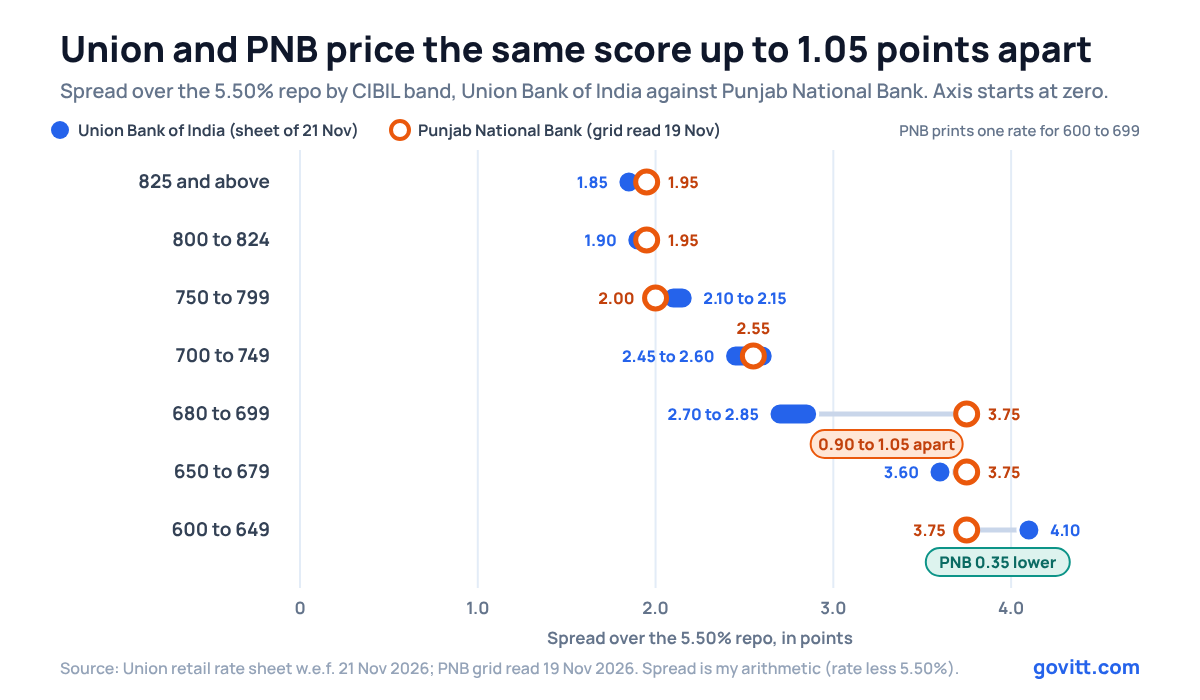
The two lenders don't price a score the same way. PNB prints one rate for the whole 600 to 699 range, a spread of 3.75. At 680 to 699 that is 0.90 to 1.05 points above Union's 2.70 to 2.85. At 600 to 649 it is 0.35 below Union's 4.10. So the cheaper lender depends on the band.
From the top band to the bottom, Union's EMI on ₹50 lakh climbs ₹7,112 a month, from ₹39,822 at 7.35% to ₹46,934 at 9.60%. PNB's climbs ₹5,666, from ₹40,127 at 7.45% to ₹45,793 at 9.25%. Across the five lowest floors in the first table, the spread differs by 0.25 points. Across Union's own bands it differs by 2.25. That is why I put the score ahead of the bank. How the score band works at a lender is in what a CIBIL score can do to your rate, and the cut-offs are in minimum CIBIL score for a home loan.
Your own spread
Subtract 5.50% from the rate on your loan. These are examples, with the EMI on ₹50 lakh and 20 years left, and the gap to Union's floor of 7.35% (EMI ₹39,822).
| Rate you pay today | Your spread over 5.50% | EMI | More than Union's floor |
|---|---|---|---|
| 8.50% | 3.00 | ₹43,391 | ₹3,569 a month |
| 8.75% | 3.25 | ₹44,186 | ₹4,364 a month |
| 9.00% | 3.50 | ₹44,986 | ₹5,164 a month |
| 9.25% | 3.75 | ₹45,793 | ₹5,971 a month |
Union's floor is for a score of 825 and above, so this is a ceiling on what is possible, not what you will be offered. Take your spread to the lender, not just the rate. A quote at 8.00% is a spread of 2.50. If your score is in the top band and a lender quotes you a spread of 3.00, you have learned something about that lender.
Transfer costs still decide whether the saving is worth it. Use the balance transfer charges post for the costs and the calculator post for the five numbers that decide the saving. Why the rate you get is often higher than the advertised one is in why your home loan rate is higher than what the bank advertises. For the lenders as a group, see the best banks for a balance transfer.
What I left out
SBI is not in the table because its grid page was blocked when I tried it. Canara Bank is not in it because its page uses CS:1 to CS:6 rows that it doesn't map to CIBIL scores, so I can't turn them into a floor and a ceiling I trust. Kotak, Bank of India and the other lenders had no usable dated page.
What I couldn't verify
- Baroda and Axis came through summaries. I read the first part of each page and a summary of the rest. Baroda's page also carries two BRLLR figures, 8.15% and 7.90%. I used 8.15%.
- Some pages carry no date. Bajaj's and Tata Capital's tables have none, and Central Bank's pages are dated 8 and 9 October. Those rates may have moved since.
- HDFC's repo. Its pages print 5.25%. The 8.00% floor is my arithmetic on 5.50%, and the printed spread of 2.50 is what I rely on.
- Whether a floor is a floor for you. The tables show a range. Which end you get depends on score, loan size and employment type, and only Union and PNB show the bands.
- Whether the spread can change. The sanction letter says whether the lender can reset the spread, and on what condition. I can't tell that from a rate page.
- Transfer terms. The tables are for fresh loans. Which of them apply to a transfer isn't always printed.
- After 4 December. Every rate above moves with the repo. The RBI decision is on 4 December and this post will need a refresh.
What I'd do this week
- Write down your spread. Your rate less 5.50%.
- Find your score band at the lender you are looking at. Union and PNB print it. For the rest, ask.
- Ask for the quote as a spread, not only as a rate: "What is the spread over repo for my score band, and over which benchmark?"
- Ask whether the spread steps up after disbursal or after a set period, and when the benchmark resets.
- Put the spread gap in rupees. 0.10% is ₹306 to ₹319 a month on ₹50 lakh. A gap of 0.50% is ₹1,542 at 7.50% and ₹1,607 at 8.75%.
- Re-check after 4 December. The repo moves the whole table together, so a quote you hold may need to be re-priced the same day.
FAQ
What is the spread over repo in a home loan? It is the part of a floating rate that sits on top of the repo. On the pages I read between 19 and 26 November 2026, with the repo at 5.50%, lenders' floors add 1.85 to 3.25 points.
What spread over repo should I ask a bank for? Ask for the spread for your score band, and for the benchmark it is added to. Among nine lenders, the floors run 1.85 to 3.25, and five of them are between 1.85 and 2.10. Your own band decides which end you land at.
How do I calculate my spread? Take the rate on your loan and subtract the repo, which is 5.50% since 7 October 2026. At 8.75% your spread is 3.25. If your loan is on MCLR, there is no spread over repo.
What is 0.10% of spread worth? On ₹50 lakh with 20 years left, ₹306 a month at 7.50% and ₹319 a month at 8.75%.
Does the spread change when the repo changes? The repo linked rate moves with the repo, so a 0.25% rise adds ₹764 to ₹800 a month on ₹50 lakh across the nine floors. Whether the lender can also change the spread is in your sanction letter.
Which lender has the lowest spread over repo? On the pages I read, Union Bank of India, at 1.85 for a score of 825 and above (7.35%, sheet of 21 November 2026). SBI and Canara aren't in the table.
Want your own spread priced? Run the Payoff & Transfer Calculator with your outstanding amount, rate and years left. GoVitt compares 50+ banks and charges you 0% commission.
Figures are for ₹50 lakh outstanding and 20 years left, with EMIs on the monthly reducing balance method, rounded to the rupee. The spread over repo is the rate printed on each lender's page less the repo of 5.50% (RBI, effective 7 October 2026), except where the lender prints it. Each lender's rates are from its own pages read between 19 and 26 November 2026, on the dates in the table. Several pages carry no effective date. Rates are for fresh loans and the ranges depend on score, loan size and employment type. The examples in "Your own spread" are not lender figures. Confirm every figure in writing with the lender before you act. This is general information, not financial advice.
Ready to take the next step?
Find out your loan options and check your eligibility with GoVitt today.