
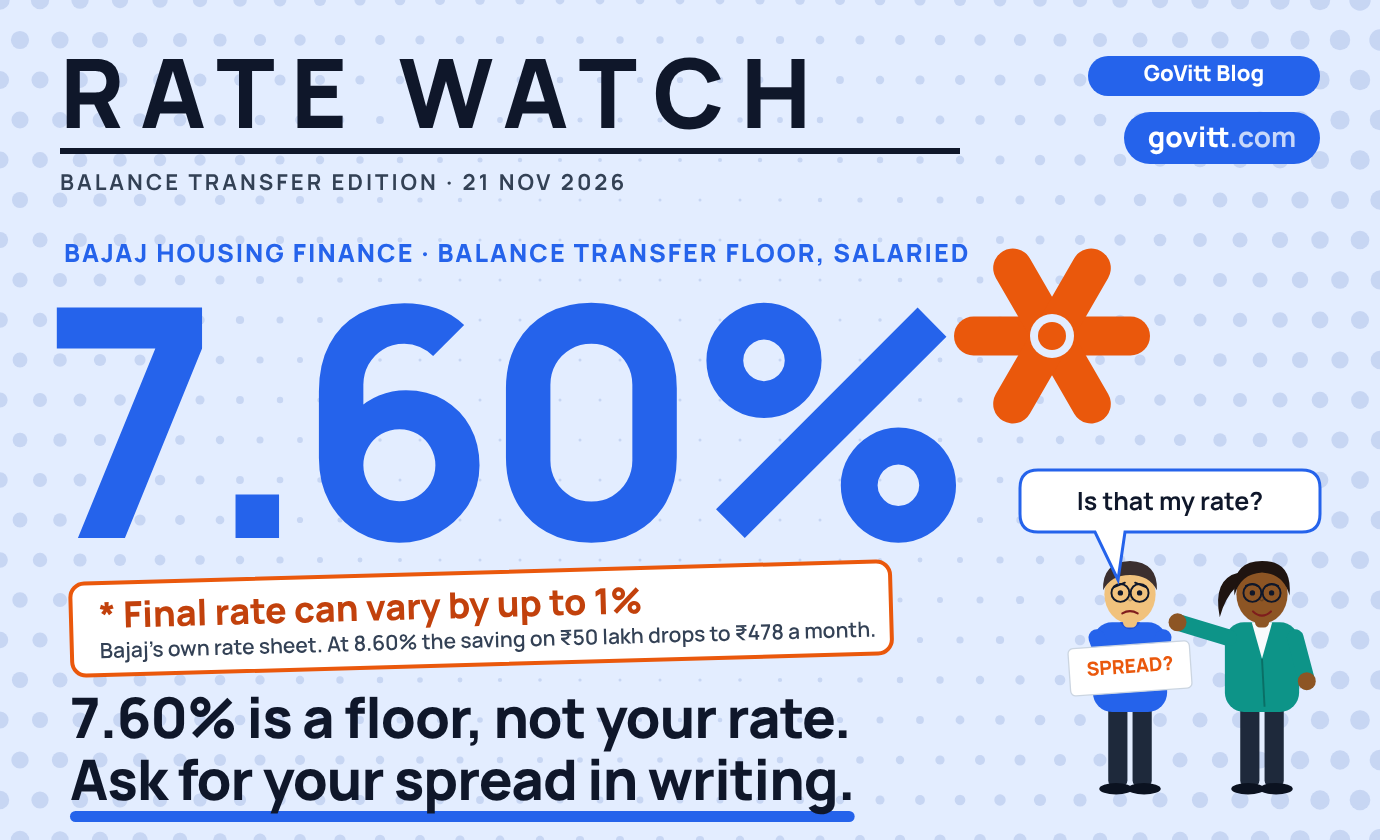
The Bajaj Housing Finance home loan balance transfer interest rate on its own pages is 7.60% to 10.35% for salaried borrowers and 8.30% to 10.80% for self-employed ones. On a ₹50 lakh loan at 8.75% with 20 years left, the 7.60% end saves ₹3,600 a month. The 10.35% end costs ₹5,230 a month more than you pay now.
The short version: that range is 2.75 points wide, and the page gives no credit score bands, no date and no processing fee. So 7.60% is a floor, not a quote. Bajaj's own rate PDF says the final rate can vary by up to 1% from the published rate, and at 8.60% the same switch saves only ₹478 a month. Get the spread over repo in writing before you pay anything.
Below: what Bajaj publishes, what I couldn't verify, what the range does to a ₹50 lakh switch, how its floor compares with four banks, and how long the costs take to pay back.
See your real payoff date in 60 seconds
Banks calculate remaining EMIs by simple subtraction. See your actual payoff date and discover how much interest a balance transfer can save.
What Bajaj publishes
I read Bajaj Housing Finance's own balance transfer and interest rate pages on 21 November 2026. These are the floating rates it prints, shown as "Effective ROI (p.a.)", and each carries an asterisk.
| Loan type | Salaried and professional | Self-employed |
|---|---|---|
| Home loan (fresh) | 7.50% to 10.25% | 8.05% to 10.65% |
| Home loan balance transfer | 7.60% to 10.35% | 8.30% to 10.80% |
| Top-up loan | 8.60% to 10.40% | 9.50% to 10.85% |
Three things stand out. A transfer costs more than a fresh loan at the floor: 0.10% more for salaried borrowers (7.60% against 7.50%) and 0.25% more for self-employed ones (8.30% against 8.05%). The top-up row starts 1.00% above the salaried transfer floor (8.60% against 7.60%), which is worth knowing if you plan to take extra money with the move. My post on balance transfer and top-up covers how to price that. And the page names no credit score band anywhere. It says only that the rate depends on factors including your credit score.
What I couldn't verify
This is the part that decides how much weight to put on 7.60%.
There's no effective date. The only date I found is "August 2026" in the title of Bajaj's interest rate page. RBI raised the repo rate from 5.25% to 5.50% on 7 October 2026, and Bajaj's own repo page shows that date. I can't tell whether the table was refreshed after it.
The web page and the PDF disagree on the top end. The page above shows a transfer range ending at 10.35% for salaried borrowers. Bajaj's rate PDF shows "Home Loan Balance Transfer" at 7.60% to 15.00%, with no salaried or self-employed split. Its footnote says the final rate offered can vary by up to 1% from the published rates. The page doesn't explain the difference, and I'm not going to guess.
The 7.60% sits 1.10% below Bajaj's own benchmark. The PDF lists a salaried REBLR (Repo External Benchmark Linked Lending Rate) of 8.70%, and 8.70% minus 7.60% is 1.10%. That's a difference between two printed numbers. I couldn't find the rule that sets the discount for a given borrower, so ask what yours is.
There's no processing fee. The page says "a nominal fee is charged at the application stage". It gives no amount and no cap. My balance transfer charges post notes that some HFCs and NBFCs go up to 2% or 3%, so don't take "nominal" as a number.
What the range does to a ₹50 lakh switch
Same base case as my other transfer posts: ₹50 lakh outstanding, 20 years left, 8.75% today, EMI ₹44,186. EMIs are monthly reducing balance, rounded to the rupee.
| Where you land | Rate | New EMI | Change from ₹44,186 | Over the remaining 20 years |
|---|---|---|---|---|
| Salaried floor | 7.60% | ₹40,586 | Saves ₹3,600 a month | ₹8,64,000 saved |
| Salaried floor plus 1.00% | 8.60% | ₹43,708 | Saves ₹478 a month | ₹1,14,720 saved |
| Self-employed floor | 8.30% | ₹42,760 | Saves ₹1,426 a month | ₹3,42,240 saved |
| Salaried ceiling | 10.35% | ₹49,416 | Costs ₹5,230 a month more | ₹12,55,200 more |
| Self-employed ceiling | 10.80% | ₹50,931 | Costs ₹6,745 a month more | ₹16,18,800 more |
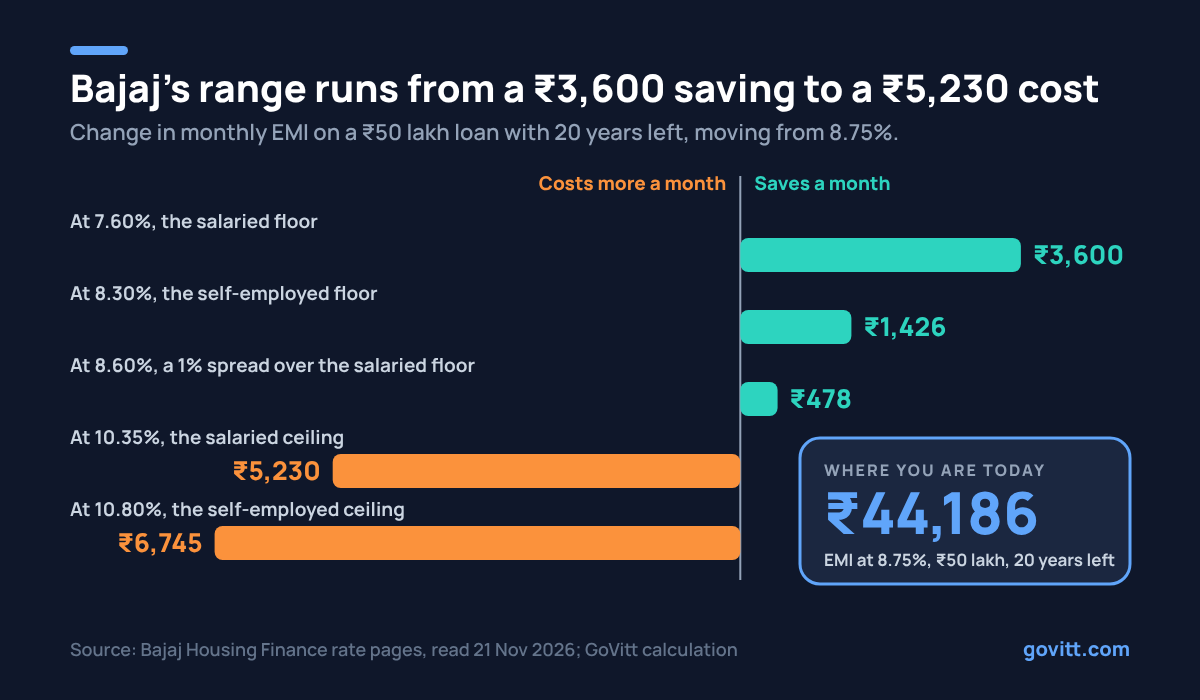
The row to look at is the second one. If Bajaj's final rate lands 1% above its floor, which is what the PDF's footnote allows, the saving drops from ₹3,600 to ₹478 a month. That's the same loan and the same lender, with a very different answer. Over five years the 7.60% switch saves ₹2.86 lakh in interest and the 8.60% switch saves ₹37,382, both before costs.
Your credit score is what moves you along that range. I wrote about how wide the bands run in how a credit score moves your home loan rate.
How the floor compares with four banks
The floors look close together. The ceilings don't. This table uses each lender's own page, read on 21 November 2026, for a salaried borrower where the page splits it, on a loan of the size shown.
| Lender | Floor | Ceiling | Note |
|---|---|---|---|
| Bank of Baroda | 7.40% | 9.15% | BRLLR minus 0.75% to plus 1.00%, benchmark effective 8 October 2026 |
| Union Bank of India | 7.40% | 9.60% | Score 825 and above to 600 to 649, rate sheet updated 8 October 2026 |
| Punjab National Bank | 7.45% | 9.25% | Score 800 and above, loan above ₹30 lakh, to 600 to 699 |
| Canara Bank | 7.55% | 10.25% | Loan up to ₹50 lakh, other borrowers. 7.50% with the 0.05% takeover concession |
| Bajaj Housing Finance | 7.60% | 10.35% | Salaried balance transfer row, no date, no score bands |
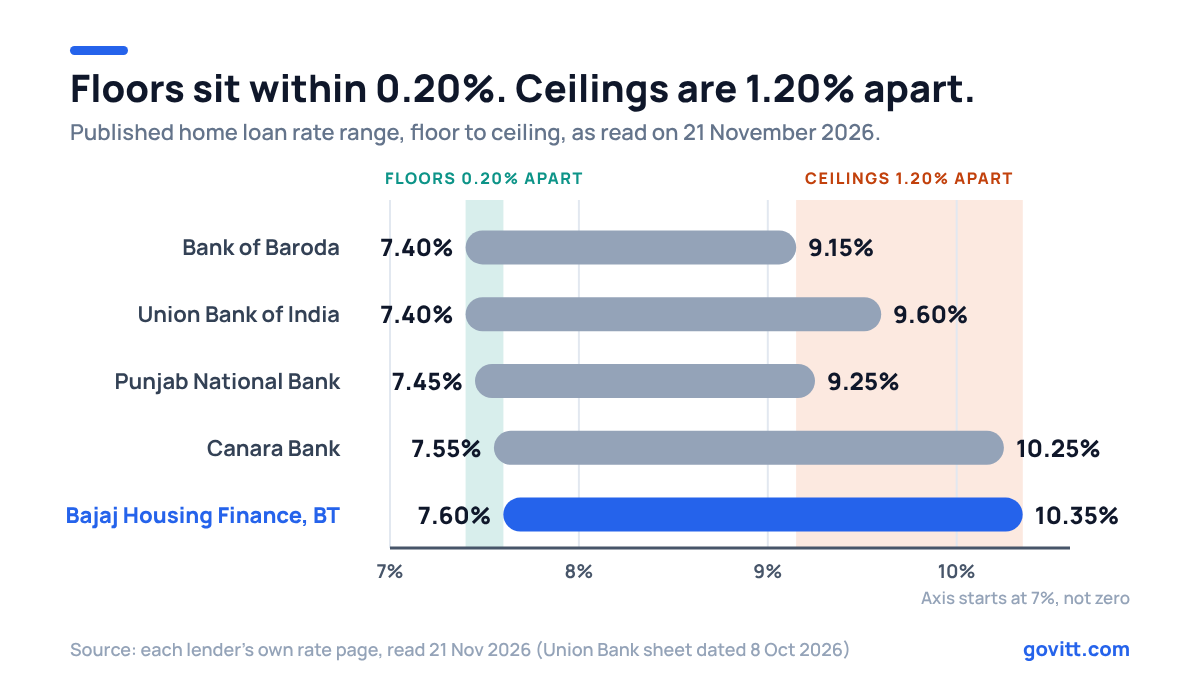
The five floors sit within 0.20% of each other. On ₹50 lakh, Bajaj's 7.60% is ₹306 a month above Canara's 7.50% (₹73,440 over 20 years) and ₹612 a month above the 7.40% at Bank of Baroda and Union Bank (₹1,46,880). The ceilings are further apart. Bajaj's 10.35% is 1.20% above Bank of Baroda's 9.15%, which on the same loan is ₹3,946 a month.
That's the real lesson. The floor tells you almost nothing, because everyone's floor is about 7.50%. Where you land in the range matters more than which lender's logo is on the sanction letter. I don't have Bajaj's score bands, and neither does anyone reading its page, so the only way to find yours is a written quote.
A caution on comparing lenders. These are published ranges, not offers. Each lender splits its range differently (by score, by loan size, by salary type), so treat the table as a map of where to look, not a ranking. My best banks for home loan balance transfer post compares them on spread, fees and top-up.
How long the costs take to pay back
Divide the all-in cost by the monthly saving and round up. I use two cost levels from my charges post for ₹50 lakh in Bengaluru, ₹53,700 and ₹76,500, which include an assumed processing fee. I've added ₹1,00,000 as an illustration of an HFC that charges more. It isn't Bajaj's fee, because Bajaj doesn't publish one.
| All-in cost | At 7.60% (saves ₹3,600) | At 8.30% (saves ₹1,426) | At 8.60% (saves ₹478) |
|---|---|---|---|
| ₹53,700 | 15 months | 38 months | 113 months |
| ₹76,500 | 22 months | 54 months | 161 months |
| ₹1,00,000 (illustration) | 28 months | 71 months | 210 months |
My rule is 24 months or less. Run that backwards and the most you can afford to spend is ₹86,400 at 7.60%, ₹34,224 at 8.30% and ₹11,472 at 8.60%. Only the 7.60% column clears the rule at the Bengaluru cost levels, and only if the final rate really lands at the floor. At 8.30% and above, a transfer from 8.75% doesn't pay back in a sensible time. I cover cases like that in when a home loan balance transfer is not worth it.
Bank or HFC?
Bajaj Housing Finance is a housing finance company, not a bank. For a floating-rate loan taken by an individual, its page lists the prepayment charge as "NIL". For a fixed-rate term loan it lists 4% on the amount prepaid. So the usual rule applies: on a floating loan you can prepay without a penalty, and on a fixed one you may not be able to.
An HFC can make sense when a bank has said no or your income is hard to document. For a salaried borrower with a clean record, a public-sector bank usually quotes a floor that is as low or lower, as the table shows. My posts on bank vs HFC vs NBFC and on moving a loan from an HFC to a bank cover when paying more is worth it, and the reverse move.
What I'd do before asking Bajaj for a quote
- Get the rate in writing, with the spread. Ask for the spread over the benchmark, the benchmark's name and how often it resets, not the headline rate.
- Ask where you sit in the range. Ask which score band and loan size the quote uses, and what rate you'd get at your score.
- Ask for the processing fee, in rupees. The page says "nominal". Write the number down, with GST.
- Ask for a bank's written takeover quote at the same time. Canara, Bank of Baroda, Union Bank and PNB all print floors near 7.40% to 7.55%.
- Add the all-in cost, including stamp duty, registration, legal and valuation, and divide by your monthly saving. Under 24 months is a yes.
- If your final rate lands more than 0.50% above the floor, rerun the sum. Don't assume the floor.
FAQ
What is the Bajaj Housing Finance home loan balance transfer interest rate? Bajaj Housing Finance's own pages, read on 21 November 2026, list 7.60% to 10.35% for salaried borrowers and 8.30% to 10.80% for self-employed borrowers on a floating-rate balance transfer. The table has no date or score bands, and Bajaj's rate PDF says the final rate can vary by up to 1% from the published rate.
Is Bajaj Housing Finance's balance transfer rate higher than its normal home loan rate? At the floor, yes. Salaried borrowers see 7.60% for a transfer against 7.50% for a fresh loan, and self-employed borrowers see 8.30% against 8.05%. At the top of the range the gap is 0.10% for salaried and 0.15% for self-employed borrowers.
Does Bajaj Housing Finance charge a prepayment fee on a floating-rate home loan? Its interest rate page lists "NIL" for individual borrowers on floating-rate home loans. Fixed-rate term loans carry 4% on the amount prepaid, plus GST, and the page notes a nil charge for loans closed from the borrower's own sources. Check your own loan terms before you rely on either.
What is Bajaj Housing Finance's processing fee for a balance transfer? Its page doesn't say. It states only that a nominal fee is charged at the application stage. Ask for the amount in rupees, with GST, before you apply, because the fee is part of the cost that decides your payback.
Is Bajaj Housing Finance cheaper than a bank for a balance transfer? Not at the floor. Its 7.60% is 0.10% above Canara's 7.50% with the takeover concession and 0.20% above the 7.40% at Bank of Baroda and Union Bank, which is ₹306 to ₹612 a month on ₹50 lakh. Ceilings differ more than floors do, so the quote at your credit score is the only comparison that counts.
Want to see your own saving at the floor and at the floor plus 1%? Run the Payoff & Transfer Calculator with your outstanding amount, rate and years left. GoVitt compares 50+ banks and charges you 0% commission.
Figures are for ₹50 lakh outstanding, 20 years left, 8.75% today, monthly reducing balance, EMI rounded to the rupee. Bajaj Housing Finance rates and prepayment terms are from its own pages, read on 21 November 2026. The tables carry no effective date, and the PDF and the web page differ on the ceiling. Bank figures are from each bank's own pages read on 21 November 2026, and one PNB figure came through a summary of a long page. Bengaluru costs are the illustrative ranges from GoVitt's charges post (16 October 2026). The ₹1,00,000 cost is an illustration, not a Bajaj fee. Confirm every figure in writing with the lender before you act. This
Ready to take the next step?
Find out your loan options and check your eligibility with GoVitt today.