
A fixed rate home loan at ICICI's lowest 60 month card, 9.15%, costs ₹1,284 a month more than 8.75% floating on ₹50 lakh with 20 years left. It only wins if your floating rate rises by 0.41% or more from the first EMI after 4 December, and stays there. If the rise starts in month 13, the break-even is 0.53%. From month 25 it is 0.72%. One 0.25% hike adds ₹800 a month. The fixed card costs ₹1,284 more from the first day, plus ₹3,540 to get in.
The short version: stay floating unless you are paying for certainty and know the price. Over five years the fixed card costs ₹1,03,447 more than floating if the repo never moves, ₹41,028 more after one 0.25% hike, and only comes out ahead, by ₹19,200, after a second hike in February. That second hike is what a Reuters poll of economists expects. It is their view, not my forecast. Going back from fixed to floating at ICICI costs 2%, which is ₹1,18,000 with GST on ₹50 lakh. A transfer to a floating 7.50% quote beat both routes on every path I ran, by ₹1,18,528 or more.
Below: what I compared, how I tested it, the break-even, five repo paths, what the economists expect, the cost of getting out, the transfer alternative, what I couldn't verify, and what I'd do.
See your real payoff date in 60 seconds
Banks calculate remaining EMIs by simple subtraction. See your actual payoff date and discover how much interest a balance transfer can save.
What I compared
I read ICICI's home loan rates page on 26 November 2026. Its fixed rate cards for 37 months and 60 months both read 9.15% to 9.60%. Every table on the page is marked valid till 30 November 2026. I use the low end of the 60 month card, because it is the best case for the fixed rate. The page is a range and doesn't say who gets which end. I wrote about the older version of those cards in my ICICI post of 21 October.
The base case is my usual one: ₹50 lakh outstanding, 20 years left, 8.75% floating today, EMI ₹44,186.
| Loan | Rate | EMI on ₹50 lakh, 20 years | More than 8.75% floating |
|---|---|---|---|
| Floating today | 8.75% | ₹44,186 | ₹0 |
| ICICI 60 month fixed, low end of the card | 9.15% | ₹45,470 | ₹1,284 a month |
| ICICI 60 month fixed, high end of the card | 9.60% | ₹46,934 | ₹2,748 a month |
The premium over floating is 0.40%, which is 9.15% less 8.75%. That is why the break-even below is so close to 0.40%. A fixed rate that is 0.40% higher wins only when floating climbs more than 0.40% and stays there long enough to repay what you paid for the head start.
How I tested it
I counted what the loan costs over five years, because that is the fixed period. The cost is the EMIs paid in 60 months, plus the balance still owed at month 60, plus any upfront cost. The floating loan's EMI is recomputed each time the rate changes, on the balance and the months left, which is the EMI route and not the tenure route. I explained that choice in part prepaying your home loan, reduce the EMI or the tenure. I assume every repo move reaches your rate at once and in full. Month 1 is the first EMI after 4 December. A hike in February lands from month 3.
I stop at month 60 because the fixed card stops there. I haven't read what ICICI moves the loan to after the fixed period, so I can't price it.
The break-even is a rise, not a date
The question is how much the floating rate must rise, permanently, for the fixed card to come out level. This is the answer on ₹50 lakh. The "with fee" column adds the ₹3,540 conversion fee.
| The rise starts | Break-even, no fee | Break-even, with the ₹3,540 fee |
|---|---|---|
| From month 1, the first EMI after 4 December | 0.40% | 0.41% |
| From month 13 | 0.51% | 0.53% |
| From month 25 | 0.70% | 0.72% |
The later the rise starts, the more you have overpaid by the time it arrives, so the more of it you need. Here is what a permanent rise does to the fixed card's five year position, with the fee in, at five sizes of rise and three start dates. Behind means the fixed card has cost you more than staying floating.
| Permanent rise in your floating rate | Fixed against floating, rise from month 1 | From month 13 | From month 25 |
|---|---|---|---|
| 0.00% | ₹1,03,447 behind | ₹1,03,447 behind | ₹1,03,447 behind |
| 0.25% | ₹41,028 behind | ₹54,547 behind | ₹67,584 behind |
| 0.50% | ₹21,488 ahead | ₹5,576 behind | ₹31,680 behind |
| 0.75% | ₹84,093 ahead | ₹43,463 ahead | ₹4,261 ahead |
| 1.00% | ₹1,46,813 ahead | ₹92,567 ahead | ₹40,245 ahead |
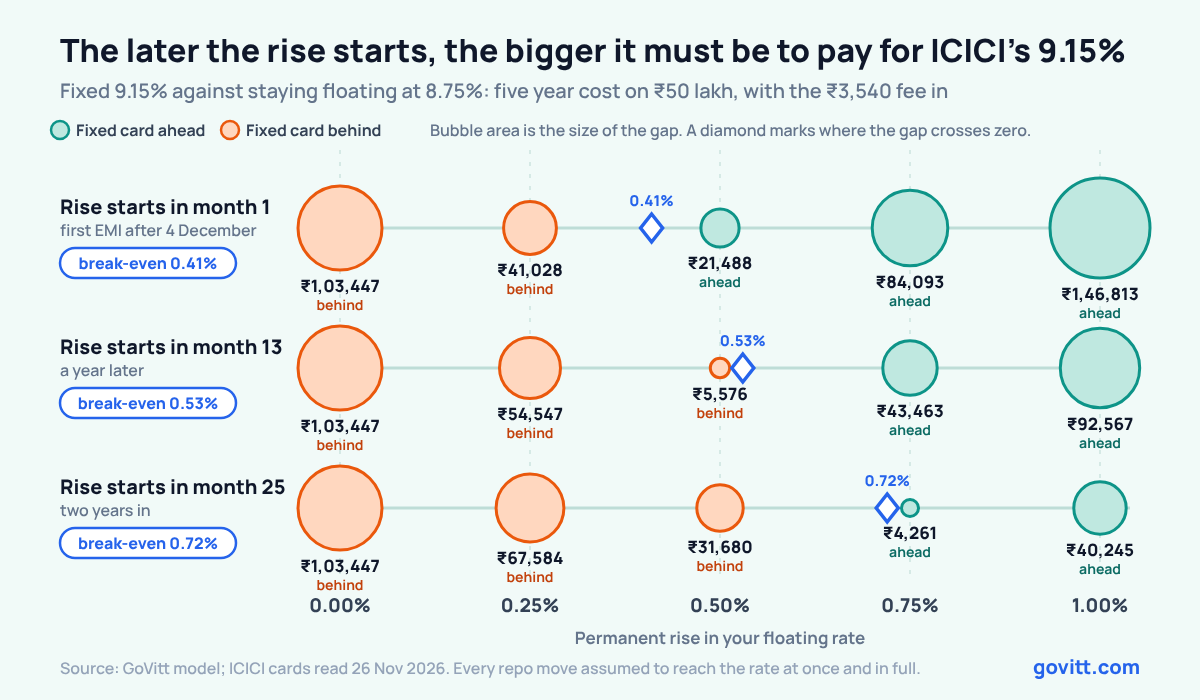
So one 0.25% hike doesn't pay for the fixed card, whenever it comes. A 0.50% rise pays for it only if it comes at once, and a flat 0.50% from month 13 leaves you ₹5,576 behind. From month 25 even a 0.50% rise leaves you ₹31,680 behind. The fixed card is a bet on more than one hike, soon, with no way back.
Five repo paths
Here are five paths for the repo, each run through the model. I show the cost of staying floating, of ICICI's 9.15% with the fee, and of a transfer to a floating 7.50% quote with the same hikes added on top.
| Repo path | Stay floating | Fixed 9.15% | Fixed against floating | Transfer to 7.50% | Transfer against floating |
|---|---|---|---|---|---|
| Repo stays 5.50% | ₹70,72,116 | ₹71,75,563 | ₹1,03,447 dearer | ₹68,38,380 | ₹2,33,736 cheaper |
| 0.25% on 4 December | ₹71,34,535 | ₹71,75,563 | ₹41,028 dearer | ₹69,00,180 | ₹2,34,355 cheaper |
| 0.25% in December and 0.25% in February | ₹71,94,763 | ₹71,75,563 | ₹19,200 cheaper | ₹69,59,816 | ₹2,34,947 cheaper |
| Those two, then 0.50% in month 13 | ₹72,93,008 | ₹71,75,563 | ₹1,17,445 cheaper | ₹70,57,035 | ₹2,35,973 cheaper |
| Those two, then back to 5.50% from month 25 | ₹71,22,834 | ₹71,75,563 | ₹52,729 dearer | ₹68,88,795 | ₹2,34,039 cheaper |
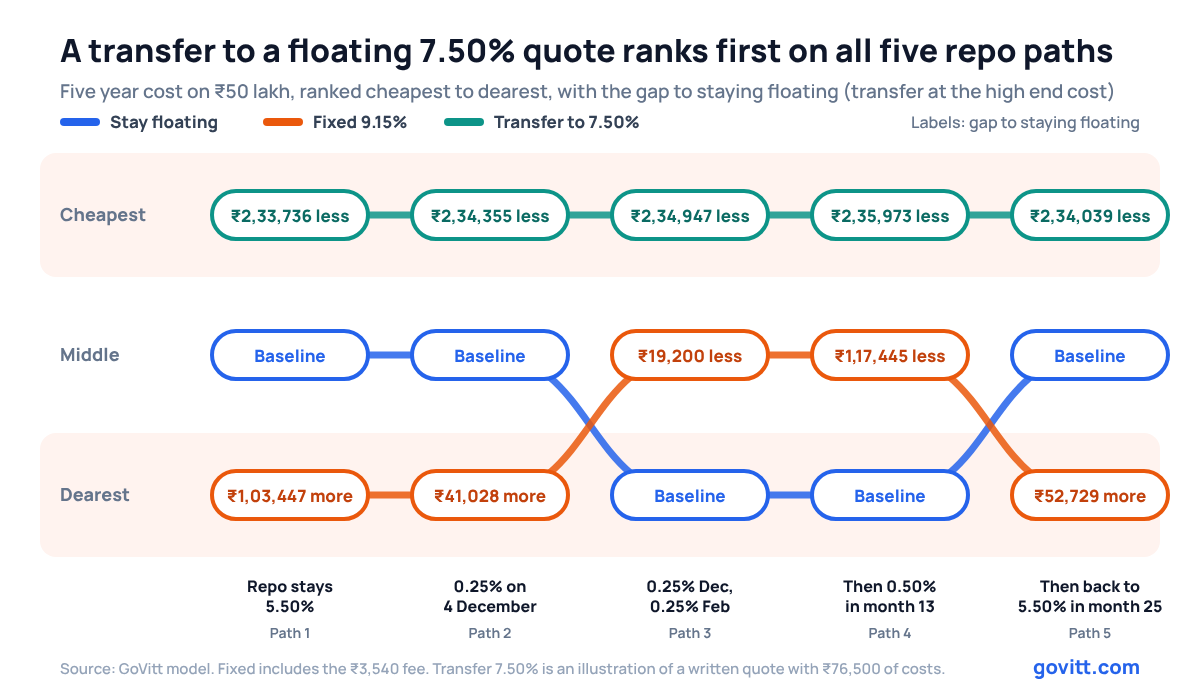
The fixed card is dearer on three of the five paths and cheaper on two. Even on the third path, the one the economists below describe, it wins by ₹19,200 on a cost of about ₹72 lakh. The last path shows the other side. If the hikes are reversed, the fixed rate keeps charging you for a cycle that has ended.
What the economists expect
A Reuters poll published on 20 November 2026 (fieldwork 13 to 20 November, read through a syndicated copy) found 56 of 61 economists expecting a 0.25% hike on 4 December, to 5.75%. Three expected no change and two expected 0.50%. Of 46 who gave a view for February, 34 expected a final 0.25% hike to 6.00%. Kotak's Upasna Bharadwaj was quoted as expecting two more hikes.
The third path in the table is that poll's majority view. It is theirs and not mine. I don't forecast RBI, and a poll is not a decision. RBI's statement of 7 October described its stance as calibrated tightening, as Business Today reported on 24 November. CPI inflation was 6.09% in October and the next print is on 14 December. The MPC meets from 2 to 4 December. I covered what a hike does to a quote in RBI policy on 4 December, switch before or after, and what I said about fixed rates after the October inflation print is in should you switch to a fixed rate.
The way out costs more than the way in
At ICICI, the door in is cheap and the door out is not. These are the lines I found on the lenders' pages, on ₹50 lakh.
| Move | What the page says | On ₹50 lakh, with GST |
|---|---|---|
| ICICI, floating to fixed | Rate conversion, ₹3,000 plus taxes | ₹3,540 |
| ICICI, fixed back to floating | 2% of the principal outstanding, for fixed loans sanctioned on or after 1 January 2026 | ₹1,18,000 |
| ICICI, prepaying a fixed loan | 2% of the amount prepaid | ₹10,000 on ₹5 lakh |
| Union Bank, floating to fixed | Once, after 12 EMIs, at floating plus 1.00%; ₹10,000 plus GST up to ₹50 lakh | ₹11,800 |
| Tata Capital, floating to fixed | 1% plus GST on principal outstanding, page undated | ₹59,000 |
| Kotak, floating to fixed | "12% p.a. onwards", page undated, read through a summary | Not stated |
The ₹1,18,000 is more than the ₹1,03,447 you lose if the repo never moves. A floating loan has no prepayment charge for an individual, as I explained in your bank can't charge you for prepaying. A fixed loan can.
Union's switch shows the same premium logic. On its 21 November sheet a loan at 7.35% would move to 8.35%, and the EMI on ₹50 lakh would go from ₹39,822 to ₹42,918, which is ₹3,096 more. A premium of 1.00% means the floating rate must rise by about 1.00% before that switch wins, and more once the ₹11,800 and the 12 EMI wait are counted. Free Press Journal reported on 9 August 2026 that Kotak offers a hybrid with a fixed period of 39, 52 or 65 months. I haven't seen the spread, so I can't price it.
A transfer beat both
The last two columns of the paths table are a floating 7.50% quote with the same hikes on top of it. The EMI is ₹40,280, which is ₹3,906 less than 8.75% before any hike, and more than four times the ₹800 that one 0.25% hike adds. Even with the high end of the Bengaluru cost, ₹76,500, the transfer is cheaper than staying floating on every path, by ₹2,33,736 to ₹2,35,973. At the low end, ₹53,700, it is cheaper by ₹2,56,536 to ₹2,58,773. Against the fixed route it is cheaper by ₹1,18,528 to ₹3,59,983.
The 7.50% is an illustration of a written quote, not a published rate, and it needs a strong score. Union's sheet of 21 November shows 7.35% for a score of 825 and above. HDFC's spread over the repo works out to 8.00% on a repo of 5.50%, which is my arithmetic from its pages of 25 November. The cost range comes from my balance transfer charges post. I compared the lenders in best banks for a home loan balance transfer. If your loan is at another bank and you wanted ICICI's fixed card, you would have to transfer to ICICI first, at an all-in cost of ₹71,400 to ₹82,400 with a 0.5% fee. That makes the fixed route dearer still.
If you're still on MCLR, the first move isn't a fixed rate. It's moving to a repo linked rate.
What I couldn't verify
- When a hike reaches your rate. My model passes every move through at once. Lenders reset on their own schedule. Axis's FAQ, read on 24 November through a summary, says the 7 October hike reaches old loans on 25 December. A lag favours floating, so the real break-evens sit a little above mine. I looked at the one-day pass-through in banks took one day to pass on the hike.
- Who gets 9.15%. The 60 month card runs from 9.15% to 9.60%. The page doesn't map a profile to a rate.
- EMI or tenure. Whether your lender raises the EMI or stretches the tenure when the rate moves. I assumed the EMI.
- What happens after 60 months. I haven't read what ICICI resets the rate to.
- What replaces the cards on 30 November. Every table on ICICI's page is marked valid till then. The RBI decision comes four days later.
- The Reuters poll and RBI's stance. I read them through secondary copies. They are other people's views.
- Undated lender pages. Tata Capital's and Kotak's switch terms carry no date.
What I'd do this week
- Write down your lender and your rate. If you aren't an ICICI borrower, forget the ₹3,540. For you, fixed means a transfer.
- Ask for the fixed rate in writing, with the fixed period, what the rate becomes after it, the fee to switch, and the fee to switch back.
- Price the exit before the entry. At ICICI that is 2%, ₹1,18,000 on ₹50 lakh.
- If you pay more than 8.75% today, price a floating transfer first. Use the five numbers in the calculator post.
- Don't decide on a headline. ICICI's cards expire on 30 November and the decision is on 4 December. A fixed quote you get now may not survive either.
- If you want certainty, call it what it is. ₹1,284 a month is the price of ICICI's 9.15%. If that buys you sleep, it can be a fair price. Just know it costs ₹1,03,447 over five years if the repo never moves.
FAQ
Is a fixed rate home loan better than floating when rates are rising? Not by default. ICICI's 9.15% card needs the floating rate to rise by 0.41% from the first EMI after 4 December and stay there, 0.53% if the rise starts in month 13. One 0.25% hike doesn't do it.
How much more is the EMI on a fixed rate home loan? On ₹50 lakh with 20 years left, ICICI's 60 month card gives ₹45,470 at 9.15% and ₹46,934 at 9.60%. Floating at 8.75% is ₹44,186, so the fixed EMI is ₹1,284 to ₹2,748 a month more.
Can I move from floating to fixed on my existing home loan? Some lenders allow it. ICICI lists ₹3,000 plus GST for a rate conversion. Union allows it once after 12 EMIs at floating plus 1.00%, for ₹10,000 plus GST up to ₹50 lakh. Tata Capital charges 1% plus GST on principal outstanding. Ask for the terms in writing.
What does it cost to move back from fixed to floating? At ICICI, 2% of the principal outstanding for fixed loans sanctioned on or after 1 January 2026, which is ₹1,18,000 with GST on ₹50 lakh. Check your own sanction letter.
How much does a 0.25% repo hike add to my EMI? On ₹50 lakh at 8.75% with 20 years left it adds ₹800 a month, and 0.50% adds ₹1,607. Those are before any change in tenure.
Will RBI raise the repo rate on 4 December? I don't forecast RBI. In a Reuters poll published on 20 November, 56 of 61 economists expected a 0.25% hike. That is their view. The decision is on 4 December.
Want your own break-even? Run the Payoff & Transfer Calculator with your outstanding amount, rate and years left. GoVitt compares 50+ banks and charges you 0% commission.
Figures are for ₹50 lakh outstanding, 20 years left and 8.75% floating today, with EMIs on the monthly reducing balance method, rounded to the rupee. The five year cost is the EMIs paid in 60 months plus the balance still owed at month 60 plus the upfront cost. Floating EMIs are recomputed at each rate change on the balance and the months left, and every repo move is assumed to reach the borrower at once and in full. ICICI Bank's cards and charges are from its own pages read on 26 November 2026, marked valid till 30 November 2026 with no other date. The ₹3,540 fee is ₹3,000 plus 18% GST. The 7.50% transfer is an illustration of a written quote with Bengaluru costs of ₹53,700 to ₹76,500 from GoVitt's charges post (16 October 2026). The economists' views are theirs, not a forecast by GoVitt. Confirm every figure in writing with the lender before you act. This is general information, not financial advice.
Ready to take the next step?
Find out your loan options and check your eligibility with GoVitt today.