
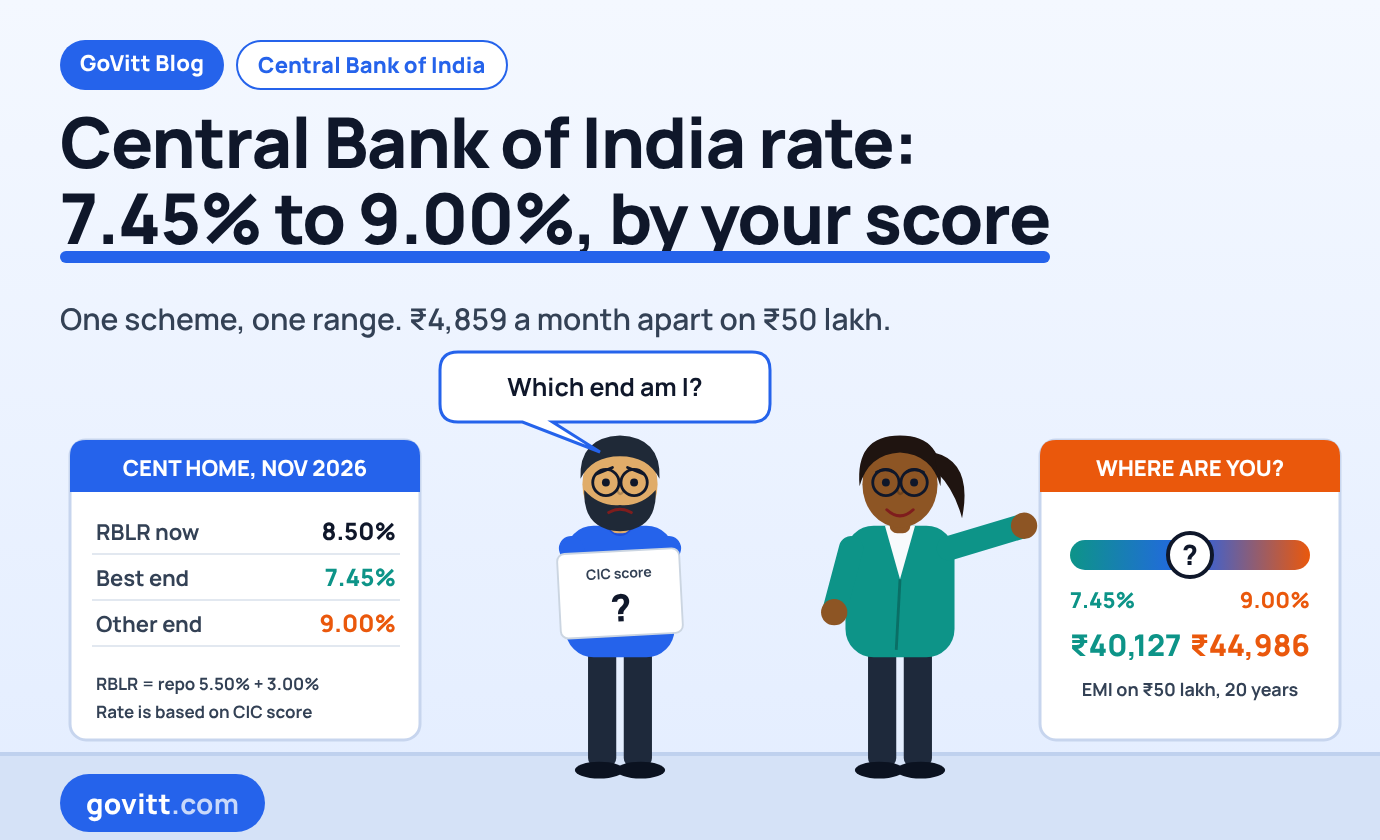
The Central Bank of India home loan interest rate on the bank's own page is 7.45% to 9.00% for its main scheme, Cent Home, as of 19 November 2026. The page marks that range "based on CIC score", so your credit score decides where you land. On ₹50 lakh over 20 years the EMI runs from ₹40,127 to ₹44,986. That is ₹4,859 a month inside one scheme.
The short version: at the top of the range, Central Bank is a good place to move a loan from 8.75%, and the saving is ₹4,059 a month. At the bottom of the range it costs you ₹800 a month more than 8.75%. The page doesn't publish the score cut-offs and it doesn't show takeover fees, so the only number that counts is the one in your written quote.
Below: what the page prints, what the spread range costs in rupees, whether a transfer pays at each point in it, and what I'd ask the bank before you send a document.
See your real payoff date in 60 seconds
Banks calculate remaining EMIs by simple subtraction. See your actual payoff date and discover how much interest a balance transfer can save.
What Central Bank's page prints
Central Bank prices its loans off its own repo-linked rate, the RBLR. The page header reads "Presently, RBLR = 8.50% [Repo (5.50%) + Spread (3.00%)]". Every scheme below is that RBLR plus or minus a spread, shown as a range, with a "present" column that gives the rate today. I read the page on 19 November 2026. It says it was last updated on 8 October 2026.
| Scheme | Spread, as printed | Rate now |
|---|---|---|
| Cent Home | RBLR minus 1.05% to RBLR plus 0.50% | 7.45% to 9.00% |
| Cent Home Loan for 3rd, 4th, 5th house | RBLR minus 0.55% to RBLR plus 1.00% | 7.95% to 9.50% |
| Cent Home Double Plus | RBLR plus 0.10% to RBLR plus 0.90% | 8.60% to 9.40% |
| Cent Top Up | RBLR minus 0.30% to RBLR plus 1.05% | 8.20% to 9.55% |
| Cent Grih Lakshmi Home | Repo plus 1.75% to Repo plus 3.00% | 7.25% to 8.50% |
The footnotes matter. Cent Home, the 3rd to 5th house loan and Cent Top Up are marked "based on CIC score". Cent Home Double Plus is marked "based on CIC score and internal risk rating". CIC stands for credit information company, so this is your bureau score, whether from CIBIL or another bureau. Every rate is also marked "subject to T and C".
Two things I'm not sure of. I couldn't see who Cent Grih Lakshmi Home is meant for, so I've shown its row as printed and nothing more. And the bank's base rate page dates the move to an RBLR of 8.50% to 9 October 2026, while the rate page says it was last updated on 8 October. That's a day's difference, and both show 8.50%.
What the page does not print
No score bands. No cut-off that says 750 gets one rate and 800 another. No loan slabs, no loan-to-value limits, no reset period, no fixed rates, no processing fee and no takeover terms. I'm not going to guess any of them. Some banks print a grid by score band. Central Bank gives you a range and leaves the rest to the branch.
How the benchmark moved
The base rate page shows two recent changes to the RBLR: 8.25% from 10 August 2026 (repo 5.25% plus 3.00%) and 8.50% from 9 October 2026 (repo 5.50% plus 3.00%). RBI hiked on 7 October. Central Bank passed it on two days later, in full. On ₹50 lakh over 20 years, that quarter point added ₹788 a month to an EMI at those rates.
The benchmark isn't the rate. Bank of India's RBLR is 8.35% as of 7 October, according to PSU Connect's report of its circular, which is lower than Central Bank's 8.50%. But the bank's spread over repo is 2.85%, against Central Bank's 3.00%, and what you pay is the benchmark plus your own spread. So don't compare banks on the benchmark. Compare the final rate in a written quote.
What your score does to the EMI
Here is the Cent Home range on four loan sizes, 20 years, monthly reducing balance, EMI rounded to the rupee.
| Loan | At RBLR minus 1.05% (7.45%) | At RBLR (8.50%) | At RBLR plus 0.50% (9.00%) |
|---|---|---|---|
| ₹30 lakh | ₹24,076 | ₹26,035 | ₹26,992 |
| ₹50 lakh | ₹40,127 | ₹43,391 | ₹44,986 |
| ₹75 lakh | ₹60,190 | ₹65,087 | ₹67,479 |
| ₹1 crore | ₹80,254 | ₹86,782 | ₹89,973 |
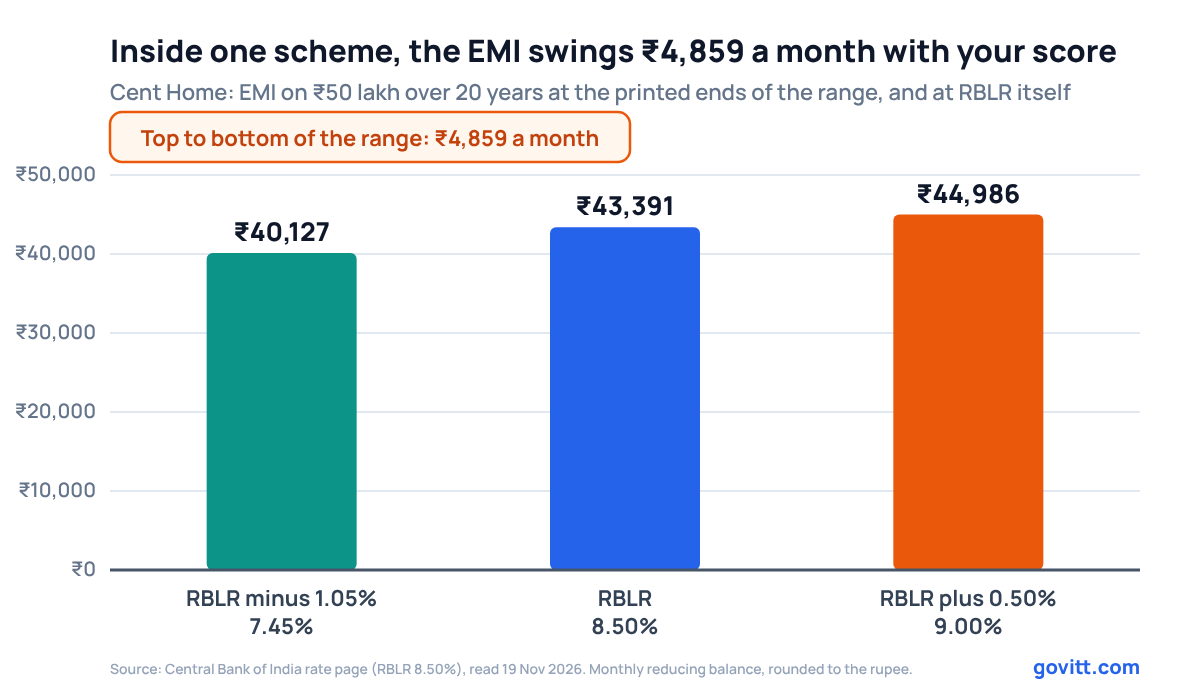
The spread range is 1.55% wide. On ₹50 lakh that is ₹4,859 a month between the two ends. A whole 0.25% RBI hike moves the same loan by about ₹766 to ₹807, depending on where in the range you sit. So your credit score can matter several times more than a policy meeting. My post on what a 0.25% RBI move compares with a credit score move makes the same point for another bank, and the minimum CIBIL score post explains what 750 against 800 changes.
If this is your third, fourth or fifth house, the page puts a 0.50% premium on both ends. That is 7.95% against 7.45% at the bottom, which is ₹1,540 a month more on ₹50 lakh, and 9.50% against 9.00% at the top, which is ₹1,621 a month more.
Does moving to Central Bank pay?
Assume ₹50 lakh outstanding, 20 years left, and you pay 8.75% today. The cost of moving is the Bengaluru all-in range from my balance transfer charges post, ₹53,700 to ₹76,500. That range assumes a processing fee. Central Bank's actual takeover fee isn't on its page, so treat the cost as an assumption. The 7.95% row is the printed bottom of the 3rd to 5th house range.
| Rate Central Bank quotes you | EMI | Monthly saving vs 8.75% | Cost back in |
|---|---|---|---|
| 7.45% (RBLR minus 1.05%) | ₹40,127 | ₹4,059 | 14 to 19 months |
| 7.95% (RBLR minus 0.55%) | ₹41,667 | ₹2,519 | 22 to 31 months |
| 8.50% (RBLR itself) | ₹43,391 | ₹795 | 68 to 97 months |
| 9.00% (RBLR plus 0.50%) | ₹44,986 | Costs ₹800 more | Never |
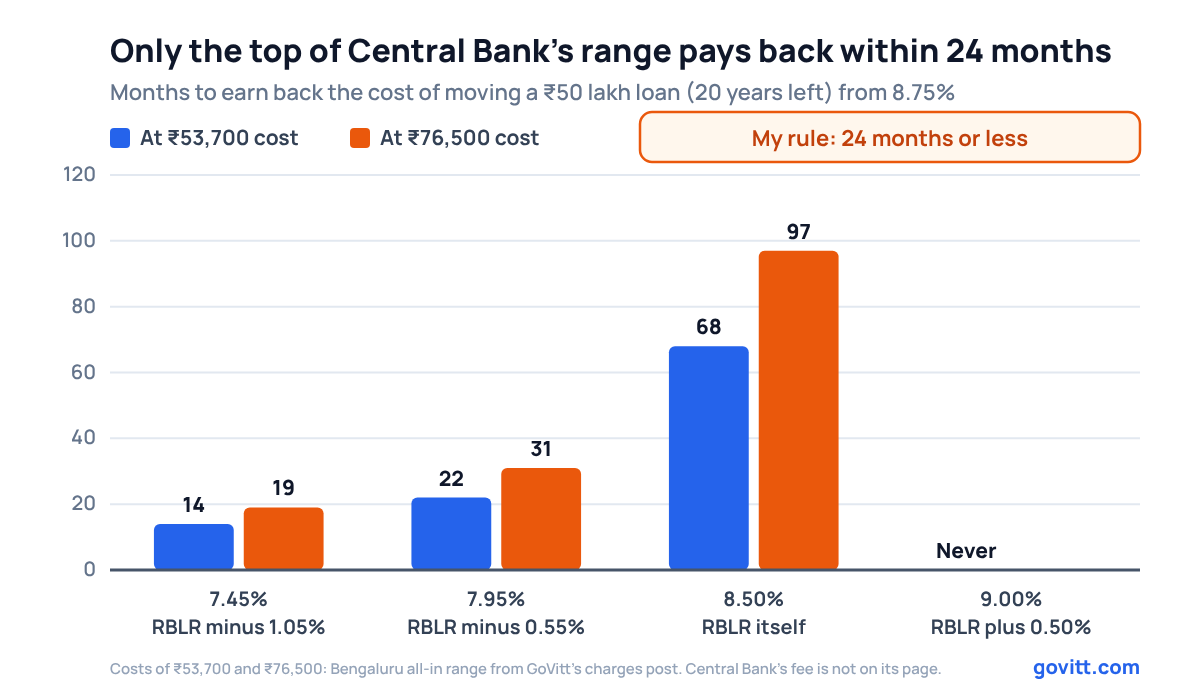
My rule is 24 months or less. Only the top of the Cent Home range clears it at both ends of the cost. At 7.95% you pass if the costs sit at the low end and fail if they sit at the high end. At the bank's own benchmark rate of 8.50% you'd wait between about five and a half and eight years. And at 9.00% there is nothing to recover. I list the five cases where I'd say stay put in when a home loan balance transfer is not worth it.
The practical rule: don't pay for a valuation until Central Bank has given you a number in writing. If the number is above 7.95% and you're at 8.75%, price another bank first.
What a hike does to this loan
The page says RBLR is repo plus a fixed 3.00%. So the formula is that any change in the repo rate changes RBLR by the same amount, and your loan, which is RBLR plus your spread, by the same amount again. The page doesn't say how often your loan resets. Ask. RBI decides on 4 December, and I don't forecast it. The arithmetic for a quarter point, on ₹50 lakh over 20 years, is ₹766 at 7.45%, ₹795 at 8.50% and ₹807 at 9.00%. My post on rates going up and whether switching still makes sense shows why a hike moves your current rate and the new quote together, so the switch saving barely changes.
Top-up loans
Cent Top Up is listed at 8.20% to 9.55%. A ₹10 lakh top-up over 20 years costs ₹8,489 a month at 8.20% and ₹9,354 at 9.55%. The tax rule on how you use it matters more than the rate, and I explain it in home loan top-up: interest rate, eligibility and the tax rule most people get wrong.
How it compares with the others
On 19 November I read the top-band starting rates at five other public-sector banks. Bank of Baroda, Canara Bank and Union Bank of India start at 7.40%, Punjab National Bank at 7.45% and SBI at 7.50%. Central Bank's 7.45% at the best end sits in that group. The point is the same for all of them: the starting rate is for the best score. My October posts on Canara, Union Bank and Bank of Baroda use the same layout, and the best banks for a balance transfer ranks the wider list.
What I'd ask Central Bank, in writing
- My rate at my credit score, written as RBLR plus or minus a spread, and which scheme it falls under.
- The score cut-offs that decide it, or at least which end of the Cent Home range I'm in.
- The takeover fee: processing, legal, valuation, and who pays what.
- The reset period and the date of my first reset.
- That my floating-rate loan carries no foreclosure charge, stated in the sanction letter.
- Whether the quote is the "present" rate in the table or a lower rate under an offer, and until when.
What I'd do this week
- Pull your credit report and check the score. It decides where in the range you land.
- Note three numbers from your latest loan statement: outstanding principal, the rate you pay and the years left.
- Ask Central Bank and one other lender for written quotes with the spread.
- Divide the total cost by the monthly saving. Under 24 months, go. Over, stay and ask your own bank to reprice.
- Ask how long the quote holds, and check it again after the RBI decision on 4 December if your quote sits close to the 24 month line.
FAQ
What is the Central Bank of India home loan interest rate in November 2026? Central Bank's page shows Cent Home at 7.45% to 9.00%, based on your CIC score, with RBLR at 8.50%. The rate for your loan depends on your score and isn't published as a grid, so ask for it in writing. I read the page on 19 November 2026.
What credit score does Central Bank of India need for its lowest rate? The page doesn't say. It marks Cent Home "based on CIC score" and prints no cut-offs. Ask the bank which score gets the 7.45% end of the range, and don't rely on another bank's bands.
Is the Central Bank of India home loan rate fixed or floating? The rates on the page are linked to RBLR, which is repo plus 3.00%, so they float with the repo rate. The page I read showed no fixed rates and no reset period.
Does Central Bank of India charge a processing fee on a home loan balance transfer? The page I read shows no processing fee or takeover terms. Ask for them in writing. My charges post shows what a Bengaluru transfer costs in total, ₹53,700 to ₹76,500 on ₹50 lakh, with MODT stamp duty that no bank can waive.
Will Central Bank's home loan rate change after the RBI meeting on 4 December? It can. RBLR is repo plus 3.00%, and the bank raised it by 0.25% two days after RBI's hike on 7 October. If RBI changes the repo rate, expect the same change in RBLR and in your rate.
Want to see what a written quote does to your own loan? Run the Payoff & Transfer Calculator with your outstanding amount, rate and years left. GoVitt compares 50+ banks and charges you 0% commission.
Figures are for the loan sizes shown with 20 years left, monthly reducing balance, EMI rounded to the rupee, at the rates in each table. Rates are from Central Bank of India's own pages as read on 19 November 2026 and can change. Transfer costs are the Bengaluru range from GoVitt's charges post and assume a processing fee that Central Bank's page does not show. Confirm everything in your sanction letter. This is general information, not financial advice.
Ready to take the next step?
Find out your loan options and check your eligibility with GoVitt today.