
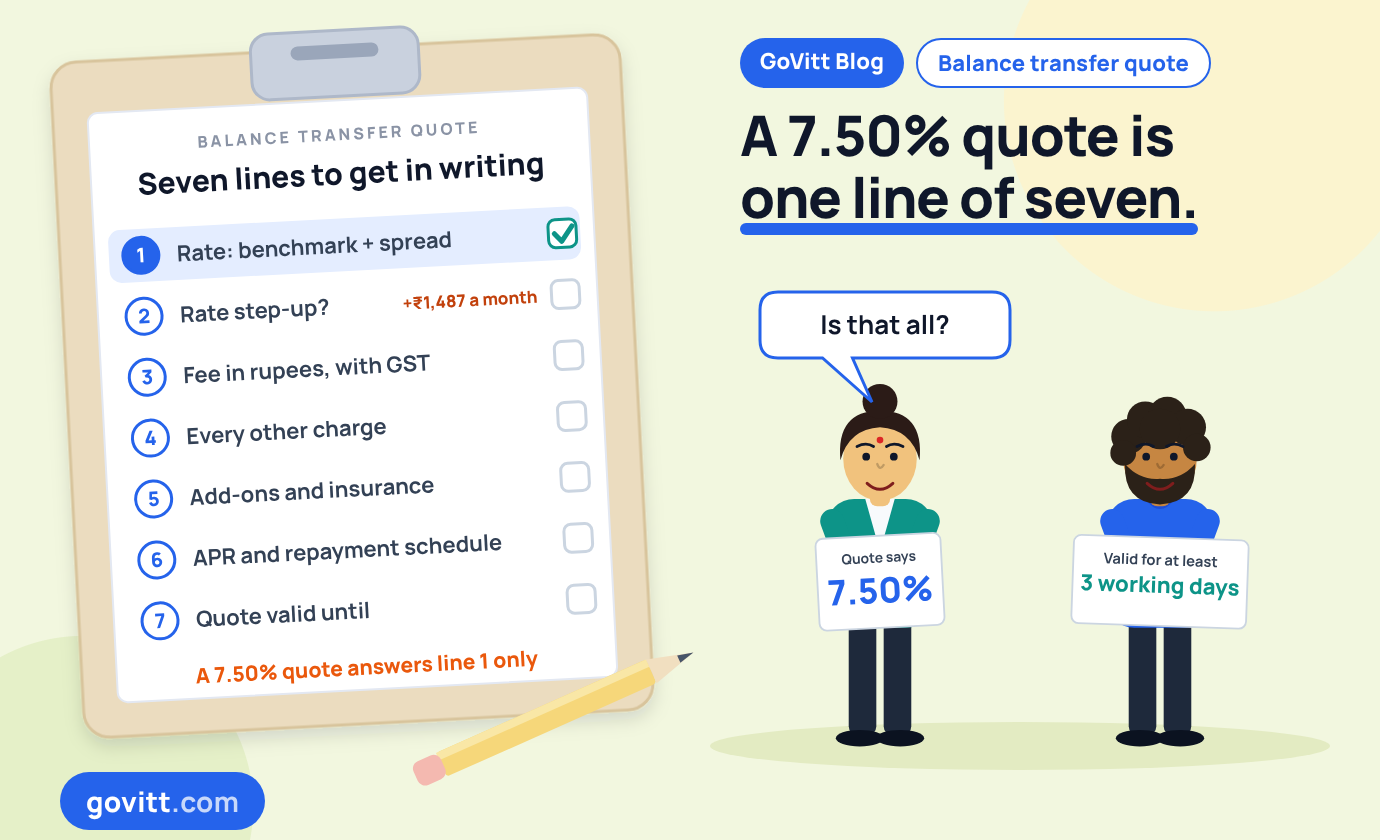
A home loan balance transfer quote that says 7.50% gives you one number out of seven. On ₹50 lakh at 8.75% with 20 years left, three quotes that all say 7.50% leave you ₹2,48,486, ₹1,36,976 or ₹68,991 better off after five years, taking the high end of the costs. The best and the worst are ₹1,79,495 apart. The headline rate was the same on all three.
The short version: a rate is a spread over a benchmark, and a quote is the spread, the fee, the other charges, the add-ons and the fine print. Ask for seven lines in writing. They are the rate in three parts, whether it steps up, the fee in rupees with GST, every other charge, the add-ons, the APR and the schedule, and how long the quote lasts. RBI's circular of 15 April 2024 requires a Key Facts Statement before you sign, and says a charge that isn't on it can't be added later without your consent. I read that as covering a transfer, though I haven't seen RBI say so for transfers in particular.
Below: the seven lines and what each is worth in rupees, three quotes side by side, what RBI's rule says and doesn't say, a message you can paste, and what I'd do.
See your real payoff date in 60 seconds
Banks calculate remaining EMIs by simple subtraction. See your actual payoff date and discover how much interest a balance transfer can save.
The seven lines
Same base case as my other transfer posts: ₹50 lakh outstanding, 20 years left, 8.75% today, EMI ₹44,186. A clean 7.50% gives an EMI of ₹40,280, which saves ₹3,906 a month. EMIs are monthly reducing balance, rounded to the rupee.
1. The rate in three parts. The benchmark's name and value, the spread over it and the resulting rate. A lender that says "7.50%" and nothing else has hidden the only part that can change. The spread is the part you can negotiate, and every 0.10% of it is worth ₹306 a month on ₹50 lakh. I wrote about how spreads are set in why your home loan rate is higher than the bank advertises.
2. Whether the rate steps up. Some quotes are a rate for the first year and a higher one after. Ask for the rate in year two and year three as numbers. If a 7.50% quote becomes 8.00% after 12 months, the EMI after the reset is ₹41,767 against ₹40,280, which is ₹1,487 a month more from month 13. I explained how to spot these in festive home loan offers: which save money and which are teaser rates.
3. The fee in rupees, with GST. A percentage isn't a fee. On ₹50 lakh, 0.25% is ₹14,750 with GST, 0.50% is ₹29,500 and 1% is ₹59,000. Ask whether any of it is refunded if you drop out after sanction.
4. Every other charge. Legal, valuation, the mortgage stamp duty, registration and small charges. In Bengaluru that is ₹36,000 to ₹47,000 on ₹50 lakh, from my balance transfer charges post and the MODT post. Ask which of them the lender collects and which you pay to others.
5. The add-ons. Insurance, a salary account, a card. Ask whether each is optional, what it costs and whether it is added to the loan. A ₹1 lakh premium added to a ₹50 lakh loan at 7.50% raises the EMI by ₹805 a month. I covered what the cover does in home loan insurance: who pays the bank.
6. The APR and the schedule. The annual percentage rate includes the interest and every charge the lender levies. Ask for the APR calculation and the full repayment schedule. The schedule is how you check the tenure and the EMI the lender is promising.
7. How long the quote lasts. Ask for the date and what happens if the repo changes before disbursal. A benchmark that moves by 0.25% between sanction and disbursal takes the 7.50% to 7.75%, which is ₹767 a month more. The circular doesn't say what a lender must do in that case, so ask.
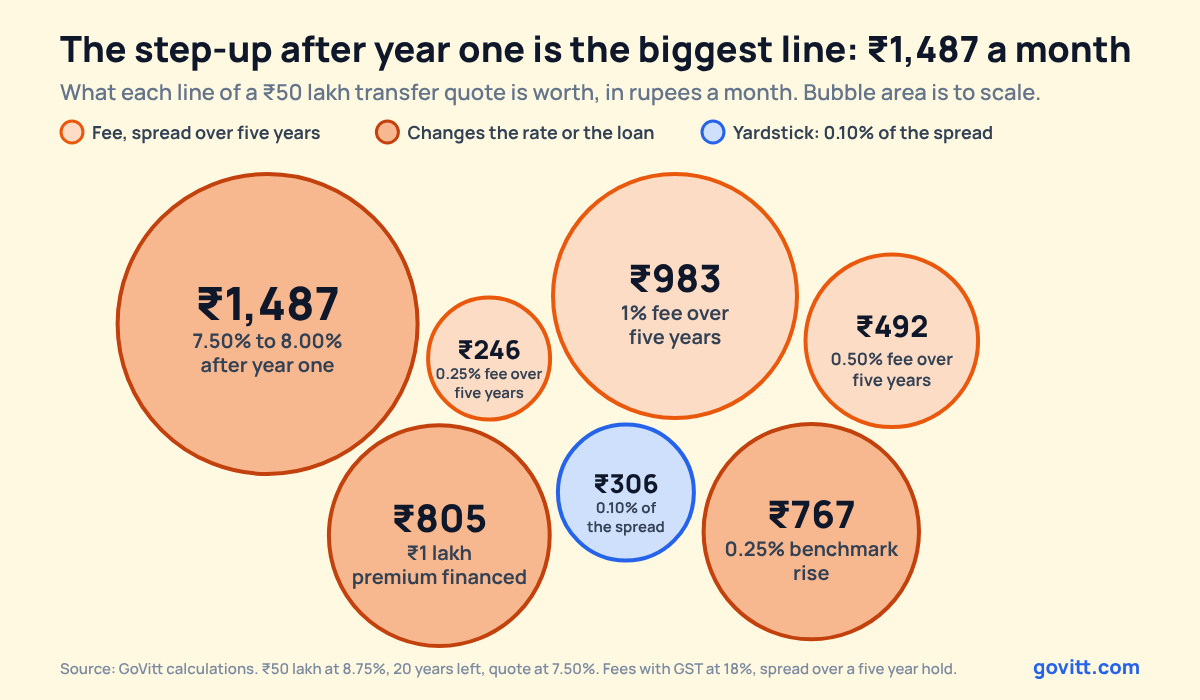
The chart puts each line on one scale, in rupees a month. The fees are spread over a five year hold: ₹246 a month for the 0.25% fee, ₹492 for the 0.50% fee and ₹983 for the 1% fee. The non-fee charges of ₹36,000 to ₹47,000 come to ₹600 to ₹783 a month on the same basis. The biggest bubble is the step-up after year one, at ₹1,487 a month. That is nearly five times the ₹306 that a 0.10% difference in the spread is worth. Most people haggle over the second and never ask about the first.
Three quotes, all 7.50%
These are illustrations, not offers. All three are for ₹50 lakh at 8.75% with 20 years left. The five year result is the EMI saved over 60 months plus the lower balance at month 60, less every cost. I show the net at both ends of the ₹36,000 to ₹47,000 non-fee range.
| Quote | The fine print | Fee with GST | Saving before costs, five years | All-in cost | Net after five years |
|---|---|---|---|---|---|
| A | 7.50% for the whole loan, fee 0.25%, no add-ons | ₹14,750 | ₹3,10,236 | ₹50,750 to ₹61,750 | ₹2,48,486 to ₹2,59,486 |
| B | 7.50% for 12 months, then 8.00%, fee 0.50% | ₹29,500 | ₹2,13,476 | ₹65,500 to ₹76,500 | ₹1,36,976 to ₹1,47,976 |
| C | 7.50% for the whole loan, fee 1%, and a ₹1 lakh premium added to the loan | ₹59,000 | ₹1,74,991 | ₹95,000 to ₹1,06,000 | ₹68,991 to ₹79,991 |
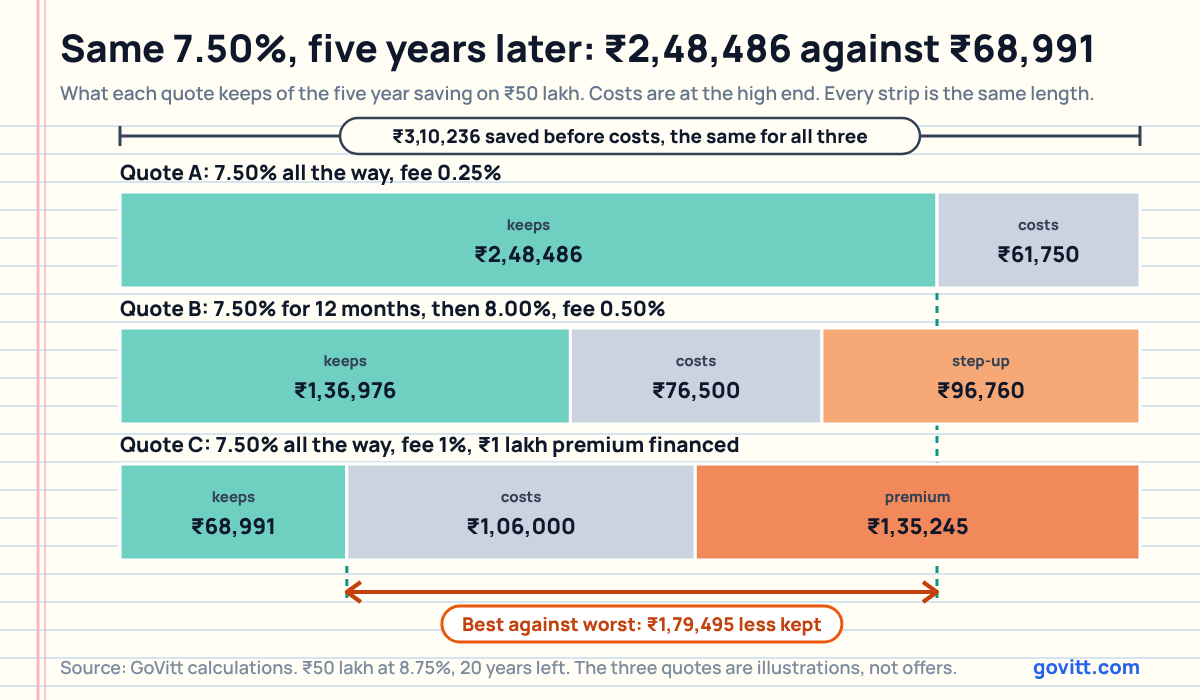
The step-up in quote B costs ₹96,760 over five years. The premium in quote C costs ₹1,35,245, because it is a ₹1 lakh loan that you then pay interest on, and the EMI is higher for it. Add the costs paid up front and you get the gap. At the high end of the costs, A keeps ₹2,48,486, B keeps ₹1,36,976 and C keeps ₹68,991.
The payback at the 7.50% rate is 13 to 16 months for quote A's fee, 17 to 20 months for B's and 25 to 28 months for C's. My rule is that the all-in cost should come back within 24 months. C fails it before the step-up or the premium are even counted, so the headline rate alone would have told you the wrong thing. If you're comparing quotes, the best banks for a balance transfer post and when a transfer is not worth it are the next reads.
What RBI's rule says, and what it doesn't
RBI's circular "Key Facts Statement (KFS) for Loans & Advances" is dated 15 April 2024. I read the circular text on its page on 25 November 2026. It applies to retail and MSME term loans extended by banks, NBFCs and housing finance companies, and to new loans sanctioned on or after 1 October 2024. In my reading, these paragraphs help you:
- Paragraph 4: the lender gives you a KFS before you execute the loan contract, in a language you understand, with the contents explained and your acknowledgement obtained.
- Paragraph 5: the KFS carries a unique proposal number and is valid for at least three working days for a loan of seven days or more. If you agree within that period, the lender is bound by its terms.
- Paragraph 6: the KFS includes a computation sheet of the APR and the amortisation schedule, and the APR includes every charge the lender levies.
- Paragraph 7: charges the lender collects for third parties, such as insurance and legal fees, also form part of the APR and are disclosed separately.
- Paragraph 8: a fee or charge not mentioned in the KFS can't be levied at any stage of the loan without your explicit consent.
What it doesn't do, as far as I can see: it doesn't give a general cooling-off period. The look-up period with an exit right is in a footnote about digital loans. It doesn't say what happens to a quote if the benchmark moves before disbursal. And I haven't seen RBI say a transfer is covered, so ask your lender to confirm that it will issue a KFS. I didn't read the annexes with the standard format.
A message you can paste
Send this by email or WhatsApp to every lender you're comparing. Keep the replies.
Hello, I'd like to move my home loan of ₹[amount] with [years] years left. Please send me in writing: 1. The benchmark, its current value, the spread and the resulting rate, and whether the spread is fixed for the whole loan. 2. Any rate that changes after a period, with the rate for each year. 3. The processing fee in rupees with GST, and whether any of it is refunded. 4. Every other charge I'll pay you or third parties, with amounts. 5. Any insurance or other product tied to this rate, with its cost and whether it is optional and added to the loan. 6. The APR with its calculation and the full repayment schedule. 7. The date this quote is valid until, and what happens if the benchmark changes before disbursal. Please also confirm you will give me a Key Facts Statement before I sign.
What I'd do this week
- Send the message above to two lenders and don't discuss rates on the phone until the reply is in your inbox.
- Put each reply into the five numbers of the calculator post. Rate, fee, other charges, years left and your hold period.
- Divide the all-in cost by the monthly saving. Under 24 months, go. Between 24 and 36, think. Over 36, stay.
- Count the step-up as a rate, not a footnote. Work out the year two and year three EMI.
- Refuse an add-on you didn't ask for, and ask what the rate would be without it.
- Read the KFS before you sign, not at the table. Check the APR, the fee and the schedule against your message.
- Check the dates around 4 December. A quote that is valid for three working days won't cover the RBI decision, which I discussed in the RBI 4 December post.
The paperwork you'll need is in documents for a balance transfer, the steps are in the transfer process, and when to start is in how soon you can transfer.
FAQ
What should a home loan balance transfer quote include? Seven lines: the benchmark, the spread and the resulting rate; any step-up; the processing fee in rupees with GST; every other charge; any add-ons and their cost; the APR with the repayment schedule; and the date the quote is valid until. A rate on its own is one of the seven.
What is a Key Facts Statement for a home loan? A standard statement RBI requires lenders to give you before you sign a retail term loan sanctioned on or after 1 October 2024. It must include the APR and the amortisation schedule. A fee that isn't in it can't be levied later without your explicit consent.
Can two quotes with the same interest rate cost different amounts? Yes. On ₹50 lakh at 8.75% with 20 years left, three quotes at 7.50% leave you ₹2,48,486, ₹1,36,976 or ₹68,991 better off after five years at the high end of the costs, because of the fee, a step-up and a financed premium.
What is a reasonable processing fee for a balance transfer? Use my 24 month rule. On ₹50 lakh at 7.50% a fee of 0.25% (₹14,750 with GST) pays back in 13 to 16 months, 0.50% (₹29,500) in 17 to 20 and 1% (₹59,000) in 25 to 28. Over 24 months, ask for a cut or a waiver.
How long is a lender's balance transfer quote valid? RBI's circular says the Key Facts Statement is valid for at least three working days for a loan of seven days or more. Lenders can give longer. Ask for the date in writing, and ask what happens if the benchmark moves before disbursal.
How do I compare two balance transfer offers? Put both on the same base case, with the rate, the fee with GST, the other charges, any step-up and any financed add-on. Divide the all-in cost by the monthly saving, and compare the five year net, not the rate.
Want to test your own quote? Run the Payoff & Transfer Calculator with your outstanding amount, rate and years left. GoVitt compares 50+ banks and charges you 0% commission.
Figures are for ₹50 lakh outstanding, 20 years left and 8.75% today, with EMIs on the monthly reducing balance method, rounded to the rupee. The three quotes, their fees, the step-up and the ₹1 lakh premium are illustrations, not any lender's offer. The five year result is the EMI saved over 60 months plus the lower balance at month 60, less the costs, with the old EMI paid in the comparison. Bengaluru costs are the illustrative ranges from GoVitt's charges post (16 October 2026). The RBI paragraphs are from the circular text read on 25 November 2026 and not from its annexes. Confirm every figure in writing with the lender before you act. This is general information, not financial advice.
Ready to take the next step?
Find out your loan options and check your eligibility with GoVitt today.