
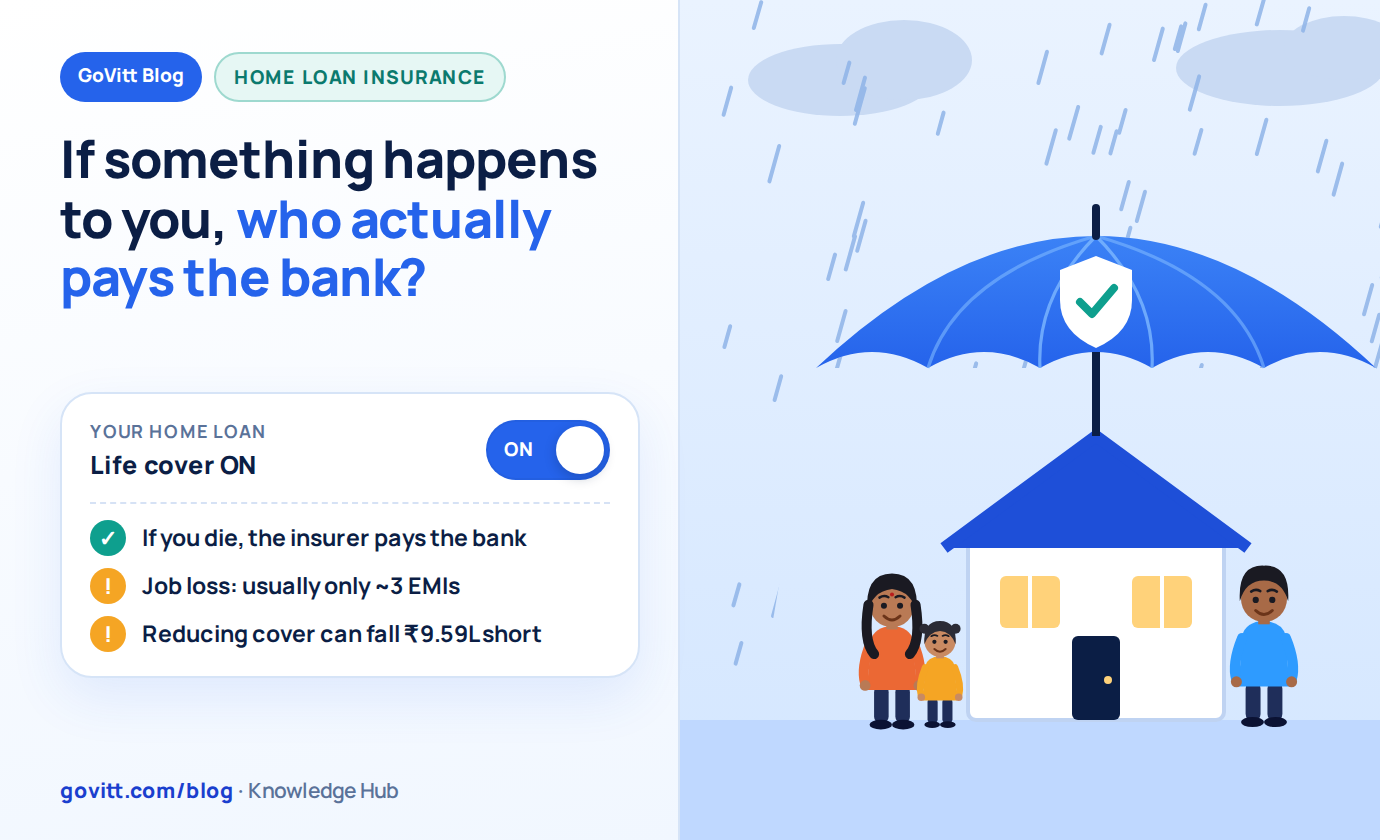
Home loan insurance: if something happens to you, who actually pays the bank?
There's one question almost nobody asks when they're signing their home loan papers. Not because it isn't important, but because nobody wants to think about it on the day they're buying a house.
If I die before this loan is paid off, what happens to my family?
And the slightly less scary version: if I lose my job, who pays the EMI?
See your real payoff date in 60 seconds
Banks calculate remaining EMIs by simple subtraction. See your actual payoff date and discover how much interest a balance transfer can save.
Usually, somewhere in that stack of papers, there's a home loan insurance form. The bank's executive says it's "for your family's safety", the premium gets added to the loan, and everyone moves on. Very few people know what it actually covers, who the money goes to, or where the gaps are. So let me go through it properly.
What home loan insurance actually is
It's a life insurance policy, sold through your lender, that is designed to pay off your home loan if you die during the loan tenure. Banks and housing finance companies usually call it a home loan protection plan. Many of these are group credit life policies, where the lender is the master policyholder and you're one of the people covered under it.
Most of them are single premium. You pay once, at the start, for the whole tenure. And most people don't pay it from their pocket. It gets added to the loan amount, so you end up paying EMI and interest on your insurance premium for the next 20 years.
That's not the same as home insurance, by the way. Home insurance, or property insurance, covers the building against fire, earthquake, flood and so on. Many lenders do require the property to be insured, because the house is their security. Home loan insurance covers your life, so the loan gets repaid if you aren't there to repay it.
Is it compulsory?
No.
No RBI or IRDAI rule says you have to buy life cover to get a home loan, and IRDAI does not allow insurance to be forced on you as a condition of the loan. The National Housing Bank has also told housing finance companies to take a borrower's clear, separate consent before selling insurance with a loan, and to offer more than one option.
In practice, some loan officers still make it sound mandatory. If you're told your loan won't go through without it, ask them to show you, in writing, which rule says so. They usually can't.
But I would never tell anyone to take a big home loan with no life cover at all. The question isn't whether to be insured. It's which policy, and from whom.
If the borrower dies, does the insurer pay the bank?
Yes. That's exactly what it's designed to do.
When the borrower dies, the family or co-borrower informs the lender and the insurer and files a claim with the death certificate, the policy details and whatever else the insurer asks for, usually medical records, and in the case of an accident, the FIR and post-mortem report. Once the insurer accepts the claim, it pays the lender directly, up to the sum assured. The lender uses that to close or reduce the loan.
If the sum assured covers the whole outstanding amount, the loan is closed. The bank then has to return the original property documents. RBI's 2023 rules on returning property papers require lenders to have a clear process for handing documents back to legal heirs when a borrower dies, and to publish it on their website.
Now the details that matter.
The claim takes time. While it's being processed, the loan account doesn't freeze on its own. Interest keeps running. Talk to the lender immediately, tell them a claim is in process, and ask whether they'll pause EMIs until it's settled. Many will, but you have to ask.
If the cover is a reducing cover, the sum assured falls every year to roughly match the loan balance. If the cover is a level cover, the sum assured stays the same. In that case the insurer pays the bank what's owed, and the rest goes to your nominee.
And the claim can be rejected. Most life policies don't pay for suicide in the first 12 months. If you hid a health condition, smoking or an existing illness on the proposal form, the insurer can reject the claim later. When the bank's executive is filling in the form for you, make sure the health questions are answered truthfully, even if it means a medical test or a slightly higher premium.
If the borrower dies without insurance
This is where families get hurt.
If there's a co-borrower, usually the spouse, the loan continues in their name. They're equally responsible for it, and the EMIs keep coming.
If there's no co-borrower, the lender will look to the legal heirs. In general, legal heirs are liable only up to the value of what they inherit from the person who died, not from their own savings or salary. But the house itself is part of what they inherit, and it's mortgaged. If the family can't keep paying, the lender can take possession and sell it under the SARFAESI Act to recover the loan. Whatever is left after the dues goes to the heirs.
So without insurance, your family's choice is often keep paying an EMI they may not be able to afford, or lose the house. That's the whole reason life cover matters.
The lender will often agree to a short moratorium or a restructured schedule to give the family time to decide. It's worth asking. Every case is different, though, so if this happens, get proper legal advice on the estate.
The gap most families find too late
This is the part I'd really like people to understand.
Most bank-sold home loan insurance is reducing cover. The sum assured goes down every year according to the loan schedule that was worked out on day one, at the rate you started with.
But your actual loan doesn't follow that schedule if rates go up. As we've seen a few times now, including RBI's hike this week, lenders often keep your EMI the same and stretch the tenure. Your outstanding balance then falls more slowly than the original plan. The insurance cover keeps falling at the original pace.
Here's a ₹50 lakh, 20 year loan that starts at 8%, where the rate goes up to 9% from year three and the EMI stays the same:
| After | Insurance cover (original schedule) | What you actually owe | The gap your family pays |
|---|---|---|---|
| 5 years | ₹43.76 lakh | ₹45.34 lakh | ₹1.58 lakh |
| 10 years | ₹34.47 lakh | ₹39.44 lakh | ₹4.97 lakh |
| 15 years | ₹20.63 lakh | ₹30.21 lakh | ₹9.59 lakh |
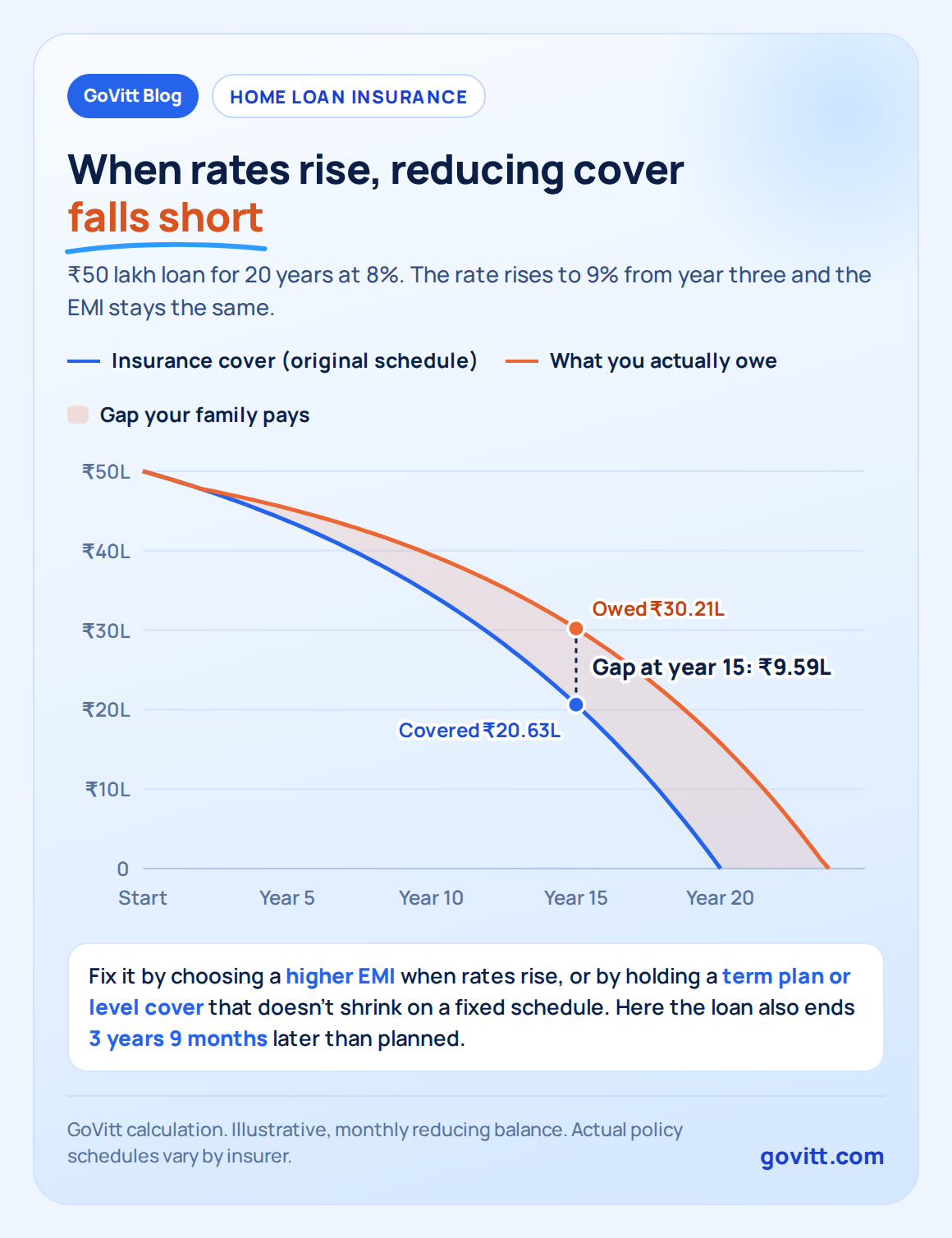
Reducing cover follows the old schedule. If rates go up and your tenure stretches, the cover can fall well short of what you actually owe.
So the insurer pays the bank ₹20.63 lakh, and your family still owes ₹9.59 lakh. And in this example the loan itself now runs 3 years 9 months past the date the cover ends, with nothing covering that stretch at all. That's not a hypothetical worry. It's exactly what happens when tenures stretch, which I wrote about in this post on why your payoff date moved.
Two ways around it. Choose the higher EMI instead of a longer tenure whenever rates go up. Or have cover that doesn't shrink on a fixed schedule, like a level cover or a separate term plan.
What about job loss?
This is where expectations and reality are furthest apart.
Job loss cover is not a standard part of home loan insurance. It's usually an add-on, often sold through a general insurer, and it's much narrower than people think.
It typically pays a few EMIs, not the loan. Three EMIs is common. The insurer pays them to the lender on your behalf, and after that you're on your own.
It covers involuntary job loss only. Layoffs, retrenchment, the company shutting down. Resigning doesn't count. Being let go during probation, for misconduct or for poor performance usually doesn't count either.
There's normally a waiting period at the start of the policy when you can't claim at all, and the cover often runs for only part of the loan tenure, not all 20 years.
Self-employed people, contract workers and people already between jobs generally can't get it.
So, to answer the question directly: no, if you lose your job, the insurer doesn't pay off your home loan. At best, with the right add-on, it pays a few months of EMIs while you find your feet.
If you do lose your job and don't have this cover, call the bank before you miss an EMI, not after. Ask about a moratorium or a temporary restructuring. Lenders have far more options for a borrower who comes to them early than for one whose account has already gone overdue. And this is exactly why I keep saying an emergency fund of at least six months of EMIs and expenses matters more than any add-on.
Riders worth looking at
Two riders are more useful than job loss cover for most people.
A disability rider pays if you're permanently unable to work because of an accident or illness. For your family's finances, that can be as damaging as death, sometimes more.
A critical illness rider pays a lump sum if you're diagnosed with one of the illnesses listed in the policy. The money is yours to use, for treatment or for EMIs.
Read the definitions in both. They're specific, and they're what the claim gets decided on.
The hidden cost of buying it through the loan
Say the single premium is ₹1 lakh and it's added to your loan at 8.25% for 20 years. That ₹1 lakh adds about ₹852 to your EMI, and you end up paying about ₹1.04 lakh in interest on it over the loan. You've paid roughly double for the same policy. In Karnataka, you also pay 0.5% stamp duty on it as part of the MODT, because it's part of the loan amount.
There's another catch. A single premium policy bought through your lender usually can't be moved if you later do a balance transfer to a cheaper lender. Some people end up with a policy tied to a bank they've left, and the new lender asks them to buy another one. I mentioned this in the balance transfer post too.
What I'd actually do
Buy a plain term insurance plan in your own name, for at least your home loan amount plus whatever your family would need to live on. Make your family the nominee, not the bank. If you die, the money comes to them, they clear the loan, and the rest is theirs. The cover doesn't shrink, it isn't tied to any lender, and you can carry it through every balance transfer. A term plan bought directly usually costs much less than a lender's single premium policy for the same cover, but compare actual quotes for your age before you decide.
Tell the bank you have it. Show them the policy. That usually ends the conversation.
If you do want the lender's policy, prefer a level cover over reducing cover. Pay the premium upfront if you can, rather than adding it to the loan. Ask for the policy document, not just the brochure. Check the sum assured, the term, the exclusions and who the beneficiary is. And remember there's a free-look period, usually 30 days, during which you can cancel and get your premium back if you were pushed into it.
If you have a co-borrower, make sure both of you are covered. If either of you dies, the other is left with the whole loan.
And keep at least six months of EMIs and expenses aside. Insurance helps your family if you die. An emergency fund is what helps you if you lose your job.
Getting a home loan, or moving one?
If you're about to take a home loan or move one, and you want an honest view on whether the insurance being offered is worth it, WhatsApp us on +91 70194 17854. We'll go through the loan and the insurance terms with you. GoVitt works with 50+ banks and housing finance companies, and we don't charge you any commission. You can also check your numbers on our EMI calculator.
This is general information, not legal, tax or insurance advice. Policy terms, exclusions and claim processes differ between insurers, and the legal position after a borrower's death depends on the facts of each case. The gap table is an illustration that assumes the rate rises from 8% to 9% from the start of year three and the EMI stays the same.
Questions people usually ask
Is home loan insurance mandatory in India? No. Neither RBI nor IRDAI makes it compulsory, and a lender can't make it a condition for approving your loan. Many lenders do require property insurance on the house itself, which is a different thing.
What happens to a home loan if the borrower dies? If there's home loan insurance, the insurer pays the lender up to the sum assured and the loan is closed or reduced. If there's no insurance, a co-borrower continues the loan. Otherwise the lender approaches the legal heirs, and if the loan isn't repaid it can sell the property to recover the dues, with any surplus going to the heirs.
Does the insurer pay the bank directly? Yes. Under home loan insurance, the claim is paid to the lender up to the outstanding loan or the sum assured. With a level cover, anything left after the loan is cleared goes to the nominee. With a term plan in your own name, the money goes to your nominee, who then repays the loan.
Does home loan insurance cover job loss? Not usually as part of the basic policy. Job loss cover is generally an add-on that pays a limited number of EMIs, often three, and only for involuntary job loss such as layoffs. Resignation, probation and misconduct are usually excluded, and self-employed people generally aren't eligible.
Are legal heirs responsible for the home loan after the borrower's death? Generally, legal heirs are liable only up to the value of the assets they inherit, not from their own money. But the mortgaged house is part of that inheritance, so the lender can sell it if the loan isn't repaid. A co-borrower remains fully liable. Get legal advice for the specific case.
Is a term plan better than home loan insurance? For most people, yes. A term plan in your own name usually costs less for the same cover, doesn't reduce on a fixed schedule, isn't tied to one lender, and pays your family directly. Compare actual quotes for your age and health first.
What happens to home loan insurance if I transfer my loan to another bank? A single premium policy bought through your lender usually can't be ported. Check the policy's terms on surrender or continuation, and ask the new lender whether your existing cover or a term plan will be accepted.
Can I cancel home loan insurance if I was forced to buy it? Most policies have a free-look period, usually 30 days, during which you can cancel and get a refund. After that, complain to the lender, then the Insurance Ombudsman or IRDAI if it isn't resolved. For housing finance companies, you can also complain to the National Housing Bank.
Ready to take the next step?
Find out your loan options and check your eligibility with GoVitt today.