
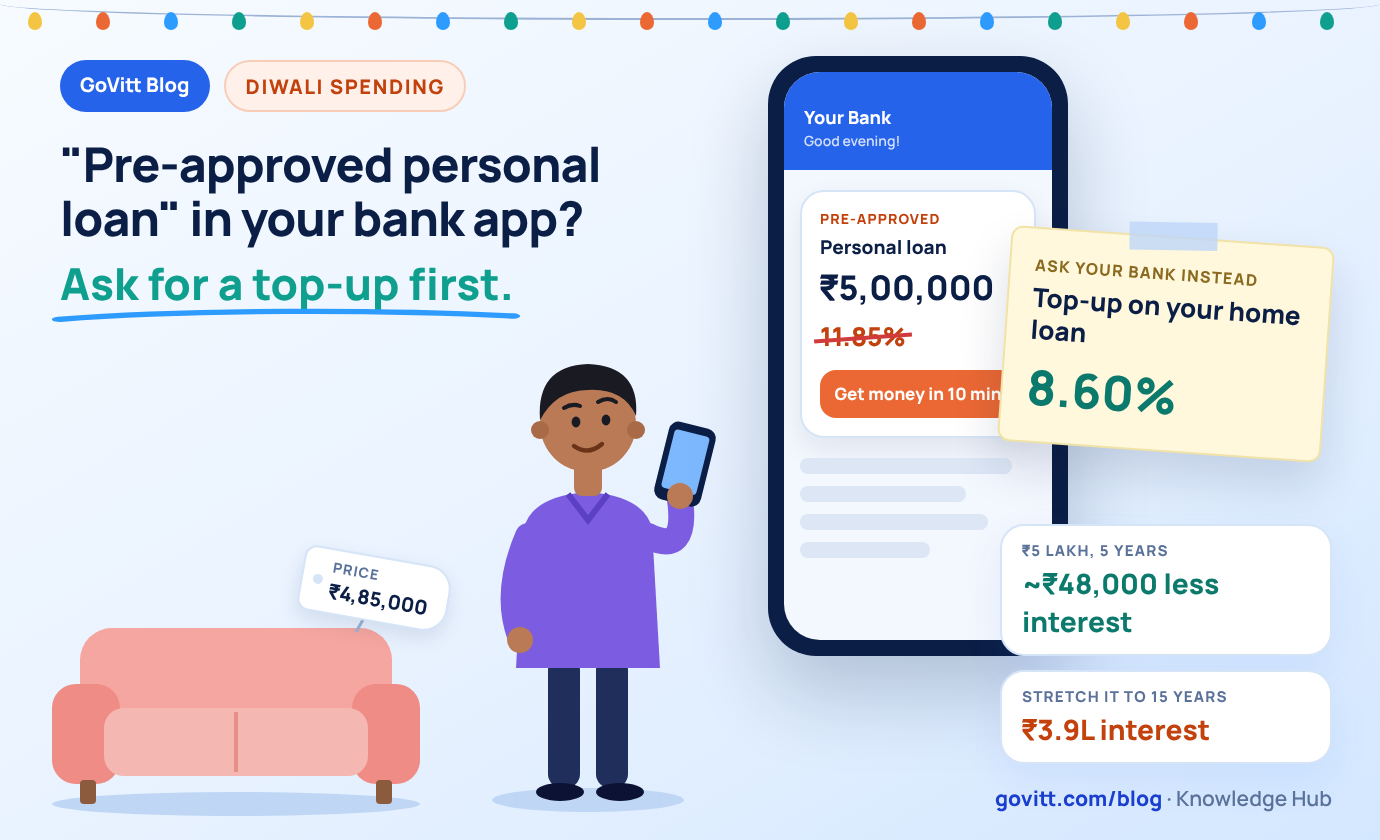
A friend called me last weekend from a furniture showroom in Whitefield. Sofa, dining table, a wardrobe for the second bedroom. The bill was close to ₹5 lakh.
His bank app had already popped up a pre-approved personal loan. ₹5 lakh, money in the account in ten minutes. He wanted to know if he should just take it.
I asked him one question. "Don't you have a home loan with the same bank?"
See your real payoff date in 60 seconds
Banks calculate remaining EMIs by simple subtraction. See your actual payoff date and discover how much interest a balance transfer can save.
He did. He'd never heard of a top-up.
What a top-up actually is
A top-up is an extra loan you take on top of your existing home loan, from the same lender. Your house is already mortgaged to the bank, so the bank sees much less risk than it does with a personal loan, where it has nothing to fall back on but your salary.
Less risk means a lower rate. That's it, really.
You can usually use the money for almost anything personal. Interiors, repairs, a child's education, a wedding, medical bills. Banks generally don't allow it for speculation or business, and a few ask what you're using it for.
The difference in rupees
Let's use PNB, because it publishes both rates on the same page.
Right now, PNB's top-up loan for existing home loan customers is 8.60%. Its personal loan for a private sector employee with a PNB salary account and a CIBIL score above 800 is 11.85%. That's the best personal loan rate this borrower can get there. With a score between 750 and 799, it's 12.85%.
On ₹5 lakh over five years, the personal loan EMI is ₹11,084 and you pay about ₹1.65 lakh in interest. The top-up EMI is ₹10,282 and the interest is about ₹1.17 lakh.
So roughly ₹48,000 saved, just by asking a different question in the same bank. And that's against the best personal loan rate. Most people don't get the best one.
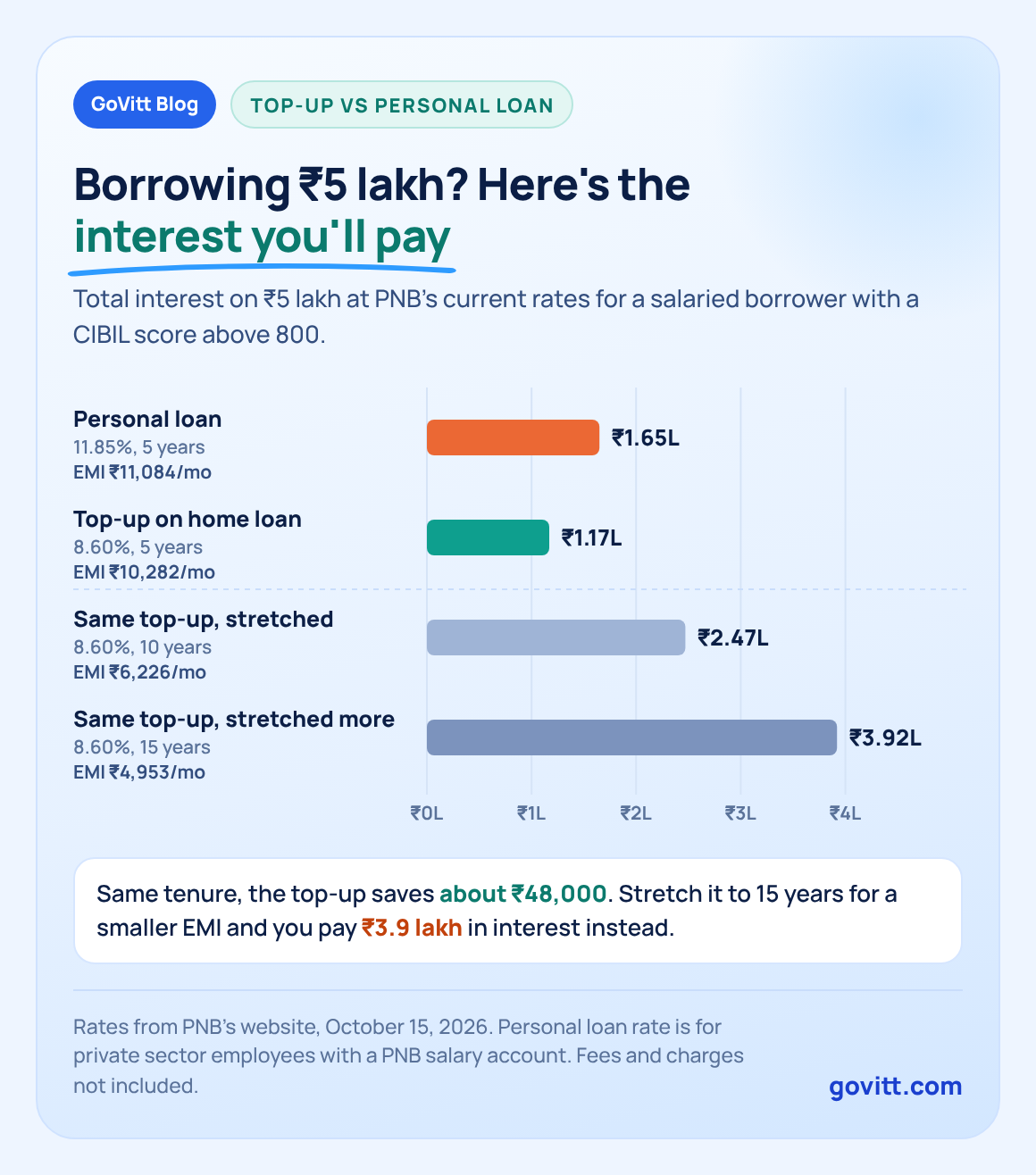
The top-up only saves you money if you keep it short. Look at the bottom two bars.
The trap is the tenure
Here's the part that catches people.
A top-up usually comes with a long tenure on offer, often as long as what's left on your home loan. So the bank will happily give you ₹5 lakh over 15 years, and the EMI drops to under ₹5,000. It feels like a great deal. Half the EMI of a personal loan!
It isn't. Over 15 years you'd pay about ₹3.9 lakh in interest on that ₹5 lakh. That's more than double what the personal loan would have cost you. You'd still be paying for that sofa when it's sitting in someone's second-hand listing.
A lower rate only helps if you pay it off in roughly the same time. So take the top-up, but pick a tenure of three to five years, the same as you would have for a personal loan. If the EMI at five years feels too high, that's a sign to borrow less, not to borrow for longer.
The tax part, since everyone asks
If you use the top-up to repair or renovate the house you live in, there's a small deduction under the old tax regime. Interest on a loan for repairs of a self-occupied home is allowed up to ₹30,000 a year, and that sits inside the same ₹2 lakh overall limit as your main home loan interest. If your home loan interest already uses up the ₹2 lakh, which it does for most people with a decent sized loan, the top-up adds nothing.
If you use it for furniture, a wedding or a holiday, there's no deduction at all. Furniture isn't a repair, however much the showroom guy says it's "for the house."
And on the new tax regime, none of this applies. So don't take a top-up for the tax benefit. Take it because it's cheaper.
When a personal loan still makes sense
I'm not saying never take one.
When you need the money in a day or two. A personal loan from your own bank can land in minutes. A top-up usually takes one to two weeks, because the bank may want fresh documents, and some revalue the property.
When the amount is small. For ₹1 lakh over a year, the rate difference is a few thousand rupees, and the processing fee and paperwork on a top-up can eat most of it.
When your home loan has been running for only a few months. Most lenders want to see 6 to 12 months of clean EMIs before they offer a top-up.
When you don't want your house anywhere near the spending. Some people prefer to keep the home loan for the home. If a personal loan for a holiday keeps you honest about paying it off in a year, that's a fair choice too.
One more thing to check first
If your home loan is with a lender that charges you 8.75% or more, a top-up from them won't be cheap either, because top-ups are usually priced a bit above the main loan rate.
In that case, it can make sense to move the whole loan to a lender with a better rate and take the top-up from the new lender at the same time. One set of paperwork, a lower rate on both. I've gone through the balance transfer maths here.
Also, any new loan, top-up or personal, adds an EMI. If you're planning to buy a second property or upgrade in the next year or two, that EMI reduces how much home loan you'll get then. I explained how that works in this post.
What my friend did
He walked out of the showroom without paying, called his bank on Monday, and asked for a top-up for five years. It came through nine days later at the bank's top-up rate. He paid the furniture store in full, which also got him a cash discount he hadn't asked for.
Not a dramatic story. But it's about ₹50,000 he didn't have to give to anyone.
Want us to check what your bank will offer?
WhatsApp your home loan lender, current rate, outstanding amount and how much you need to +91 70194 17854. We'll tell you whether a top-up from your bank, a top-up after moving to a better lender, or a personal loan works out cheapest for you, with our 50+ partner banks and housing finance companies. You can also see what lenders are offering right now. GoVitt doesn't charge you any commission.
Rates are from PNB's website as on October 15, 2026. The personal loan rate shown is for private sector employees with a PNB salary account and a CIBIL score of 800 or above. Top-up and personal loan rates vary by lender and borrower. EMI figures assume monthly reducing balance and exclude processing fees and other charges. Tax treatment is under the old regime. This is general information, not tax advice.
Questions people usually ask
Is a top-up home loan cheaper than a personal loan? Usually, yes. At PNB in October 2026, the top-up rate is 8.60% while personal loans for private sector salaried borrowers start at 11.85%. On ₹5 lakh over five years, that saves about ₹48,000 in interest, as long as you keep the top-up tenure short.
What is the interest rate on a home loan top-up? It varies by lender, but top-ups are usually priced a little above the lender's regular home loan rate. PNB's top-up term loan is 8.60% as of October 15, 2026, and it doesn't vary by credit score.
Can I use a top-up loan for anything? Mostly. Lenders generally allow personal uses like home renovation, furniture, education, weddings or medical expenses. Speculation and business use are usually not allowed, and some lenders ask for the purpose.
Is there a tax benefit on a top-up home loan? Only if you use it for repair, renovation or construction of the house, and only under the old tax regime. For repairs of a self-occupied home, the interest deduction is capped at ₹30,000 a year and shares the overall ₹2 lakh limit with your main home loan. There's no deduction if you use it for furniture, travel or other expenses.
How long does a home loan top-up take? Usually one to two weeks, depending on the lender and whether it needs a fresh property valuation. A pre-approved personal loan from your bank can be credited within minutes, which is its main advantage.
Who is eligible for a top-up on a home loan? Existing home loan borrowers with a clean repayment record, usually at least 6 to 12 months of EMIs paid on time. The total of your home loan and top-up must stay within the lender's limit for the property's current value, and your income must support the extra EMI.
Ready to take the next step?
Find out your loan options and check your eligibility with GoVitt today.