
Search for bank approved projects in Bangalore and you'll find lender lists with hundreds of names and no definition of "approved". Kotak's Bengaluru list runs to about 200 projects, and the bank says it has more than 2,000 approved across 22 cities. HSBC's marks 16 as new in February 2026. Neither page says what the bank checked, or when.
So here is what APF (approved project finance) means, what it gets you and what it doesn't, before you pay a booking amount. I read the lender pages on 5 November 2026. Where the pages are silent, I say so.
The short answer
An APF number means a lender has vetted a project and cleared it for home loans, so it can lend to buyers there with fewer project-level checks. It is specific to the lender, usually to a phase, and it can be reviewed or withdrawn. It is not a RERA registration, and it is not a promise that the flat will be delivered on time. Before you book, ask the builder for the APF number and the approving banks, confirm with the bank you plan to use that your tower is covered today, and check the project's RERA registration yourself.
See your real payoff date in 60 seconds
Banks calculate remaining EMIs by simple subtraction. See your actual payoff date and discover how much interest a balance transfer can save.
What the bank checks before it gives an APF
No bank publishes its checklist. The two explainers I read agree on the broad shape:
| Check | What it covers |
|---|---|
| Legal | Title and encumbrances; title deeds, NOCs and freehold or leasehold papers |
| Technical | Whether construction meets safety and quality standards; clearances such as fire and electrical |
| Financial | Whether the builder is viable and the project is funded |
| Regulatory | Whether the project complies with local laws and approvals |
That table draws on PropNewz (updated 26 August 2026) and HomeBazaar (updated 13 January 2025), which is dated, so read it as a guide to what banks usually look at, not any one bank's policy. Kotak describes the APF number as the number it allots to a project, to show the project is legally authentic and compliant.
What an APF gets you
- A faster loan. Kotak says loans on approved projects "would be processed much faster". Union Bank, on its builder tie-up page, lists quick processing and sanction, reduced legal charges and no need for interim security on tie-up projects. That page is undated.
- Smoother staged payments. PropNewz says the bank has already looked at the project and the builder, so disbursements to the builder during construction tend to go more smoothly.
- A better rate? I couldn't confirm it. PropNewz says some lenders offer better terms on approved projects. I found no bank page that quotes a lower rate for an approved project, so don't count on one.
What "bank approved" does not mean
- It isn't RERA. These are two separate checks. PropNewz is blunt that APF doesn't replace RERA registration, which you should confirm yourself.
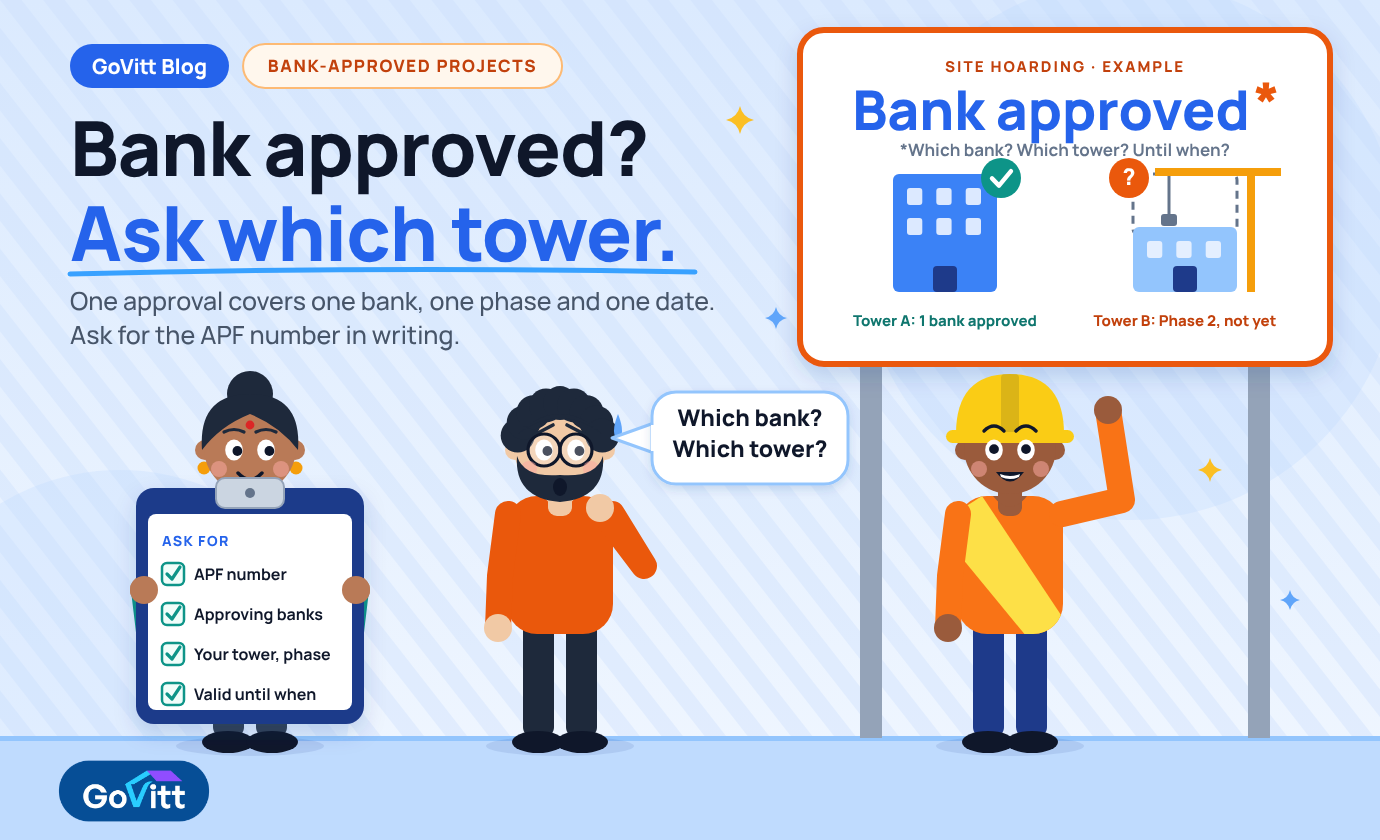
- It isn't every bank. Approvals are lender specific. A builder who says "bank approved" may mean a bank you will never use. The builder's word is not your lender's word.
- It may not be your tower. PropNewz says APF is project or phase specific and time bound. Check that your tower and unit sit inside the approved phase and that the approval is current.
- It isn't a delivery promise. PropNewz calls APF a "stamp of legitimacy" that lowers risk but doesn't remove the need for your own checks.
- It isn't defined on the list. Neither the Kotak nor the HSBC page says what "approved" means or when the list was updated. HSBC's only guidance is to ask your relationship manager for the details of the project.
Why it matters before you book
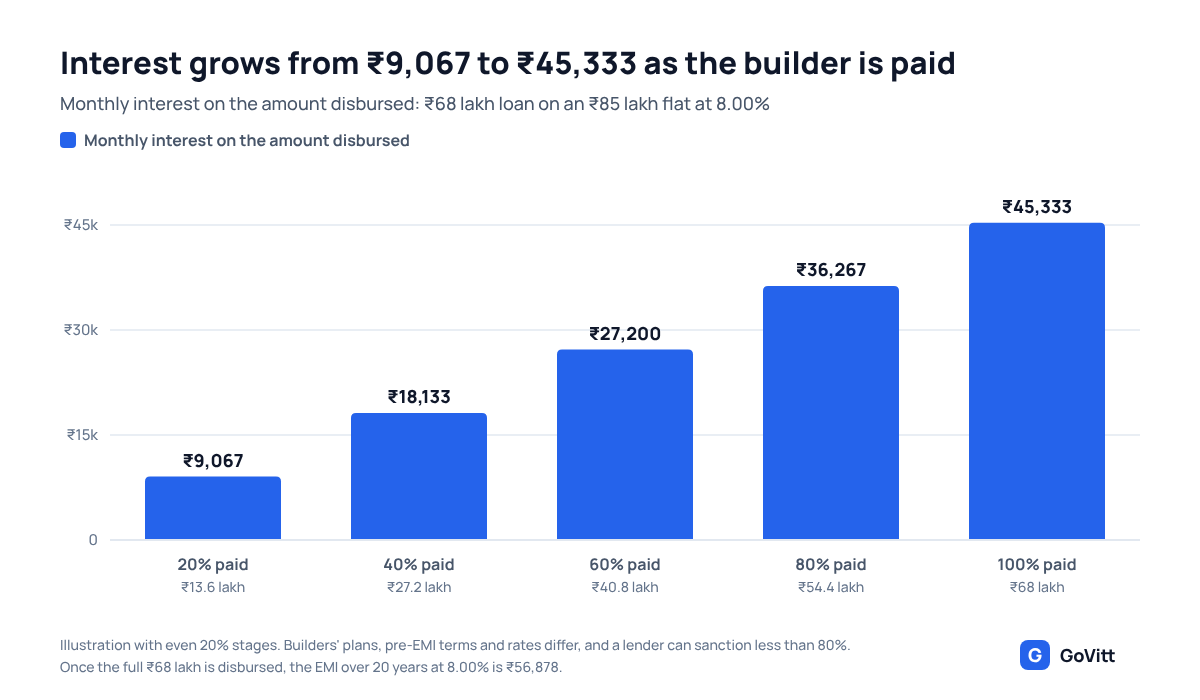
A bank pays an under construction project's builder in stages, and you pay interest on what it has paid out. Here is an illustration. Say you buy an ₹85 lakh flat with an 80% loan, which is ₹68 lakh, at 8.00%. If you pay interest only on what has been disbursed, your monthly payment grows as the builder is paid:
| Disbursed | Amount | Interest a month at 8.00% |
|---|---|---|
| 20% | ₹13.6 lakh | ₹9,067 |
| 40% | ₹27.2 lakh | ₹18,133 |
| 60% | ₹40.8 lakh | ₹27,200 |
| 80% | ₹54.4 lakh | ₹36,267 |
| 100% | ₹68 lakh | ₹45,333 |
Now suppose construction stalls with 60% paid. You keep paying ₹27,200 a month on a flat you can't move into. Six months costs ₹1.63 lakh, a year ₹3.26 lakh, two years ₹6.53 lakh. That is before the rent you are still paying.
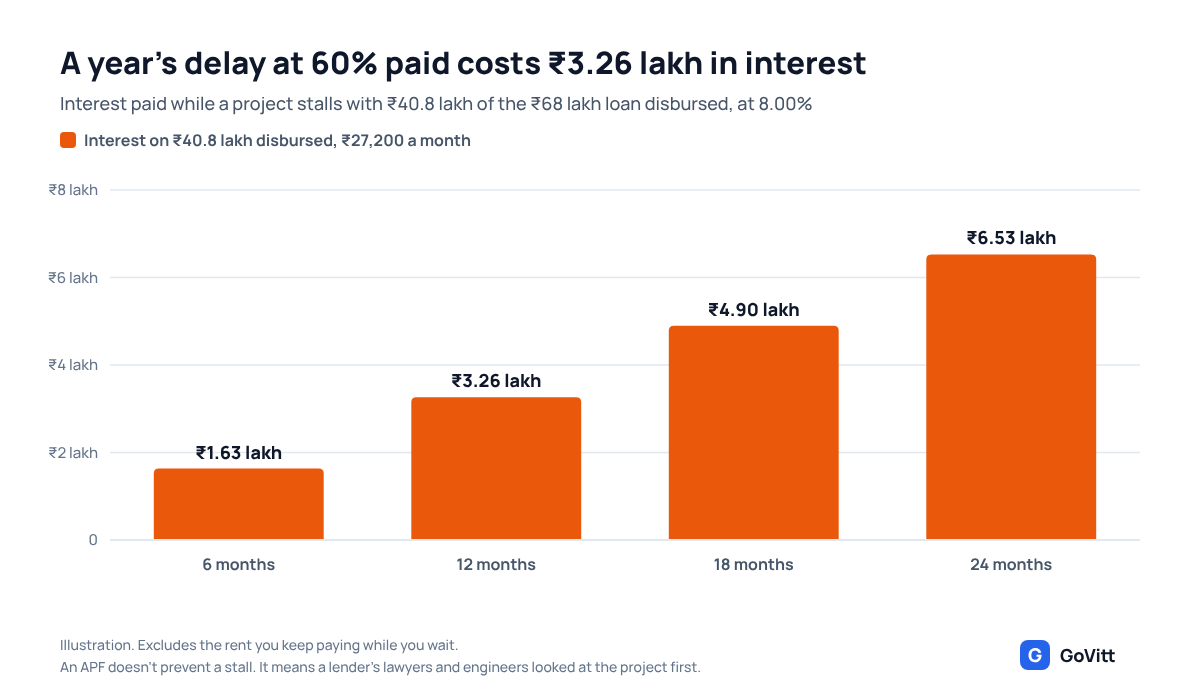
An APF can't stop a project from stalling. What it tells you is that a lender's lawyers and engineers looked at the project before you did. That is a reason to ask for it before you commit, not after your booking amount is gone. The cash you need on top of the loan is in stamp duty and registration charges in Karnataka.
If the project isn't on your bank's list
PropNewz says a project the bank has never seen "can face extra scrutiny at each stage", which can slow disbursement and strain your payment schedule. It also says a project that many banks have declined deserves a closer look, since the reason may be a legal or approval gap. HomeBazaar goes further and calls a missing APF a warning sign.
I'd put it this way. A missing APF means that lender hasn't vetted the project. It may be new, or it may have a gap. Ask why. The pages I read don't say whether a lender will lend on a project it hasn't approved, so don't assume it will or won't. Each lender decides, and the answer has to come from the lender in writing.
How to check a project in about 20 minutes
- Ask the builder for the APF number and the names of the approving banks, for your tower or phase.
- Look at your lender's published list. Kotak, HSBC and Union Bank each publish one. A list can be out of date, so treat it as a first filter.
- Ask your lender's relationship manager, in writing: is this project, and this tower, approved today? Under which APF number, and valid until when?
- Check K-RERA yourself. Ujjivan Small Finance Bank's guide (July 2025) points to rera.karnataka.gov.in: open Registered Projects, search by project name, promoter or registration number, and read the promoter, approvals, projected completion date and complaints. I couldn't open the portal, so go by what you see on screen.
- Know why RERA matters even with a bank approval. Under section 4(2)(l)(D) of the RERA Act, a builder must put 70% of the money collected from buyers into a separate account for that project's construction and land cost (Business Today, April 2019).
The rest of the pre-booking checks, the agreement and the title, are in before you pay that booking amount. If you're buying a resale flat instead, the checks that matter most are on the flat's own papers, and buying a resale flat in Bengaluru: check the khata before you check the EMI covers them.
What I'd do before paying a booking amount
- Get the APF number and the approving banks from the builder, in writing, for your tower.
- Confirm with the bank you will actually use, not just any bank. Ask for the approval date and validity.
- Check the RERA registration on the K-RERA portal and read the promoter, approvals and complaints.
- Ask two lenders about the project by name before you pay. If two or more have declined it, find out why.
- Work out your cash first. Margin money, stamp duty and registration come out of your pocket, and the EMI calculator shows what the EMI will be once the loan is fully disbursed.
FAQ
What are bank approved projects in Bangalore? They are residential projects that a lender has vetted and cleared for home loans, usually shown on that lender's published list. Kotak's Bengaluru list has about 200 projects, and HSBC publishes one too. Neither page defines "approved" or gives an update date, so confirm with your own lender.
What is an APF number? It is the number a bank or housing finance company gives a project it has approved for home loans. Kotak says it is the number allotted to the project, showing it is legally authentic and compliant. It is lender specific, usually phase specific, and it can be reviewed or withdrawn.
Is a bank approved project safe to buy? It is safer than one no lender has looked at, but it isn't a guarantee. An APF means a lender checked the legal, technical, financial and regulatory side of the project. It does not promise on time delivery, so check RERA registration and read the builder's agreement yourself.
Can I get a home loan for a project that isn't bank approved? The pages I read don't say, so ask the lender in writing. PropNewz says a project the bank hasn't seen faces extra scrutiny at each stage, which can slow disbursement. Each lender decides case by case.
How do I check whether a project is approved by a bank? Ask the builder for the APF number and the approving banks. Then check your own lender's published project list and ask its relationship manager, in writing, whether your tower is approved today and until when.
Is APF the same as RERA registration? No. APF is a lender's clearance of a project for loans. RERA registration is the project's registration with the state regulator. They are separate checks, and a bank approval doesn't replace RERA.
Not sure whether your project will clear a lender? Talk to an advisor (free, WhatsApp) and we'll check it against our lender panel. GoVitt compares 50+ banks and charges you 0% commission. For how lenders in the city compare, see home loan in Bangalore: which banks lend easiest here.
The interest example is an illustration: an ₹85 lakh flat, an 80% loan of ₹68 lakh at 8.00%, interest only on the amount disbursed, with payments in even stages of 20%. Builders' payment plans, lenders' pre-EMI terms and rates differ, and a lender can sanction less than 80%. Lender project lists change without notice and carry no update date, so confirm every project with your lender in writing. This is general information, not legal advice.
Ready to take the next step?
Find out your loan options and check your eligibility with GoVitt today.