
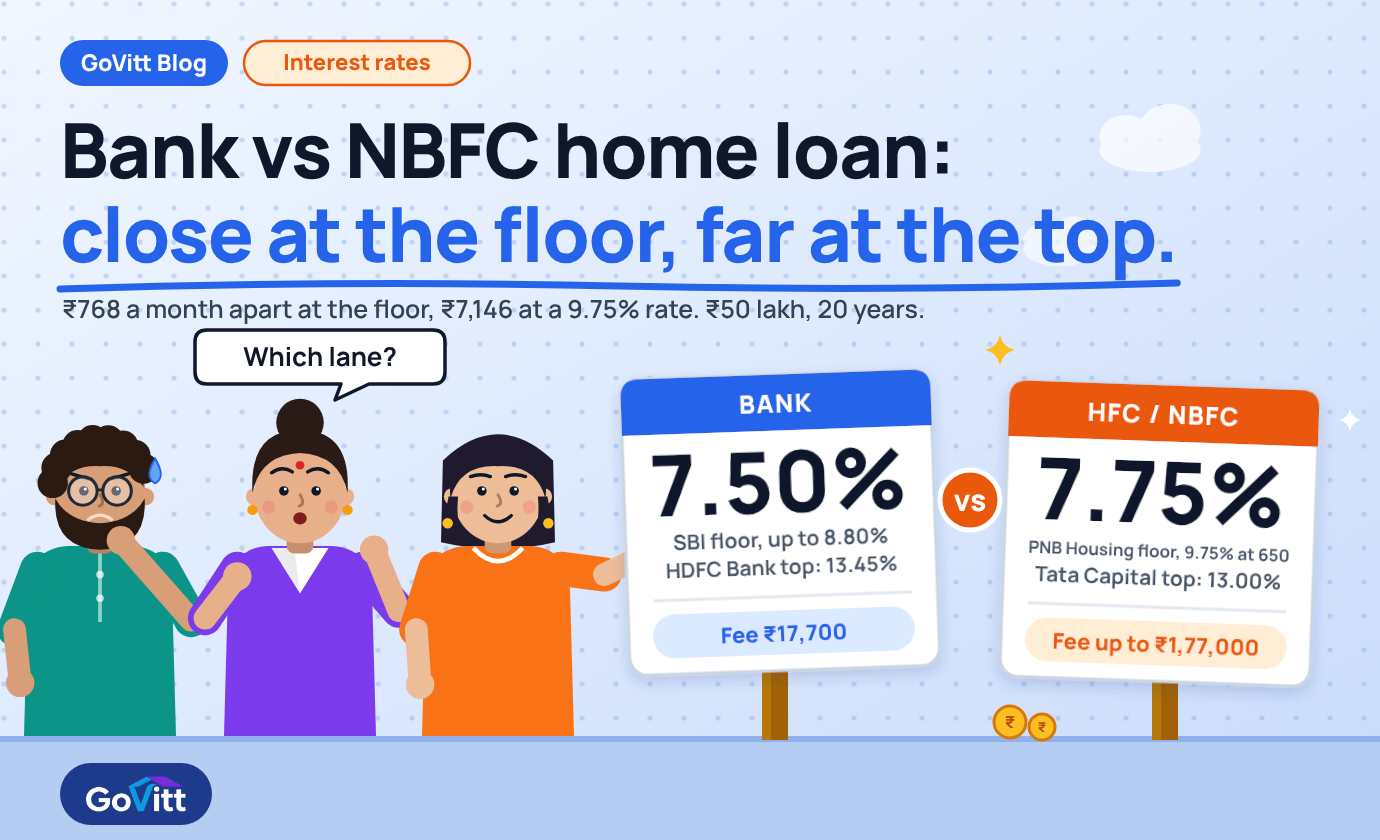
The bank vs NBFC home loan gap is small at the floor and large everywhere else. SBI starts at 7.50%, PNB Housing at 7.75% and Tata Capital Housing at 7.99%. On ₹50 lakh over 20 years that is ₹768 and ₹1,511 a month more than SBI. But PNB Housing's rate for a score up to 650 is 9.75%, which is ₹7,146 a month more than SBI's floor and ₹17.15 lakh over the loan. The cheapest floor I found belongs to an HFC, not a bank: LIC Housing Finance at 7.15%.
So "bank or NBFC?" is the wrong question. The right one is: what rate will this lender actually give me, and is the gap worth what I get for it? Below: what the three names mean, what really differs, what each gap costs in rupees, the fee gap, when I'd pay more, and what a "bridge" HFC loan costs if you plan to move later.
First, the honest part
I read these lender pages on 7 November 2026. Three of the HFC pages contradict themselves, a fourth shows no rate and a fifth I couldn't re-read:
See your real payoff date in 60 seconds
Banks calculate remaining EMIs by simple subtraction. See your actual payoff date and discover how much interest a balance transfer can save.
- PNB Housing: the table runs from 7.75% (salaried, score 825 and above, up to ₹50 lakh) to 9.75% (score up to 650). Its FAQ says rates "start from 8.25%". It also lists a 14.75% fixed rate while saying floating only. No effective date. On 29 October my HFC transfer post saw "as low as 7.50%".
- Bajaj Housing Finance: the page is titled "August 2026". Salaried 7.50% to 10.25%, self-employed 8.05% to 10.65%, although its meta description says self-employed 7.50%. It says it offers no fixed-rate home loans, then lists a fixed-rate prepayment charge. A different page, on bajajfinserv.in, is for Bajaj Finance, a different company, and shows a fee of up to 4%. Don't mix them up.
- Tata Capital Housing Finance: salaried 7.99% to 13%, self-employed 8.25% to 13%. Its meta says 7.50%, and a results summary on the same site shows a maximum of 18%.
- Aadhar Housing Finance: its page shows no stated rate or fee. Its EMI calculator's rate slider runs from 9.9% to 20%, with 15% as the default. That is a calculator, not a rate card.
- LIC Housing Finance: 7.15% is as of 22 October, from my LIC post. I couldn't re-read LIC's page this week.
Banks aren't clean either. HDFC Bank's range runs from 8.00% to 13.45%. Every rate here can change: RBI raised the repo rate to 5.50% on 7 October, and the next decision is on 4 December.
The short answer
Take the bank if a bank will say yes, and ask it for its best rate in writing. Take an HFC when a bank has said no in writing, or when speed or paperwork is worth more than the gap. If you do, price it as a bridge. At 9.75% against 7.75% on ₹50 lakh, you pay ₹1,00,066 more interest in the first year, plus ₹53,700 to ₹76,500 to move later. Know that figure before you sign.
What bank, HFC and NBFC actually mean
| Bank | HFC | NBFC |
|---|---|---|
| What it is | Takes deposits, regulated by RBI | A finance company that mostly lends for housing |
| A finance company that lends for many things | Examples | SBI, HDFC Bank, Canara, Union |
| LIC Housing Finance, PNB Housing, Bajaj Housing, Tata Capital Housing | Bajaj Finance, and others that lend for many purposes | Regulator |
| RBI | RBI, since 9 August 2019 (it took over from the National Housing Bank) | RBI |
Going by their names, most lenders that people call "NBFC home loan" companies are HFCs: LIC Housing Finance, PNB Housing Finance, Bajaj Housing Finance, Tata Capital Housing Finance, Aadhar Housing Finance. An HFC must keep at least 60% of its assets in housing finance. For you, as a borrower, the useful split is not the licence. It is how each one prices, who it says yes to, and what it charges to get in and out. If you want the HFC-to-bank move, I wrote that separately in moving your home loan from a housing finance company to a bank.
What actually differs
How the rate is set. Banks price a floating-rate home loan off an external benchmark, usually the repo rate, plus a spread. HFCs use their own benchmark. Tata Capital Housing's page shows a prime lending rate table effective 1 November 2026. That matters because RBI's draft Interest Rates on Loans and Advances Directions, 2026, issued 12 August, would let an NBFC's benchmark stay internal. It would also let a lender change a spread only if your credit profile changes, and reset rates at most every three months. It is still a draft. New facilities would be covered from 1 April 2027 and existing ones by 1 April 2029. I covered it in RBI's new loan pricing draft.
Prepayment. For a floating-rate loan to an individual, there is no prepayment or foreclosure charge, whether bank or HFC. RBI's HFC framework of 22 October 2020 bars HFCs from charging it too. Bajaj Housing says nil on floating and 4% on fixed. Tata Capital Housing's page says there is a "nominal" charge if you repay from other people's funds. I couldn't tell whether that applies only to fixed-rate or business loans. Ask for "nil on floating" in writing.
Who they say yes to. This is the real reason HFCs exist, and most of the evidence is the lenders' own claims. Kotak's article (25 June 2026, the bank's own marketing, with a disclaimer saying accurate as of July 2025) says HFCs are quick and flexible on documents and credit scores, and charge higher rates, while banks charge less and are slower. Aadhar's page says "No salary slips? No problem. We assess your loan based on your earnings" and starts at ₹10,000 of monthly income. Most of its home loans are capped at ₹75 lakh. These are claims. I haven't tested any of them.
How high the top of the range goes. Home First Finance Company's Q2 FY27 release (28 October 2026) shows a cost of borrowings of 7.8% and a spread of 5.2%. If spread means yield less cost of funds, that is about 13.0% charged on its loans. That's my arithmetic. The company doesn't print it as a yield. It is in line with the 13% top of Tata Capital's range, and it shows what the other end of the HFC market looks like.
Speed. I found no published turnaround figure on the pages I read. "Faster" is the lenders' claim. Don't pay 2% more for a promise.
HFC vs bank home loan: what the gap costs
Most comparisons stop at the floor. Don't. On ₹50 lakh over 20 years, against SBI's 7.50% (EMI ₹40,280, total interest ₹46.67 lakh):
| Lender and what the rate is | Rate | EMI | Extra a month | Extra over 20 years |
|---|---|---|---|---|
| LIC Housing Finance, floor (22 Oct) | 7.15% | ₹39,216 | ₹1,063 less | ₹2.55 lakh less |
| PNB Housing, floor (HFC) | 7.75% | ₹41,047 | ₹768 | ₹1.84 lakh |
| Tata Capital Housing, floor (HFC) | 7.99% | ₹41,791 | ₹1,511 | ₹3.63 lakh |
| HDFC Bank, floor | 8.00% | ₹41,822 | ₹1,542 | ₹3.70 lakh |
| SBI, top of its range | 8.80% | ₹44,345 | ₹4,066 | ₹9.76 lakh |
| PNB Housing, score up to 650, up to ₹50 lakh | 9.75% | ₹47,426 | ₹7,146 | ₹17.15 lakh |
| Bajaj Housing, top of salaried range | 10.25% | ₹49,082 | ₹8,803 | ₹21.13 lakh |
| Tata Capital Housing, top | 13.00% | ₹58,579 | ₹18,299 | ₹43.92 lakh |
| HDFC Bank, top | 13.45% | ₹60,189 | ₹19,909 | ₹47.78 lakh |
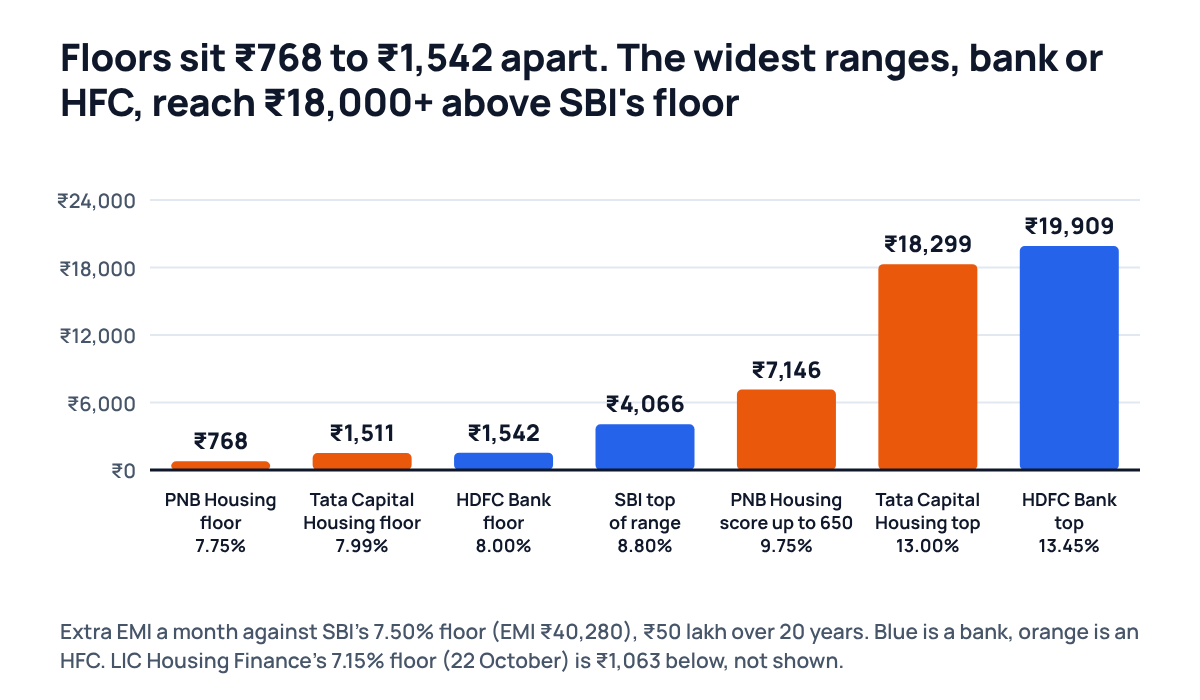
Three things stand out.
- At the floor, the gap is ₹768 to ₹1,542 a month. That is 0.25% to 0.50% on the rate, and it is smaller than one score step at Union Bank, which is at least ₹2,390 a month in my Union Bank post.
- The like-for-like gap for a weak profile is smaller than it looks. A weak-score borrower doesn't get SBI's floor. SBI's own top is 8.80%. Against that, PNB Housing's 9.75% is ₹3,081 a month more, or ₹7.39 lakh over 20 years. That assumes SBI would lend at 8.80% to a score that weak, which it may not.
- Banks go high too. HDFC Bank's range reaches 13.45%. The licence does not set your rate. Your profile does. How the average borrower fares is in average home loan interest rate in India. RBI data cited there has banks' new housing loans at 7.66% in June.
My own rate posts have the bank floors in detail: SBI, Union Bank, HDFC and LIC Housing Finance.
The fee gap
Rate is not the only price. Processing fees on ₹50 lakh, with 18% GST:
| Lender | Fee as published | On ₹50 lakh with GST |
|---|---|---|
| LIC Housing Finance | 0.25%, capped at ₹15,000, plus GST | ₹14,750 |
| SBI | 0.35%, capped at ₹15,000, plus GST | ₹17,700 |
| HDFC Bank | Up to ₹25,000 plus GST | Up to ₹29,500 |
| Tata Capital Housing | Up to 3% plus GST | Up to ₹1,77,000 |
At the top of its range, Tata Capital Housing's fee is ₹1,59,300 above SBI's. "Up to" is a ceiling, not a quote. You may pay less, and you should negotiate. But the extra ₹1,59,300 of fee alone equals about 105 months of the ₹1,511 a month that Tata Capital Housing's floor costs over SBI's, which is nearly 9 years. Compare the total, not the rate.
When paying more is worth it
I'd consider an HFC when one of these is true:
- A bank has said no, in writing, and you can't fix the reason in time. Ask the bank for the reason. If it is a score, a gap in income proof or a part-built property, an HFC is a real option. If it is the property, don't assume an HFC is the way out. I found no HFC page that says it lends on B-khata or unapproved layouts. See which Bengaluru layouts banks will lend on.
- Your income is real but hard to document. Self-employed and cash-heavy profiles are where HFCs say they flex (Aadhar's claim above). Bajaj Housing's own self-employed range starts 0.55% above its salaried floor.
- The deal dies without speed. A builder deadline, a token you'd lose, a price that rises. Put a rupee figure on what waiting costs. If it is more than the extra EMI times the months you'd wait, pay.
I would not pay more when:
- The gap is 0.25% to 0.50%. That is ₹768 to ₹1,542 a month. Compare on fee and service, not on the licence.
- You can fix the problem in 60 to 90 days. A score or a missing document is cheaper to fix than to finance at 9.75%. The usual reasons are in home loan rejected: the 9 usual reasons.
- The fee is the surprise. If the fee is 3%, the headline rate no longer matters.
A simple test: at a 2% gap, you pay about ₹8,339 a month more in interest on ₹50 lakh. If the alternative costs you less than that every month, take the bank and wait.
Using an HFC as a bridge: what it costs
Say a bank declines you today and an HFC offers 9.75% (PNB Housing's rate for a score up to 650, up to ₹50 lakh). You plan to move to a bank at 7.75% once your score recovers. That 7.75% is my assumption, not a quote. Here is the price on ₹50 lakh over 20 years:
| Months on the HFC loan | Extra interest at 9.75% vs 7.75% | All-in, with the cost of moving (₹53,700 to ₹76,500) |
|---|---|---|
| 12 | ₹1,00,066 | ₹1,53,766 to ₹1,76,566 |
| 24 | ₹2,00,172 | ₹2,53,872 to ₹2,76,672 |
| 36 | ₹3,00,133 | ₹3,53,833 to ₹3,76,633 |
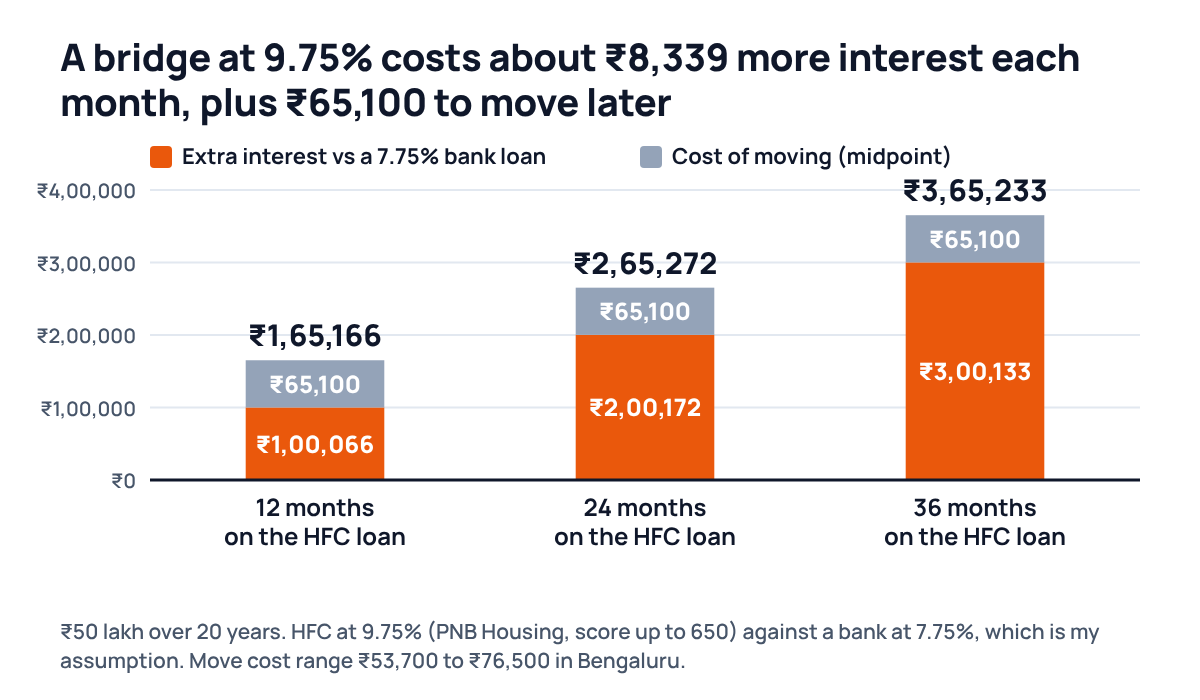
The move cost is my Bengaluru estimate for ₹50 lakh from home loan balance transfer charges, and the midpoint is ₹65,100. The midpoint of ₹65,100 equals about 8 months of the extra interest. So the move itself is the small part. The long wait is what hurts.
Two rules for a bridge. First, take a floating rate with no prepayment charge, and have it in writing. Second, set a date. Every month you wait costs about ₹8,339. The mechanics of the move, including the foreclosure letter and the new lender's valuation, are in the HFC-to-bank transfer post.
What I'd do this week
- Get two written quotes for the same profile: one bank and one HFC. Same loan, tenure, income and score.
- Ask the HFC five things: the benchmark and your spread, how often the rate resets, who can change the spread, the processing fee with GST, and the prepayment charge on floating.
- If a bank says no, ask for the reason in writing. If you can fix it in 60 to 90 days, do that first.
- Price the bridge with the table above before you accept a 9% to 10% rate.
- Compare the totals (rate and fee) on the rates page.
FAQ
Which is better, a bank or NBFC home loan? The bank, if it will lend to you, because floors are close and bank rates for strong profiles tend to be lower. On ₹50 lakh the floor gap is ₹768 to ₹1,542 a month. An HFC makes sense when a bank has declined you, or paper or speed matters more than the gap.
Is an HFC home loan more expensive than a bank loan? Often, but not always. LIC Housing Finance's 7.15% floor (22 October) is below every bank floor I read. At the top of the range, HFCs run higher: Bajaj Housing 10.25% and Tata Capital Housing 13% against SBI's 8.80%. HDFC Bank's range reaches 13.45%, so profile matters more than licence.
What is the difference between an HFC and an NBFC for a home loan? An HFC is a finance company that mostly lends for housing and must hold at least 60% of its assets there. An NBFC lends for many purposes. RBI has regulated HFCs since 9 August 2019. For a borrower the practical difference is pricing, fees and who they approve, not the label.
Is it easier to get a home loan from an HFC than a bank? Lenders say so. Kotak's article and Aadhar's page both claim flexibility on documents and scores. I haven't tested it, and I found no HFC page that lends on B-khata or unapproved layouts. Easier approval usually comes with a higher rate.
Can I move from an HFC to a bank later? Yes, if the bank approves you. It costs about ₹53,700 to ₹76,500 on ₹50 lakh in Bengaluru, from my estimate. Floating-rate loans to individuals carry no prepayment charge, so ask for that in writing before you take the HFC loan.
Are HFC home loans regulated? Yes. RBI took over HFC regulation from the National Housing Bank on 9 August 2019. RBI's draft loan pricing directions of 12 August 2026 would cover new facilities from 1 April 2027 if finalised. It is still a draft.
Want to see what a bank would actually offer you? Compare rates from 50+ banks before you accept a higher rate from anyone. GoVitt compares 50+ banks and charges you 0% commission.
Rates, fees and conditions are as published on each lender's own page on the dates stated, read on 7 November 2026 unless noted, and several HFC pages contradict themselves, as described above. LIC's rate is from my 22 October post. Press and bank-written articles are labelled as claims. EMIs use the standard monthly reducing balance method, rounded to the nearest rupee, on ₹50 lakh over 20 years unless stated. The bridge table is an illustration using an assumed 7.75% bank rate. Your rate, profile and lender will differ. This is general information, not financial or legal advice. Check your sanction letter and ask for every figure in writing.
Ready to take the next step?
Find out your loan options and check your eligibility with GoVitt today.