
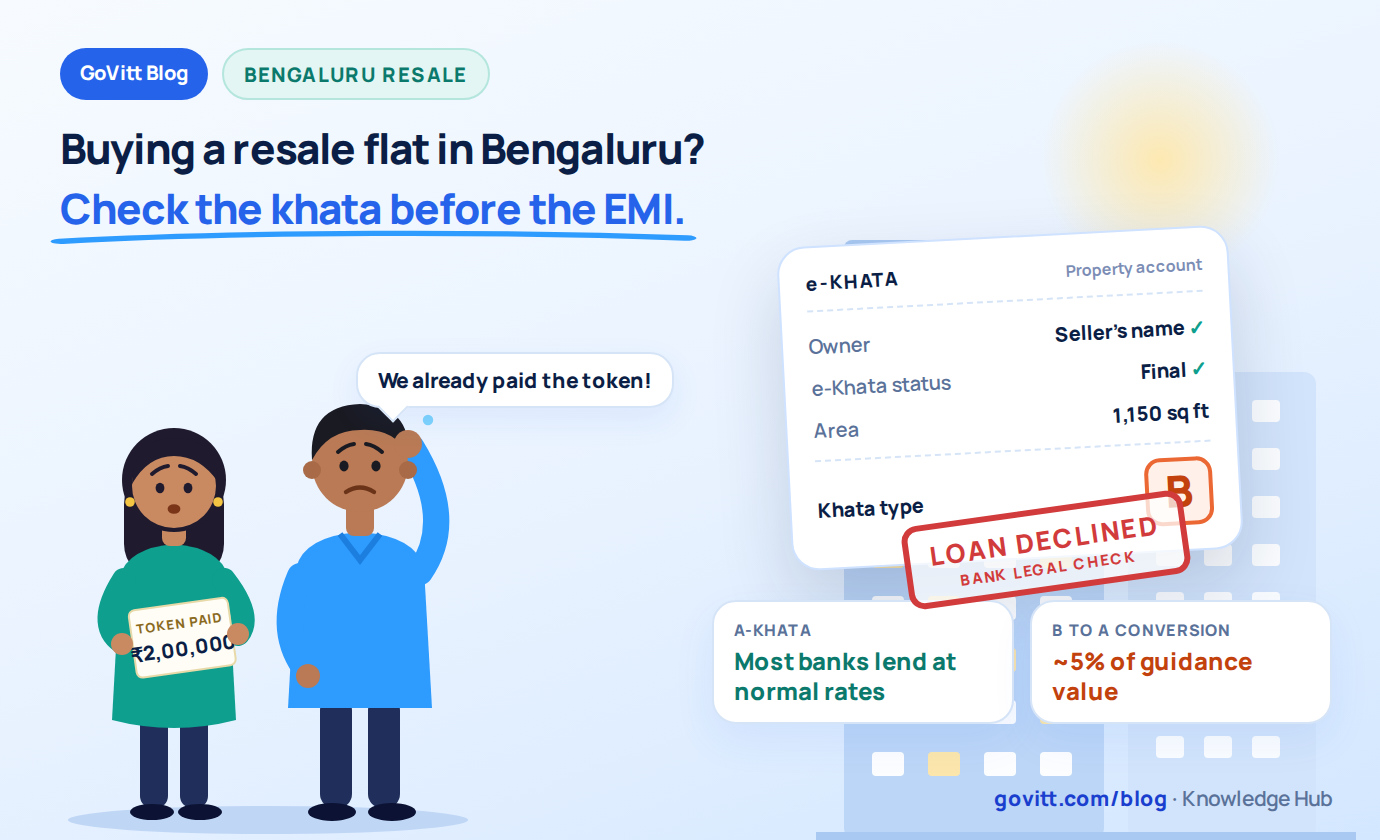
A couple came to us last year with a resale 2BHK they'd found off Sarjapur Road. Good society, good school nearby, priced about ₹10 lakh below similar flats in the area. They'd already paid ₹2 lakh as token.
Their loan was sanctioned in principle within a week. Then the bank's lawyer looked at the papers and wrote one line in his report. B-khata.
The loan was rejected. The seller wasn't in a hurry to return the token. And that ₹10 lakh discount suddenly made a lot more sense.
See your real payoff date in 60 seconds
Banks calculate remaining EMIs by simple subtraction. See your actual payoff date and discover how much interest a balance transfer can save.
I see some version of this every few months. So if you're looking at a resale flat this festive season, here's what to check, and why the bank cares so much about one word on one piece of paper.
A, B and e, without the jargon
A khata is your property's account with the city. It records who owns the property for tax purposes, its size, and what it's used for. It isn't proof of ownership by itself, but you can't do much without it.
An A-khata means the property is fully legal in the city's eyes. It was built on approved land, with an approved plan, and the dues have been paid. Banks are happy with it.
A B-khata is a separate register the city started for properties that aren't fully regular. Maybe the layout wasn't approved, the building deviates from its plan, or betterment charges were never paid. The city still collects tax on these, but that's about all the B-khata does for you.
The e-khata is the digital version of either. This is where people get confused. Getting an e-khata doesn't make a B-khata property into an A-khata one. It just puts the same record online. You check it on the government's e-Aasthi portal.
Why the bank cares
Before a bank lends you a rupee, its lawyer checks whether the property has a clean title and whether the bank could sell it if you stopped paying. A B-khata property fails the second part. If it's irregular, it's harder to sell, and some buyers can't get loans on it either. So the bank sees it as weak security.
Most banks, and almost all public sector banks, simply won't lend on a B-khata property. A few housing finance companies and NBFCs will, usually at a higher rate, a smaller loan compared with the flat's value, and stricter terms.
The e-khata matters for a different reason. In Bengaluru, a property sale can't be registered without one, and that's been the case since late 2024. So if the seller doesn't have a final e-khata in their name, the deal can't even be registered, never mind financed.
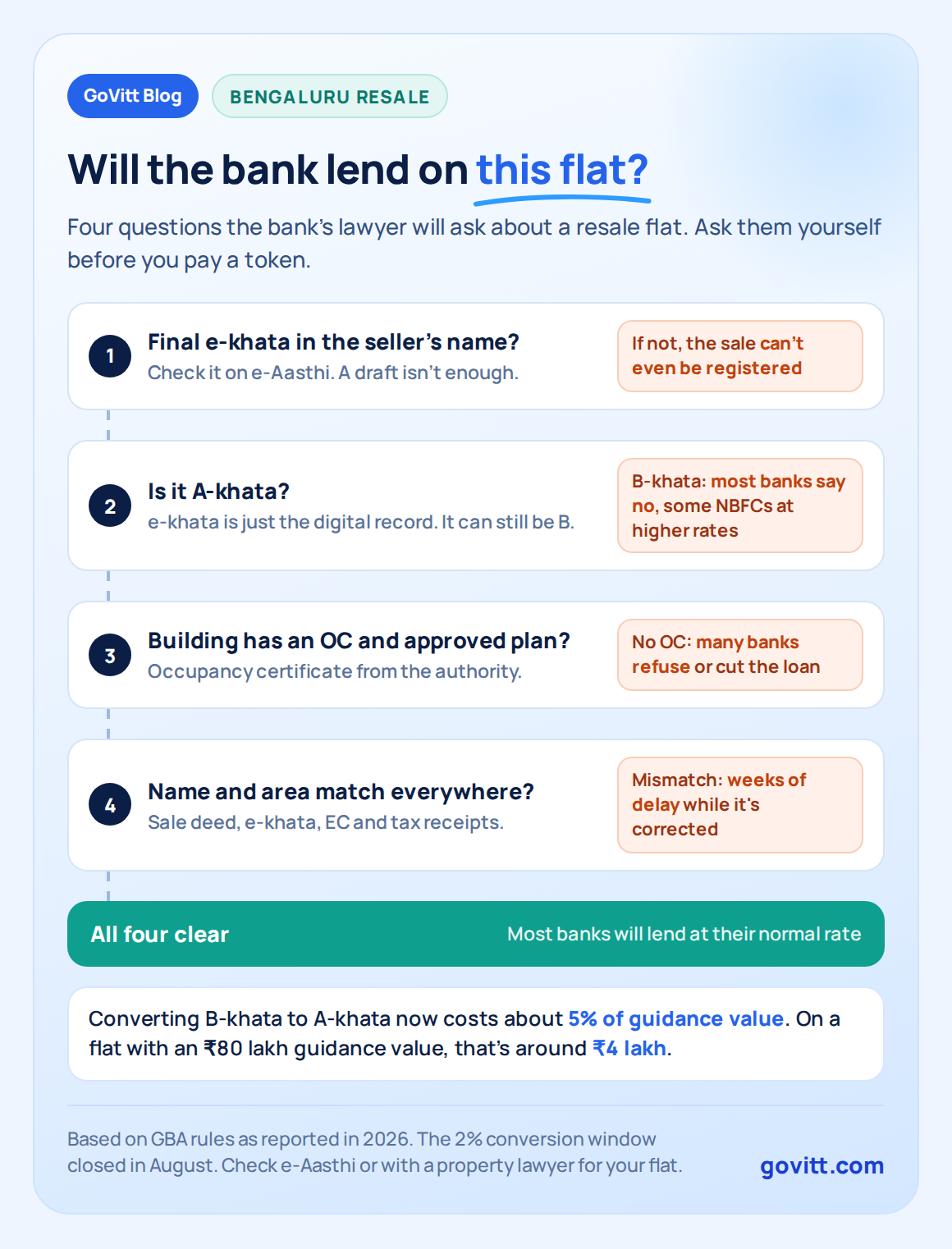
Ask these four questions yourself before you pay a token. The bank will ask them anyway.
What converting B to A costs now
You can convert a B-khata property to A-khata, as long as it meets the conditions. As reported, the B-khata needs to have been on record by September 30, 2024, the property needs a valid e-khata, and property tax needs to be paid up. Properties on land marked for roads or parks are out, and conversion doesn't fix serious building violations.
The fee is a percentage of the property's guidance value. This summer the city ran a 100-day window where it was cut to 2%. That window closed in late August, and the fee is back at 5%.
On a flat with a guidance value of ₹80 lakh, that's about ₹4 lakh now, against ₹1.6 lakh if it had been done during the window.
If you love a B-khata flat and the price is right, this is a negotiation point. Either the seller gets it converted before the sale, or the price comes down by at least the conversion cost plus a cushion for the time it takes. Don't pay a token on the promise that the khata "will be done after registration."
Buying a new flat from a builder is different
For an under-construction flat, there's no khata yet. Each flat gets its khata after the building is complete and has an occupancy certificate.
So for new projects, the bank looks at other things. Whether the building plan is approved, whether the project is registered with Karnataka RERA, and whether the bank has already approved the project for lending. Ask the builder which banks have approved the project. If the list is short or the big banks are missing from it, ask why.
The one to watch is a completed building that never got its OC. Flats in those buildings struggle to get an A-khata later, and you're back to the problem above. I've written about the other checks before booking with a builder in this post.
Four checks before you pay a token
Ask the seller for the e-khata number and look it up on e-Aasthi yourself. It should be a final e-khata, not a draft, and it should be in the seller's name. Draft e-khatas are generated automatically and often have mistakes.
Ask directly whether it's A-khata or B-khata. If the seller hesitates, you have your answer.
Ask for the building's occupancy certificate and approved plan. For an apartment, the association or builder should have both.
Check that the owner's name and the property's area match on the sale deed, the e-khata, the encumbrance certificate and the tax receipts. A mismatch isn't always a deal breaker, but correcting it can take weeks.
And one more thing that would have saved the couple I mentioned. Write into the token receipt that the token is fully refundable if the bank declines the loan on legal or technical grounds. A genuine seller with clean papers won't mind. The ones who object usually know something you don't.
Better still, get your loan pre-approved and ask the lender to run its legal check on the property before you pay anything. Most lenders will do it once you're a serious applicant.
If you already own a B-khata flat
Some people bought B-khata properties years ago with a loan from an NBFC at a high rate, because that was the only option.
Once the property is converted to A-khata, the main banks will consider it, and you can move the loan. Say you have ₹40 lakh left with 18 years to go at 10%. Moving it to a bank at 7.75% cuts your EMI by about ₹5,600 a month, or roughly ₹12 lakh over the rest of the loan. That pays for a ₹4 lakh conversion fee in about six years from the EMI saving alone, before you count what A-khata does to the property's resale value.
Transfer costs and the right rate for you will change these numbers, so run your own. The full transfer process is here.
Send us the papers first
If you're about to buy a resale flat in Bengaluru, WhatsApp us the property details and whatever papers you have to +91 70194 17854 before you pay a token. We'll tell you which of our 50+ partner banks and housing finance companies are likely to lend on it, and at what rate. You can also check how much you can borrow on our EMI calculator, or see what lenders are offering right now. GoVitt doesn't charge you any commission.
Khata rules are set by the Greater Bengaluru Authority and change from time to time. Fee and eligibility details are as reported in 2026 and may have changed. This is general information, not legal advice. Always get a property lawyer's opinion before you buy. EMI figures assume monthly reducing balance.
Questions people usually ask
Can I get a home loan on a B-khata property in Bengaluru? It's difficult. Most banks, especially public sector banks, don't lend on B-khata properties. Some housing finance companies and NBFCs do, usually at a higher interest rate, for a smaller share of the property's value, and on stricter terms.
What is the difference between A-khata, B-khata and e-khata? A-khata is for properties that fully comply with city rules. B-khata is a separate register for irregular properties, used mainly for tax collection. e-khata is the digital version of the khata record and can be either A or B. Getting an e-khata doesn't convert a B-khata property into A-khata.
Is e-khata mandatory for buying a flat in Bengaluru? Yes. A valid e-khata has been required to register a property sale within Bengaluru city limits since late 2024. Check that the seller has a final e-khata in their name on the e-Aasthi portal before you pay a token.
How much does it cost to convert B-khata to A-khata? As reported, the fee is 5% of the property's guidance value, after a 100-day window in 2026 when it was cut to 2%. On a flat with an ₹80 lakh guidance value, that's about ₹4 lakh. Check the current fee with the Greater Bengaluru Authority before you rely on it.
Do I need a khata for an under-construction flat? No. Individual flats get their khata after the building is complete and has an occupancy certificate. For under-construction flats, banks check the approved plan, RERA registration and whether they've approved the project for lending.
What should I check before paying a token for a resale flat? Confirm a final e-khata in the seller's name, whether it's A or B khata, the building's occupancy certificate and approved plan, and that names and areas match across the sale deed, e-khata, encumbrance certificate and tax receipts. Make the token refundable if the bank declines the loan on legal grounds.
Ready to take the next step?
Find out your loan options and check your eligibility with GoVitt today.