
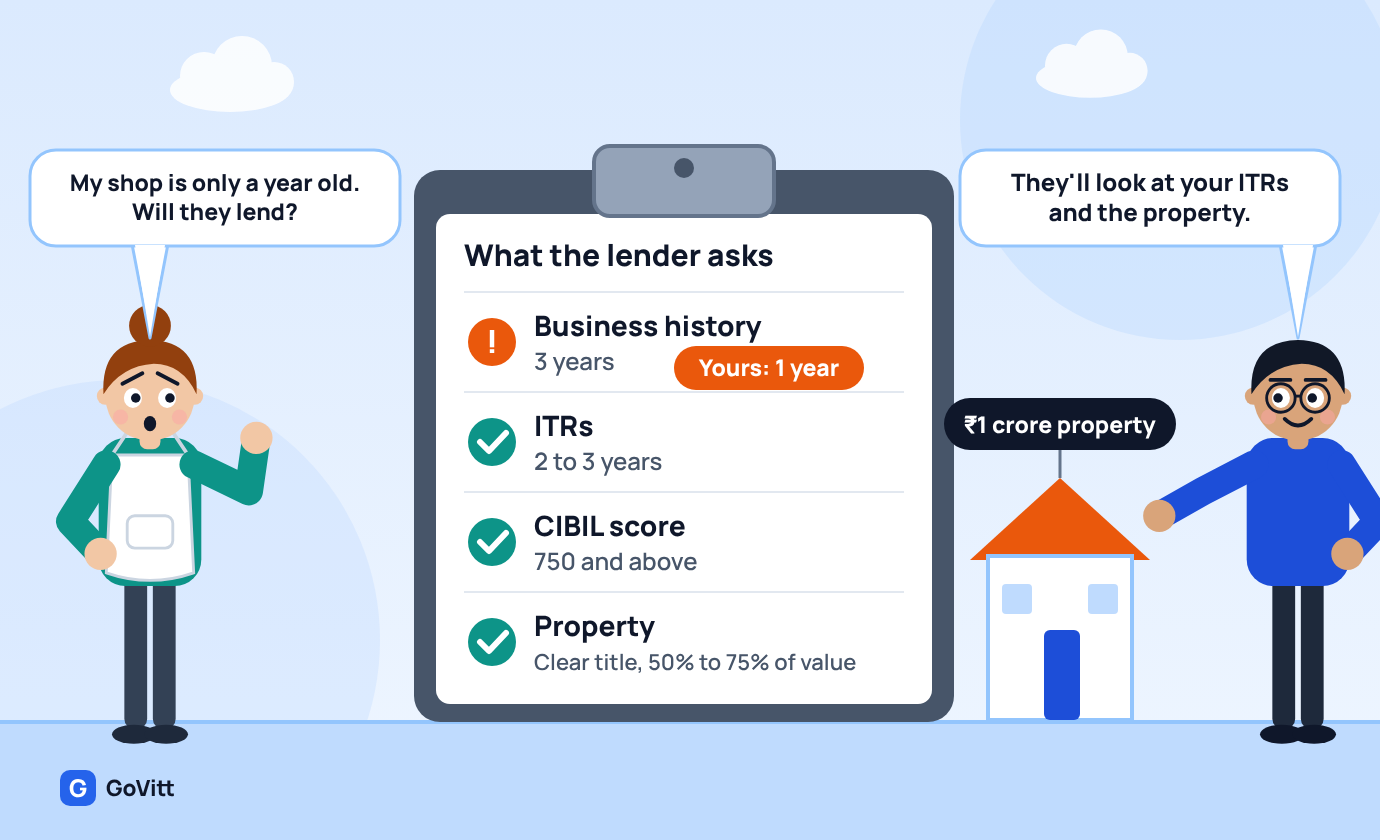
Loan against property for business means you mortgage a property you own and put the money into your business. Where a lender's page states a minimum business history, it says three years: Kotak Mahindra Bank, Standard Chartered, Poonawalla Fincorp and Bajaj Housing Finance all do. Tata Capital's guide says "typically" three years.
None of them publishes separate terms for a loan against property for a new business. So if yours is a year old, expect to be judged on your own ITRs, your CIBIL score and the property, and expect the answer to differ by lender. On a ₹1 crore property, a 60% limit allows ₹60 lakh, but at ₹1 lakh a month of income your EMI room supports a loan of about ₹47.19 lakh.
Below: what lenders say, the loan your property allows against the loan your income allows, what it costs, what RBI's prepayment rule says about business loans, and what to price if the business is too young.
See your real payoff date in 60 seconds
Banks calculate remaining EMIs by simple subtraction. See your actual payoff date and discover how much interest a balance transfer can save.
First, the honest part
I couldn't find a lender page that sets out what happens to a business under three years old. Poonawalla Fincorp says its criteria "are only a guide and may vary based on the borrower's unique situation", which is a door left open and not a rule. Whether a lender makes an exception, and on what, is a question for the lender.
Pages also disagree with each other. Standard Chartered's is undated and carries a 2022 copyright. Kotak's rate page says 9.75% in its table and 9.50% in its FAQ. HDFC Bank's own pages give two different limits on the share of property value. I read all of them on 1 November 2026 and name the conflicts below.
What lenders say about business loans against property
| Lender | Business history asked | Loan as a share of property value | Tenure | Rate and fee as listed |
|---|---|---|---|---|
| Kotak Mahindra Bank | At least three years | Not stated on the pages I read | Not stated; the rate is fixed for the first 39, 52 or 65 months, then floats with repo | From 9.75% (its FAQ says 9.50%); fee up to 1%; loans of ₹10 lakh to ₹5 crore |
| Standard Chartered | At least 3 years in business, profitable, turnover of ₹100 lakh for an entity | Up to 75% on residential, 60% on commercial | Up to 20 years | On a pricing grid I couldn't see; page undated |
| HDFC Bank | Not stated on the pages I read | One page: generally not above 50% for a new customer, 60% in total for an existing one. Another: up to 65% | Up to 15 years | 8.95% to 10.25% by property type; fee up to 1.50% or ₹4,500, whichever is higher |
Poonawalla Fincorp and Bajaj Housing Finance also ask for at least three years. Tata Capital's guide says most lenders finance up to 70% of the property's value, with a ₹50 lakh property and a ₹35 lakh loan as its example.
In loan against property in 2026: rates, how much you can borrow, and the fine print I quoted HDFC Bank at 8.55% to 13.00% (24 October). The page I read on 1 November lists 8.95% to 10.25%. Either the page changed or HDFC's pages disagree. Don't plan on a rate until you have it in writing.
If your business is under three years old
A three year rule means a business that's one or two years old falls short on paper. What I couldn't find is what lenders do about it. Three questions are worth asking in the first call, and none is a promise:
- Will you assess the loan on my personal income? If you have two or three years of ITRs from other income, such as a salary, rent or an earlier business, ask whether the loan can rest on that, with the new business as the end use.
- Can a co-applicant carry the income? A spouse or parent whose business is three years or older may satisfy the rule. They become liable for the loan.
- Do you have a product with a shorter history? My earlier post on whether self-employed people can get home loans easily says newer businesses face closer scrutiny and that NBFCs are often more flexible. Ask, and ask for it in writing.
Ask before you pay anything. Kotak's page says its processing fee, up to 1%, is non-refundable.
What lenders ask for
The lists differ by lender. These are the items that recur on the pages I read:
- Identity and address: PAN, Aadhaar or another KYC document.
- The business: documents for the business you declare (Bajaj Housing Finance's wording).
- Income: ITRs and audited balance sheets and profit and loss statements, usually for the last two to three years (Tata Capital). Kotak asks for profits in the past two years and an income above ₹1.8 lakh a year.
- Bank statements: the last six months (Tata Capital).
- The property: original title deed, sale deed and up to date property tax receipts, with a clear and marketable title.
Kotak adds that a CIBIL score of 750 and above can get cheaper loans with longer durations. Where a score of 750 sits against the rest of the home loan world is in minimum CIBIL score for a home loan in 2026, and what 750 vs 800 gets you.
How much you can borrow: the lower of two numbers
The property sets one ceiling, as a share of its value. Your income sets the other, because the EMI has to fit. I use 50% of monthly income as the cap on all your EMIs together, the figure from my other posts. The rate is 9.75%, Kotak's starting rate and close to the middle of HDFC Bank's listed range, over 15 years.
| Loan | EMI | Monthly income needed | Property value needed at 60% |
|---|---|---|---|
| ₹20 lakh | ₹21,187 | ₹42,400 | ₹33.3 lakh |
| ₹30 lakh | ₹31,781 | ₹63,600 | ₹50 lakh |
| ₹40 lakh | ₹42,375 | ₹84,800 | ₹66.7 lakh |
| ₹50 lakh | ₹52,968 | ₹1,06,000 | ₹83.3 lakh |
| ₹60 lakh | ₹63,562 | ₹1,27,200 | ₹1 crore |
Now a ₹1 crore property and ₹1 lakh a month of income from your ITRs. At 60% the property allows ₹60 lakh. Your income allows an EMI of ₹50,000, which at 9.75% over 15 years is a loan of ₹47.19 lakh. Income decides. If you already pay ₹20,000 a month in other EMIs, the room drops to ₹30,000 and the loan to ₹28.31 lakh.
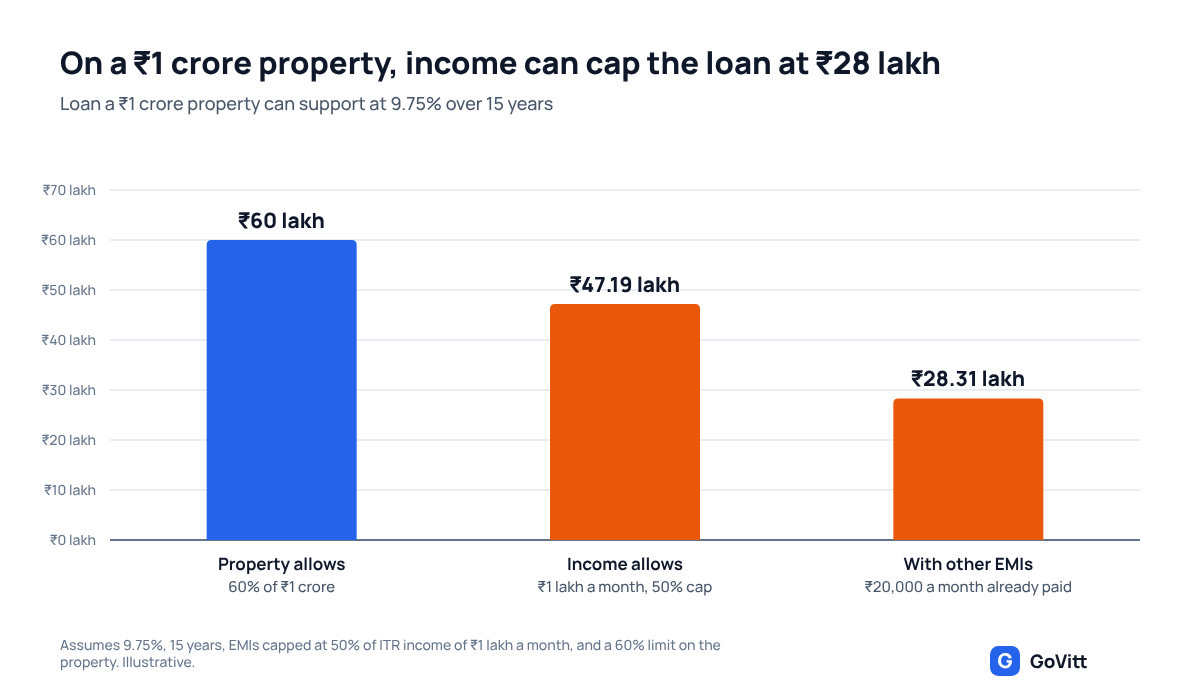
For a young business, the income line is the one to work on. A lender reads what your return shows, not what the business will earn next year.
What it costs
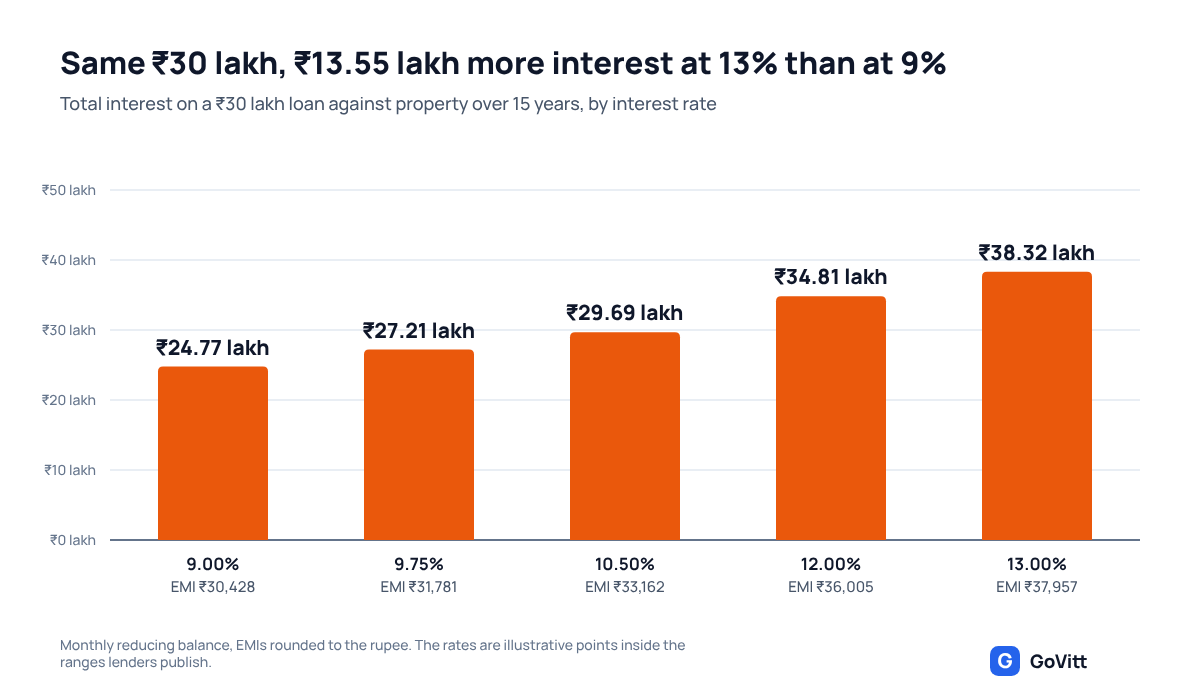
The rate is the big number. Published starting points run from 8.95% (HDFC Bank) to 9.75% (Kotak), and the range in my 24 October post went up to 13%. On ₹30 lakh over 15 years, the rate you land on is worth a lot: at 9.00% the EMI is ₹30,428 and the interest ₹24.77 lakh, and at 13.00% it is ₹37,957 and ₹38.32 lakh. That is ₹13.55 lakh more for the same loan.
The fee comes on top. Kotak lists up to 1% and HDFC Bank up to 1.50% or ₹4,500, whichever is higher, plus taxes. On ₹30 lakh that is up to ₹35,400 and ₹53,100 with GST. Add mortgage stamp duty and registration, about 0.6% in Karnataka on the figures in my top-up post, which is ₹18,000 on ₹30 lakh, plus valuation and legal charges.
Prepayment: what RBI's rule says for business loans
Older advice says a business loan carries a prepayment charge. RBI's Pre-payment Charges Directions, 2025, changed that for floating rate loans sanctioned for business purposes to individuals and micro and small enterprises (MSEs), on loans sanctioned or renewed on or after 1 January 2026.
Lender type
Charge on a floating rate business loan to an individual or MSE
Commercial banks (not small finance, regional rural or local area banks), Tier 4 urban co-operative banks, NBFC-UL, All India Financial Institutions
None, whatever the amount
Small finance banks, regional rural banks, Tier 3 urban co-operative banks, state and central co-operative banks, NBFC-ML
None on loans sanctioned up to ₹50 lakh; above that, the lender's own approved policy
Fixed rate loans
Not covered by the no-charge rule; the lender's own policy applies
The rule applies whatever the source of funds and with no lock-in period. It is written for individuals and MSEs. If you borrow through a company or a firm that isn't an MSE, ask your lender which rule applies.
Lender pages haven't all caught up. HDFC Bank's loan against property page still lists a 2% charge on business purpose loans, and it is undated and cites a 2023 benchmark. Standard Chartered's page lists 4% on part prepayment but says it doesn't apply to MSE and individual borrowers on floating rate loans. On a ₹10 lakh part payment, 2% is ₹20,000, and ₹23,600 with GST. Read the prepayment clause in your sanction letter. If it shows a charge on a floating rate loan sanctioned after 1 January 2026, ask which clause allows it. For the non-business version of the rule, see your bank can't charge you for prepaying a floating rate home loan.
The risks, said plainly
- Your property is at stake. If you stop paying, the lender can recover its dues by selling it under the SARFAESI Act.
- The EMI starts in month one, and a young business may not be earning yet. Keep six months of EMIs in cash before you sign.
- The rate floats. Repo is 5.50% after RBI's 7 October hike, and the next decision is on 4 December. Kotak's loan is fixed for the first 39, 52 or 65 months and floats after that.
- Tax depends on use. Interest on money used in the business is generally a business expense. Ask your CA, because this is a summary and not tax advice.
If the business is too young: what else to price
| Option | What it needs | The catch |
|---|---|---|
| Top-up on your home loan | An existing home loan with a clean record | Ask whether the lender accepts business use. On ₹10 lakh over 5 years it cost ₹2.41 lakh in my comparison |
| Personal loan | Income and score | Starts at 9.99% at ICICI Bank and HDFC Bank. The same ₹10 lakh over 5 years cost ₹3.52 lakh |
| A co-applicant with three years of history | A family member whose business meets the rule | They become liable for the loan |
| Wait a year | Another year of ITRs | You lose the year, but you meet the rule |
The three way cost comparison is in top-up vs loan against property vs personal loan: what each one really costs.
What I'd do this week
- Count your months in business and your filed ITRs. Use the date on your registration. That is the number the three year rule is checked against.
- Read the income your last two or three returns show. Not turnover, and not what you expect.
- Check your CIBIL score. Below 750, work on it first.
- Work out the loan from both sides. Take 50% to 65% of the property's value, then the EMI your income can carry, and use the lower number.
- Ask two lenders the same three questions in writing: the business history they need, the rate and its spread, and the prepayment clause for a business purpose loan.
- Price the top-up and the co-applicant route before you pay any fee.
FAQ
Loan against property for business: what do banks ask for? Where a lender states a minimum business history, it is three years. They also ask for two to three years of ITRs, financial statements, six months of bank statements, and a property with a clear title. Kotak asks for profits in the past two years, and a score of 750 and above can get cheaper terms.
Can I get a loan against property for a new business? No lender I checked publishes terms for a business under three years old. Ask whether the loan can be assessed on your personal income and ITRs, whether a co-applicant with a three year history can carry it, and whether any product has a shorter history. Don't pay a fee before you have the answer.
How much loan against property can I get on a ₹1 crore property? The property allows 50% to 75% depending on the lender, which is ₹50 lakh to ₹75 lakh. Your income decides the rest. At ₹1 lakh a month of income, 9.75% and 15 years, the EMI room supports ₹47.19 lakh.
Is there a prepayment charge on a loan against property taken for business? Not on a floating rate loan to an individual or MSE from a commercial bank, for loans sanctioned or renewed on or after 1 January 2026. Small finance banks, NBFC-ML and some others can't charge on loans up to ₹50 lakh. Some lender pages still show 2%. Check your sanction letter.
What interest rate can I expect? Published starting points run from 8.95% (HDFC Bank) to 9.75% (Kotak), with ranges up to 13%. On ₹30 lakh over 15 years, 9.00% costs ₹24.77 lakh in interest and 13.00% costs ₹38.32 lakh.
What is the maximum tenure? HDFC Bank lists up to 15 years and Standard Chartered up to 20. Longer tenure lowers the EMI and raises the interest.
Not sure which lender fits a young business? Talk to an advisor on WhatsApp with your property value, months in business and the income your last return shows. GoVitt compares 50+ banks and charges you 0% commission.
Lender pages read on 1 November 2026; undated pages are marked where used. EMIs use the standard monthly reducing balance method and are rounded to the nearest rupee. The 9.75% rate and the 50% income cap are assumptions, not quotes. Monthly income needed is rounded up to the nearest ₹100. Fees include 18% GST where shown, and mortgage stamp duty and registration use the 0.6% from GoVitt's top-up post. Your lender's rules, rate and charges will differ. Tax points are a summary, not tax advice. Check your sanction letter and Key Fact Statement before you sign.
Ready to take the next step?
Find out your loan options and check your eligibility with GoVitt today.