
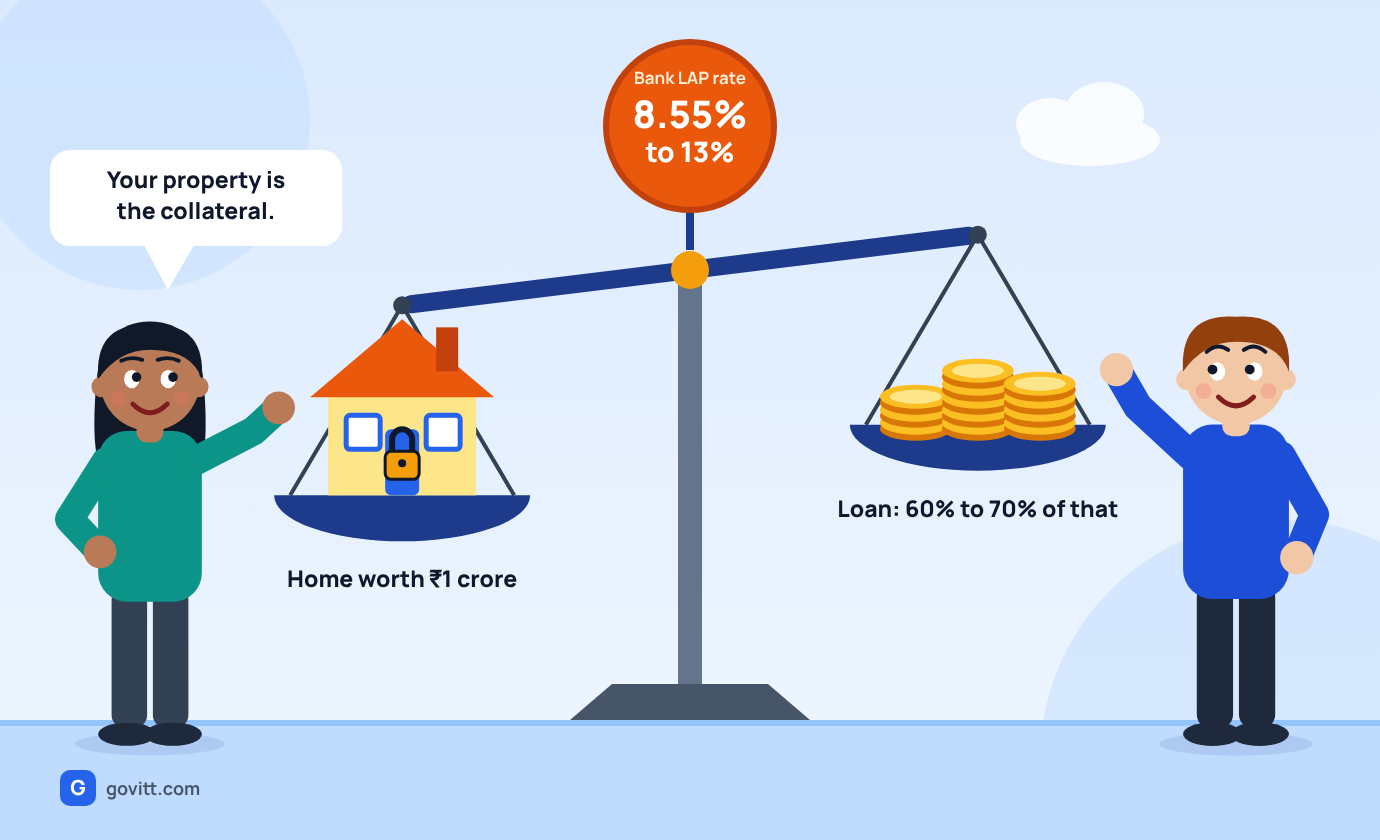
A loan against property (LAP) lets you borrow against a home, shop or office you already own, without selling it. At banks, loan against property interest rates run from about 8.55% to 13%, depending on the lender, your credit score, your income proof and the type of property. You typically get 60% to 70% of the property's market value, for up to 15 years.
It is cheaper than a personal loan and gives you much more money. But you are putting your property on the line, and the rate is floating, so it can rise when RBI raises the repo rate. RBI did that on 7 October, to 5.50%.
Below: the rates, how much you can really borrow, what it costs on ₹30 lakh, every fee, and when a home loan top-up is the cheaper option.
See your real payoff date in 60 seconds
Banks calculate remaining EMIs by simple subtraction. See your actual payoff date and discover how much interest a balance transfer can save.
Loan against property at a glance (checked 24 October 2026)
| Item | What to expect |
|---|---|
| Interest rate, banks | About 8.55% to 13% (floating) |
| Interest rate, NBFCs | Usually higher than banks |
| Loan amount | 60% to 70% of the property's market value (the "loan to value" or LTV) |
| Tenure | Typically up to 15 years |
| Rate type | Mostly floating, linked to the repo rate or the bank's own benchmark |
| Prepayment charge | Nil on floating rate loans to individuals for non-business use. Business use can attract a charge. |
| Processing fee | Usually 0.5% to 1% of the loan, plus GST. Check each lender. |
| What you pledge | Your property, with the title deed mortgaged to the lender |
What a loan against property is, in plain words
You own a property. The lender values it, keeps a charge on it, and lends you a share of that value. You keep living in it or renting it out. When you finish repaying, the charge is removed.
Two things make it different from a home loan:
- There is no purchase. You can use the money for a business, a child's education, a medical bill, a wedding, or to consolidate debts. Lenders may ask what the money is for and some restrict speculative use, such as investing in the stock market.
- The rate is higher. A home loan is the safest loan a bank gives. A LAP is a little riskier for the lender, so it costs more. At the lowest home loan rates today (SBI from 7.50%, Canara from 7.55%), a LAP is typically 1% or more above.
How much loan against property can you get?
Two limits decide it, and the lower one wins.
- The property limit. The lender takes the market value, then applies its LTV, usually 60% to 70% for a residential property. HDFC Bank, for example, lists LTV up to 65% on its LAP.
- The income limit. The lender checks that your total EMIs stay within a share of your income. This is called FOIR (fixed obligations to income ratio). 50% is a common working figure. Each lender sets its own.
Here is an example. Your flat is worth ₹1 crore. Your take-home income is ₹1.2 lakh a month. The rate is 9.5% over 15 years.
| Test | Working | Maximum loan |
|---|---|---|
| Property limit | 65% of ₹1 crore | ₹65 lakh |
| Income limit, no other EMIs | 50% of ₹1.2 lakh is ₹60,000 a month | About ₹57.5 lakh |
| Income limit, ₹15,000 of other EMIs | ₹45,000 a month left | About ₹43.1 lakh |
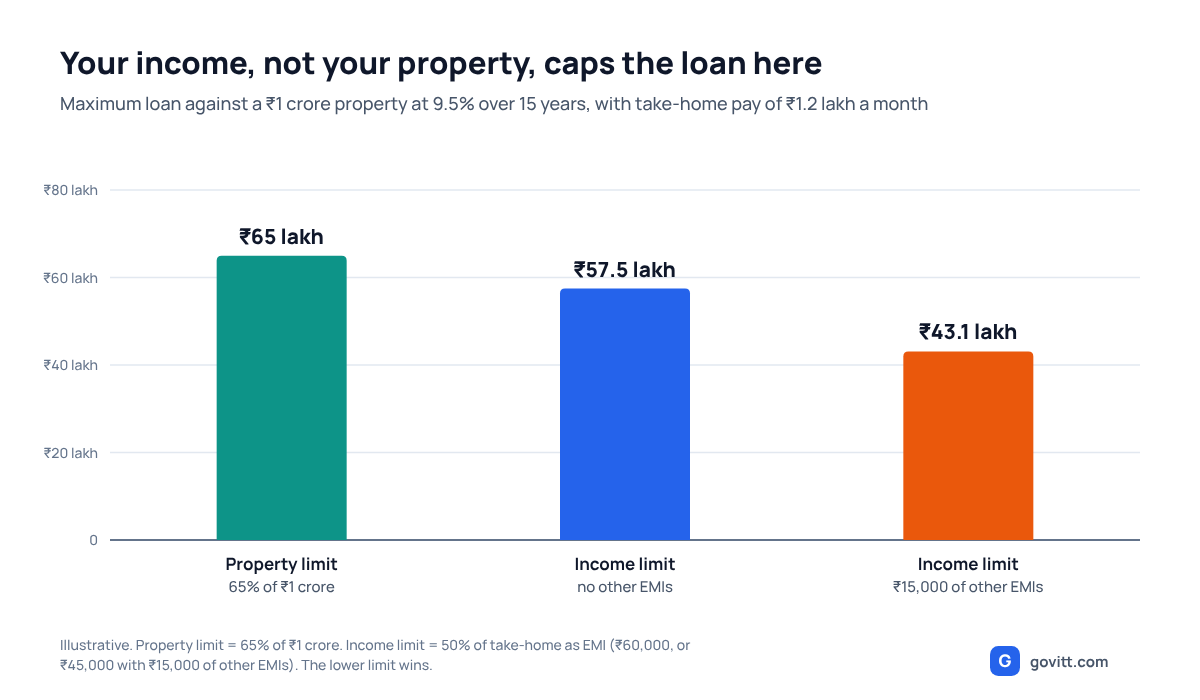
So the property says ₹65 lakh, but your income says ₹57.5 lakh, or ₹43.1 lakh if you already pay ₹15,000 a month in other EMIs. That is why two owners of the same flat can be offered very different amounts.
If you have a home loan on the same property, the lender subtracts what is outstanding. A top-up on that loan is often the simpler route. I cover it in home loan top-up: rates, eligibility and tax.
Loan against property interest rates by lender (October 2026)
| Lender | Published floating rate range | Notes |
|---|---|---|
| HDFC Bank | 8.55% to 13.00% | LTV up to 65%. Lowest rates for the strongest profiles. |
| SBI (property loan) | 9.20% to 10.75% | Narrower band. Check your slab. |
I did not list ICICI Bank because its LAP page still showed pre-hike figures when I checked. Lenders reprice after every repo change, so ask for today's rate in writing before you decide.
What moves your rate within a range:
- Credit score. 750 or above gets you the bottom of the range. Below 700, expect the top, or a refusal.
- Type of property. Self-occupied residential is cheapest. Rented residential costs more. Commercial and industrial property cost more again.
- Income proof. Salaried borrowers with clear payslips usually get better pricing than those who need "income assessed" from bank statements.
- Loan size and LTV. A lower LTV (you borrow less against the value) can get you a better rate.
- Use of funds. A business purpose can change the rate and the prepayment terms.
What a loan against property costs: ₹30 lakh
Rates are not the whole story. The tenure you pick matters just as much.
| Rate | Tenure | EMI | Total interest |
|---|---|---|---|
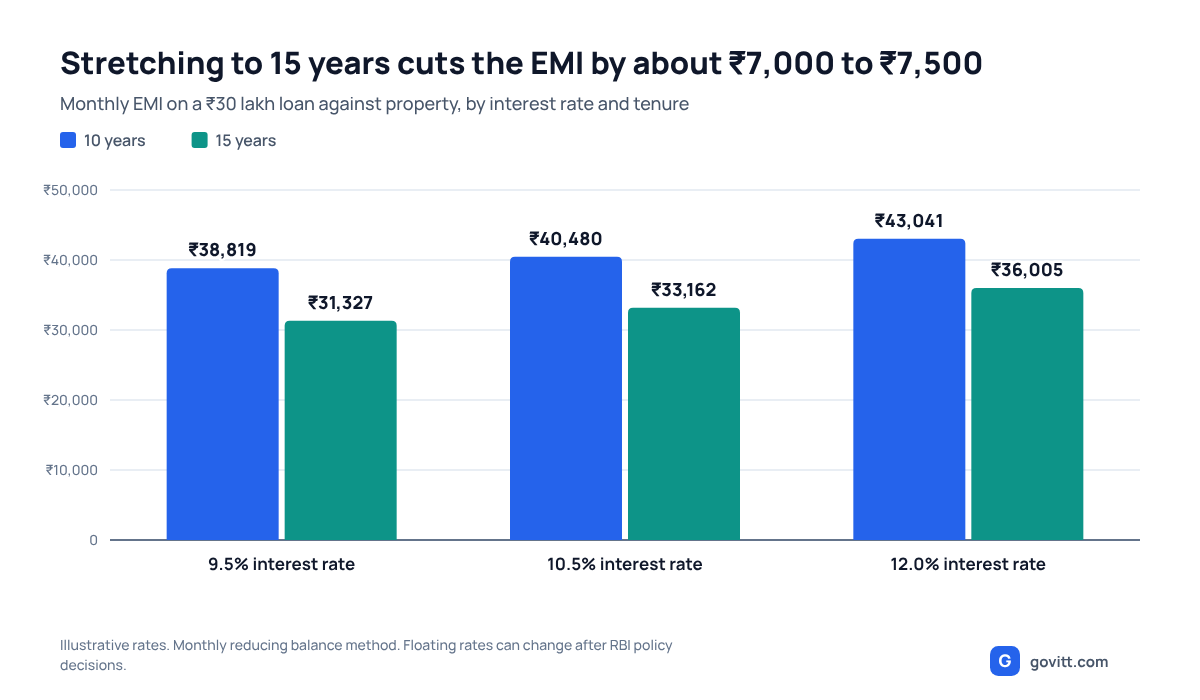
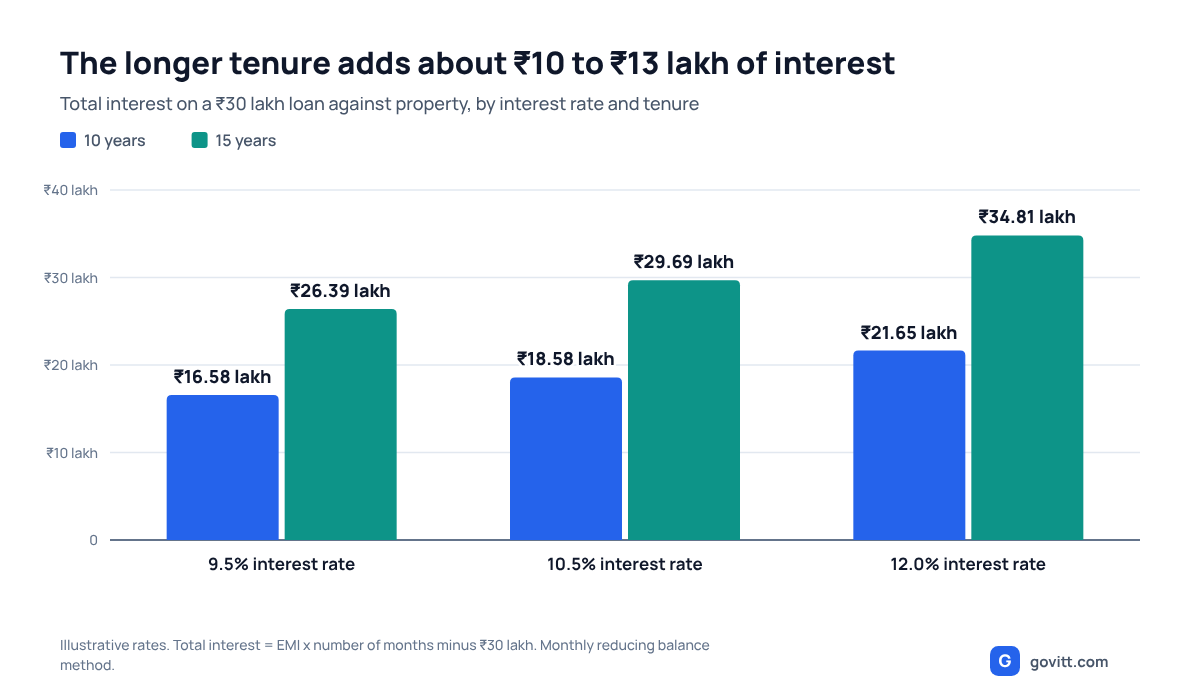
| 9.5% | 10 years | ₹38,819 | ₹16.58 lakh |
| 9.5% | 15 years | ₹31,327 | ₹26.39 lakh |
| 10.5% | 10 years | ₹40,480 | ₹18.58 lakh |
| 10.5% | 15 years | ₹33,162 | ₹29.69 lakh |
| 12% | 10 years | ₹43,041 | ₹21.65 lakh |
| 12% | 15 years | ₹36,005 | ₹34.81 lakh |
Two things stand out:
- Going from 10 to 15 years lowers the EMI by about ₹7,000 to ₹7,500 but adds ₹10 to ₹13 lakh of interest.Pick the shortest tenure your budget can carry.
- The jump from 9.5% to 12% on a 15 year loan is ₹4,678 a month. Your credit score is worth real money here.
You can try your own numbers on our home loan EMI calculator. The formula is the same for a LAP.
Loan against property fees and charges
| Fee | Typical amount | On ₹30 lakh |
|---|---|---|
| Processing fee | 0.5% to 1% of the loan, plus GST | ₹15,000 to ₹30,000, plus GST |
| Valuation and legal checks | Fixed charges, vary by lender and city | Ask for the number |
| Stamp duty and registration on the mortgage | Varies by state | In Karnataka, our top-up post used about ₹6,000 on ₹10 lakh (0.5% stamp duty and about 0.1% registration). Ask your lender what applies. |
| Prepayment or foreclosure, floating rate, personal use | Nil | ₹0 |
| Prepayment or foreclosure, floating rate, business use | May apply | Ask before you sign |
| Late payment | Lender specific | Ask for the number |
RBI's rule helps you here: lenders cannot charge a prepayment or foreclosure fee on floating rate loans to individuals for non-business purposes. If the loan is for your business, the lender may still charge one. Always ask which side of that line your loan sits on.
Fees vary. These are typical ranges, not quotes. Get every charge in writing, in rupees, before you sign.
Top-up, personal loan or loan against property?
If you already have a home loan, you have three ways to raise money. Here is ₹10 lakh through each:
| Option | Rate used | Tenure | EMI | Total interest |
|---|---|---|---|---|
| Home loan top-up | 8.50% | 10 years | ₹12,399 | ₹4.88 lakh |
| Loan against property | 10.00% | 10 years | ₹13,215 | ₹5.86 lakh |
| Loan against property | 10.00% | 15 years | ₹10,746 | ₹9.34 lakh |
| Personal loan | 13% | 5 years | ₹22,753 | ₹3.65 lakh |
The rates are illustrative. Check what each lender offers you.
How to read it:
- A top-up is usually the cheapest long-term option, if you already have a home loan with a clean repayment record.
- A LAP makes sense when you need a bigger amount, or when you don't have a home loan to top up.
- A personal loan has a high EMI but a short life. The total interest looks lower only because the loan is gone in five years. Compare EMIs and tenure, not just the rate.
- Stretching any secured loan to 15 years is the expensive part, not the loan type. At 15 years the LAP above costs ₹9.34 lakh in interest on ₹10 lakh borrowed.
Tax: can you claim the interest?
It depends on what you do with the money:
- Used to buy, build or renovate a house: home loan interest rules can apply. Our top-up post explains the limits under Section 22 of the Income-tax Act 2025, which replaced Section 24(b) from 1 April 2026.
- Used in your business: the interest is generally a business expense.
- Used for personal needs such as a wedding, travel or paying other debts: no deduction.
Keep the bank statements that show where the money went. Check with your CA for your case.
The risks, said plainly
- You can lose the property. If you stop paying, the lender can recover its dues by selling the mortgaged property under the SARFAESI Act.
- The rate floats. When the repo rate rises, so does your EMI or your tenure. RBI's next decision is on 4 December 2026.
- Borrowing against your only home for a speculative purpose is the riskiest use. If you need to use it, size the EMI so that you can still pay it if your income dips for six months.
- The big loan feels small. A ₹30 lakh LAP at 10.5% over 15 years returns ₹59.7 lakh to the lender (₹29.69 lakh of that is interest).
Who a loan against property suits, and who should look elsewhere
A LAP can make sense if you:
- Need ₹15 lakh or more, for a business, education or a medical cost
- Own a property with a clear title and a good market value
- Have a CIBIL score of 750 or more and steady, provable income
- Have no home loan to top up, or need more than a top-up allows
Look elsewhere first if you:
- Have a home loan with a clean record and need under ₹10 to ₹15 lakh. Ask for a top-up first
- Need a small amount for a short time. A personal loan may be simpler
- Want money for speculation, such as shares or crypto. That is risking your home for a gamble
- Have a property with a disputed title, or in an unapproved layout. Most lenders will say no
Compare before you sign
The spread between lenders on a LAP is wide, and the rate you are offered depends on your profile. Before you pledge your property, compare rates from 50+ banks and see what you qualify for. GoVitt charges you 0% commission.
FAQ
What is the interest rate on a loan against property? At banks, published floating rates run from about 8.55% to 13% as of 24 October 2026. HDFC Bank lists 8.55% to 13.00% and SBI lists 9.20% to 10.75%. NBFCs usually charge more. Your exact rate depends on your credit score, property type and income proof.
How much loan can I get against my property? Typically 60% to 70% of the property's market value, but your income can lower that. Lenders also check that your total EMIs stay within a share of your income, usually around 50%. The lower of the two limits applies.
Is a loan against property cheaper than a personal loan? Usually yes, on the rate. LAP rates are far below personal loan rates. But a LAP is secured by your property, runs longer, and risks your home if you default.
Is a home loan top-up better than a loan against property? Often, yes, if you already have a home loan with a good record. A top-up typically has a lower rate and simpler paperwork. A LAP suits larger amounts or borrowers with no home loan to top up.
Can I repay a loan against property early? For a floating rate loan to an individual for non-business use, RBI does not allow a prepayment or foreclosure charge. For business use, the lender may charge one. Check the sanction letter.
What documents do I need? Typically ID and address proof, income proof (payslips and Form 16 for salaried people, ITR and financial statements for self-employed), bank statements, and the property papers: title deed, tax receipts and approvals. Each lender has its own list.
Can I get a loan against a rented or commercial property? Yes, many lenders allow it, often at a higher rate and a lower LTV than for a self-occupied home.
Rates, LTV figures and rules as of 24 October 2026, from HDFC Bank and SBI's published loan against property details and RBI's directions on prepayment charges. Fee ranges are typical, not quotes. The repo rate is 5.50% after RBI's 7 October 2026 hike. EMIs use the standard monthly reducing balance method. We will update this page in November and after the 4 December 2026 MPC decision.
Ready to take the next step?
Find out your loan options and check your eligibility with GoVitt today.