
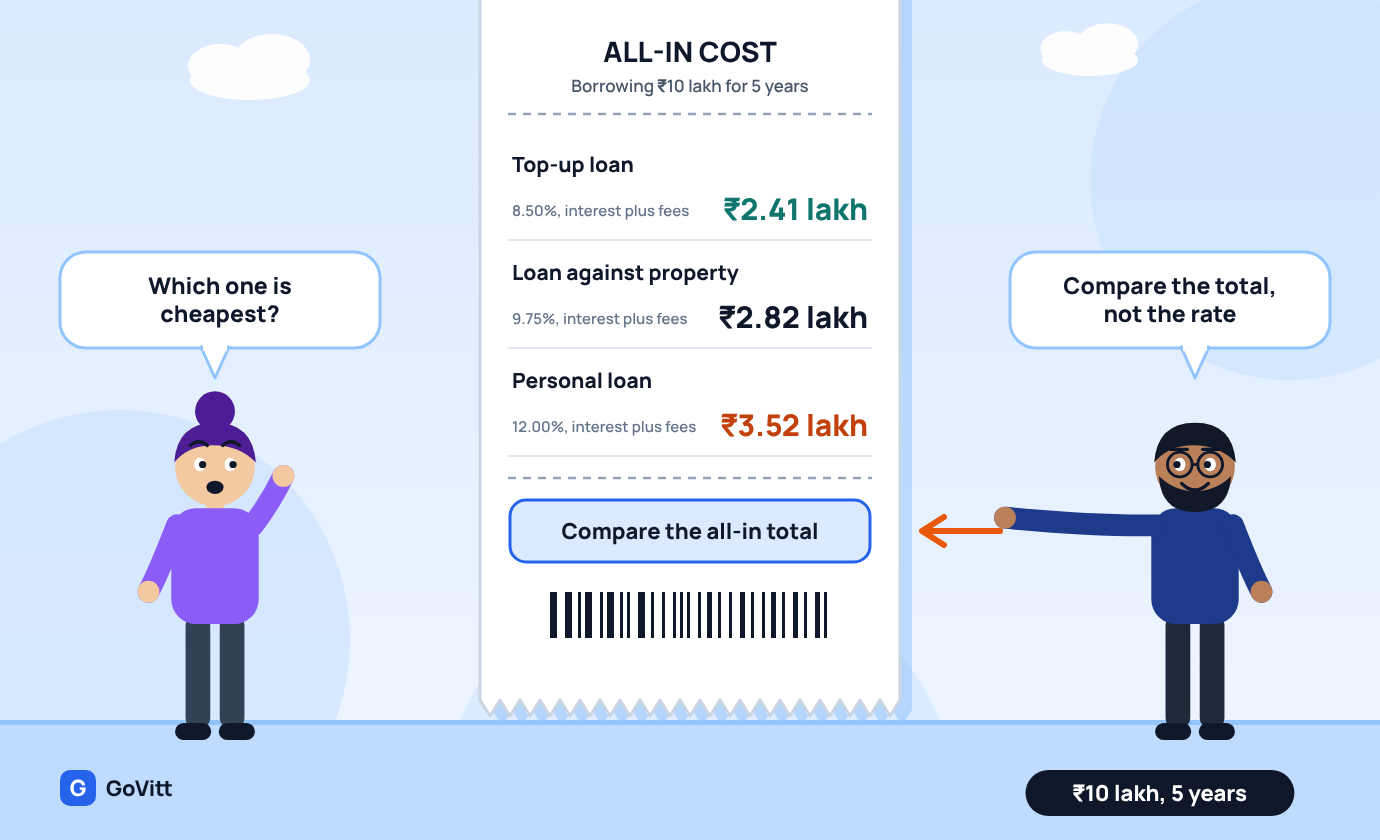
Top up loan vs loan against property vs personal loan, on ₹10 lakh over five years: the top-up costs ₹2.41 lakh, the loan against property ₹2.82 lakh and the personal loan ₹3.52 lakh. That is interest plus fees. Same amount, same five years. The cheapest is ₹1.11 lakh below the dearest.
The catch is tenure. Banks offer a top-up for 10 to 15 years, a loan against property for up to 15, and a personal loan for up to 7. Take the long tenure and the ranking flips. A top-up over 15 years costs ₹7.83 lakh in total, more than twice the personal loan. Compare the total you'll pay, not the rate.
Below: the table, the tenure trap, what else separates the three, and which one fits which need.
See your real payoff date in 60 seconds
Banks calculate remaining EMIs by simple subtraction. See your actual payoff date and discover how much interest a balance transfer can save.
First, the honest part
I can't know your rate. Lenders publish ranges, and the low end is for their best borrowers.
- Top-up: SBI lists 8.00% to 10.75% (checked 23 October). LIC Housing Finance starts at 7.65%.
- Loan against property: HDFC Bank lists 8.55% to 13.00% and SBI 9.20% to 10.75% (checked 24 October).
- Personal loan: ICICI Bank and HDFC Bank both start at 9.99%. SBI's Xpress Credit runs 11.15% to 14.30% as shown on ClearTax, an undated page that mentions June 2026.
I use the middle of each range: 8.50% for the top-up, 9.75% for the loan against property and 12.00% for the personal loan. If your quotes differ, rerun the three lines with them. Two more limits. The two secured loans float with the repo rate, which RBI raised to 5.50% on 7 October, and the next decision is on 4 December. And valuation and legal charges on the secured loans are not in my numbers, because they vary by lender and city. Ask for them.
The one table: ₹10 lakh over five years
| Top-up | Loan against property | Personal loan | |
|---|---|---|---|
| Rate used | 8.50% | 9.75% | 12.00% |
| EMI | ₹20,517 | ₹21,124 | ₹22,244 |
| Total interest | ₹2,31,020 | ₹2,67,440 | ₹3,34,640 |
| Fees and charges | ₹10,130 | ₹14,850 | ₹17,700 |
| All-in cost | ₹2,41,150 | ₹2,82,290 | ₹3,52,340 |
| Cost per ₹1 lakh borrowed | ₹24,115 | ₹28,229 | ₹35,234 |
What is in the fees line:
- Top-up: SBI's 0.35% fee is ₹3,500, and with GST ₹4,130. Add about ₹6,000 for stamp duty (0.5%) and registration (about 0.1%) in Karnataka, the figure from the top-up post.
- Loan against property: lenders charge 0.5% to 1%. I used 0.75%, which is ₹7,500 and ₹8,850 with GST, plus the same ₹6,000.
- Personal loan: SBI's 1.50% is ₹15,000, which is also its cap, and ₹17,700 with GST. ICICI Bank lists up to 2%, which would be ₹23,600.
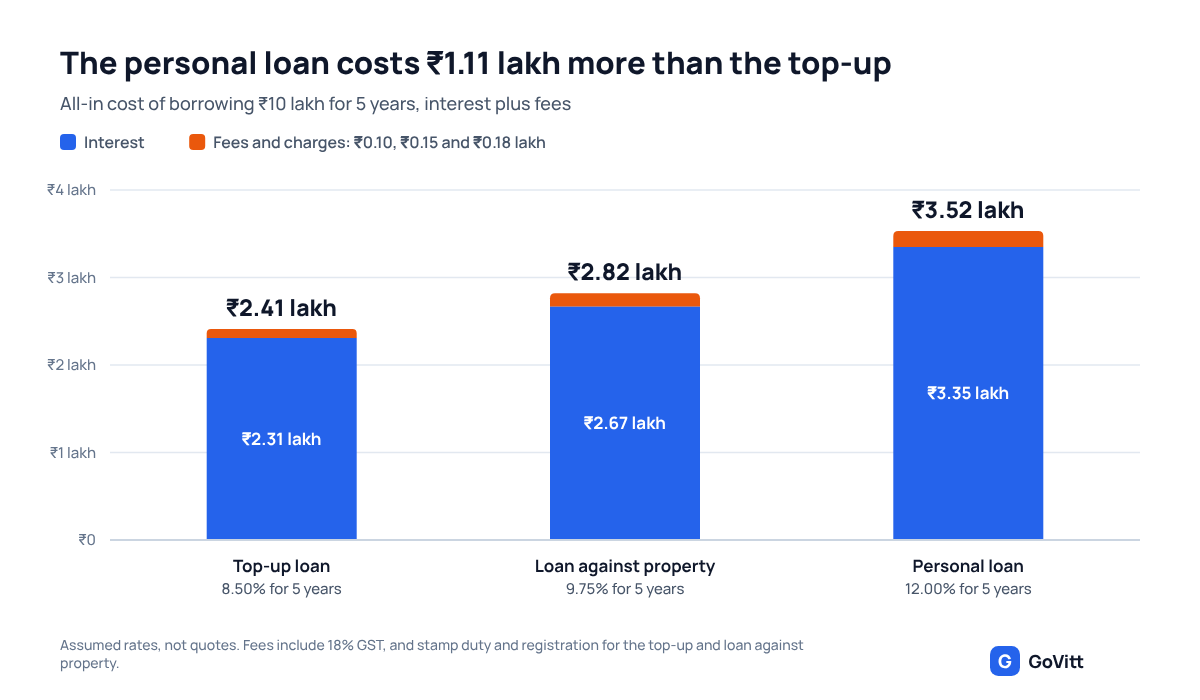
The personal loan costs ₹1.11 lakh more than the top-up and ₹70,050 more than the loan against property. The loan against property costs ₹41,140 more than the top-up.
Most of that is the rate. At 12.00% against 8.50%, the personal loan pays ₹1.04 lakh more interest over the same five years. The fee gap adds the rest. A top-up with a clean repayment record is the cheapest of the three, as I said in home loan top-up: interest rate, eligibility and the tax rule.
Tenure flips the ranking
Same ₹10 lakh. Here is what each costs at the tenures banks offer:
| Loan | Tenure | EMI | Total interest | All-in cost |
|---|---|---|---|---|
| Personal loan | 3 years | ₹33,214 | ₹1.96 lakh | ₹2.13 lakh |
| Personal loan | 5 years | ₹22,244 | ₹3.35 lakh | ₹3.52 lakh |
| Personal loan | 7 years | ₹17,653 | ₹4.83 lakh | ₹5.01 lakh |
| Top-up | 5 years | ₹20,517 | ₹2.31 lakh | ₹2.41 lakh |
| Top-up | 7 years | ₹15,836 | ₹3.30 lakh | ₹3.40 lakh |
| Top-up | 10 years | ₹12,399 | ₹4.88 lakh | ₹4.98 lakh |
| Top-up | 15 years | ₹9,847 | ₹7.72 lakh | ₹7.83 lakh |
| Loan against property | 5 years | ₹21,124 | ₹2.67 lakh | ₹2.82 lakh |
| Loan against property | 10 years | ₹13,077 | ₹5.69 lakh | ₹5.84 lakh |
| Loan against property | 15 years | ₹10,594 | ₹9.07 lakh | ₹9.22 lakh |
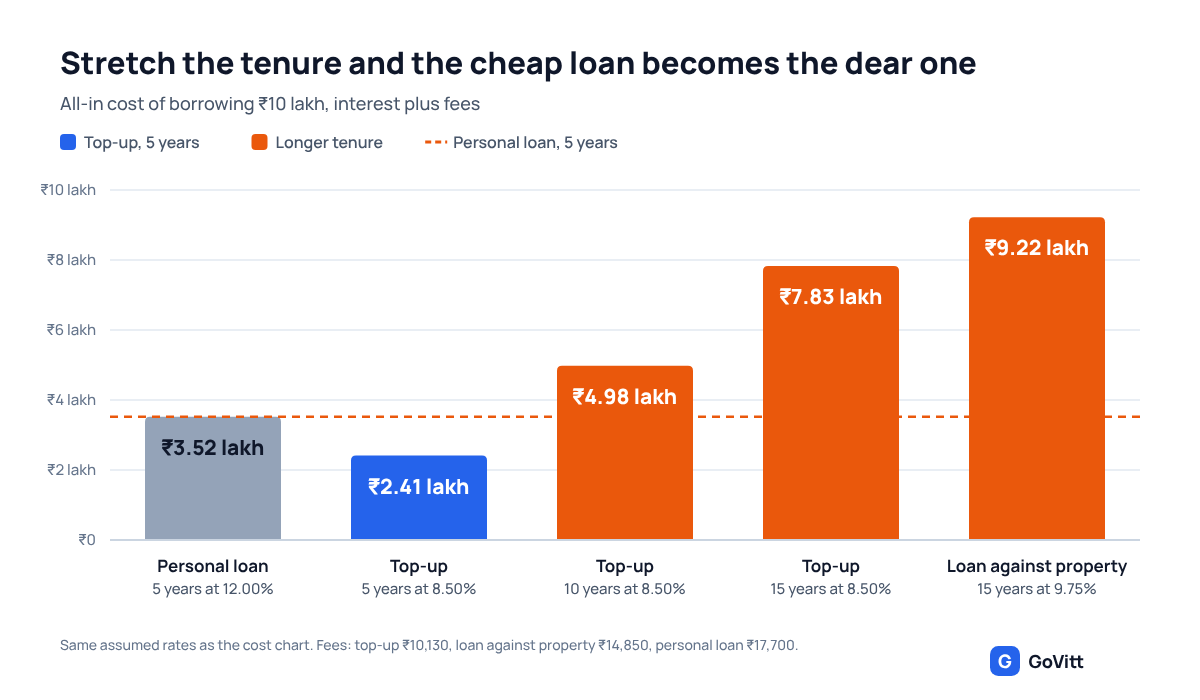
A top-up stays cheaper than the 5 year personal loan up to about 7 years. At 7 years it costs ₹3.40 lakh against ₹3.52 lakh. By 7 years and 3 months, the saving is gone.
Look at the 10 year top-up. The EMI is ₹12,399, which is ₹9,845 a month below the personal loan's. The total is ₹4.98 lakh, which is ₹1.46 lakh above it. That small EMI is how a cheap rate ends up costing more.
Two ways out:
- Ask for the tenure you need. If you can clear the money in 5 years, take 5 years.
- Or take the long loan and pay the short EMI. A 15 year top-up where you pay ₹20,517 a month costs the same as the 5 year one. For a floating rate loan to an individual for non-business use, RBI bars a prepayment charge on loans sanctioned or renewed from 1 January 2026. Check your sanction letter.
One more trap. Say you take 15 years and pay only the small EMI for the first 5. You will have paid ₹3.85 lakh in interest and still owe ₹7.94 lakh. Early EMIs are mostly interest. Planning to prepay later isn't free.
What else separates the three
| Top-up | Loan against property | Personal loan | |
|---|---|---|---|
| What backs it | Your house, through your home loan | Your property, with the title deed mortgaged | Nothing |
| Who can get it | Existing home loan borrowers with a clean record | Owners of a property with clear title | Borrowers whose income and score pass the lender's checks |
| How much | The lower of what the property value and your income allow | Typically 60% to 70% of the property's value, lowered by your income | Up to ₹1 crore at HDFC Bank, set by income |
| Tenure on offer | Up to 15 years at HDFC Bank with a transfer, up to 20 at ICICI Bank | Typically up to 15 years | 12 to 84 months at ICICI Bank |
| Prepaying | Nil on floating rate, for personal use | Nil on floating rate for personal use; business use may be charged | ICICI Bank: nil after 24 EMIs. SBI: 2% of the amount prepaid |
| Tax on the interest | Up to ₹30,000 a year on a renovation, old regime only | None for personal use; a business expense if used in a business | None |
| What you risk | Your home | Your property | Your credit score |
The loan against property post has the limits and an example of how income caps the amount: loan against property in 2026: rates, how much you can borrow, and the fine print.
How much the gap is worth
The bigger the amount, the more the rate difference costs. Interest only, over five years, with the same rates as above:
| Amount | Top-up | Loan against property | Personal loan | Personal loan minus top-up |
|---|---|---|---|---|
| ₹5 lakh | ₹1,15,480 | ₹1,33,720 | ₹1,67,320 | ₹51,840 |
| ₹10 lakh | ₹2,31,020 | ₹2,67,440 | ₹3,34,640 | ₹1,03,620 |
| ₹25 lakh | ₹5,77,460 | ₹6,68,660 | ₹8,36,660 | ₹2,59,200 |
On ₹5 lakh the gap is ₹51,840 over five years, before fees. That's real money, but it's the case where speed or paperwork can still tip you towards a pre-approved personal loan. I worked through that one in before you tap "pre-approved personal loan" in your bank app this Diwali. At ₹25 lakh the gap is ₹2.59 lakh, and the choice stops being close.
Which one for which need
| You need | Start with | Why |
|---|---|---|
| Money for 3 to 7 years, and you have a home loan with a clean record | Top-up | Lowest rate and fees. Ask for the shortest tenure you can carry |
| A small amount this week, and you hold a pre-approved offer | Personal loan, with a 3 to 5 year tenure | Speed and no property paperwork. Price the fee in rupees |
| ₹15 lakh or more, and the top-up is capped by your income or property value | Loan against property | Bigger amounts, rate still below a personal loan |
| No home loan to top up | Loan against property, or a personal loan if the amount is small | There's nothing to top up |
| Money for a business | Loan against property, with business use stated | Check the prepayment terms; the interest is generally a business expense |
The risks, said plainly
- Top-up and loan against property put your property at stake. If you stop paying, the lender can recover its dues by selling it under the SARFAESI Act.
- The rate floats. Repo is 5.50% after RBI's 7 October hike. A further hike raises your EMI or stretches your tenure.
- A personal loan has a high EMI. Less room each month, and a missed EMI hits your score.
- Tax depends on use. A top-up for a wedding or a car gets no deduction. The full rule is in the top-up post.
What I'd do before signing
- Write down the amount and the month you can clear it by. That sets the tenure.
- Ask each lender for a quote in rupees: rate, processing fee, stamp duty, valuation and legal, all in one list.
- Ask for the shortest tenure that keeps your EMIs at 40% of your take-home pay or less.
- Compare the all-in cost, not the EMI. A low EMI is how a long loan sells itself.
- Read the prepayment line in the sanction letter, and ask in writing if business use changes it.
- Keep every bill if you're renovating and plan to claim the interest deduction.
FAQ
Top up loan vs loan against property: which is cheaper? A top-up, if you already have a home loan with a clean record. On ₹10 lakh over 5 years at the rates I used, a top-up costs ₹2.41 lakh all in and a loan against property ₹2.82 lakh. A top-up is usually priced close to your home loan rate. A loan against property is a fresh loan, so it costs more.
Is a loan against property cheaper than a personal loan? On the rate, yes. On ₹10 lakh over 5 years it costs ₹2.82 lakh against ₹3.52 lakh, a gap of ₹70,050. But it is secured on your property and usually offered for longer. At 15 years it costs ₹9.22 lakh, so the tenure matters more than the product.
What is the difference between a top-up loan and a loan against property? A top-up is an extra loan from the lender that already funds your home, on the same property. A loan against property is a separate loan from any lender, against a property you own, with or without a home loan on it.
Which is better for ₹10 lakh: a top-up, a loan against property or a personal loan? A top-up, if you qualify, with a tenure of 5 years or less. It costs ₹2.41 lakh in total. A loan against property costs ₹2.82 lakh and a personal loan ₹3.52 lakh. If you don't have a home loan to top up, the loan against property is the next one to price.
Can I repay a top-up, a loan against property or a personal loan early? For a floating rate loan to an individual for non-business use, RBI bars a prepayment charge on loans sanctioned or renewed from 1 January 2026. A personal loan follows its own terms: ICICI Bank lists no foreclosure charge after 24 EMIs, and SBI lists 2% of the amount prepaid. Check your sanction letter.
Can I take a top-up from a different bank? Only by moving your home loan to that bank. The new lender pays off your old one and gives you the extra amount in one go. That is a balance transfer with a top-up, covered in home loan balance transfer and top-up.
Not sure which one fits? Talk to an advisor on WhatsApp with the amount, the tenure you want and your home loan details. GoVitt compares 50+ banks and charges you 0% commission.
Rates and rules as of 29 October 2026, except where a date is given. EMIs use the standard monthly reducing balance method and are rounded to the nearest rupee. The three rates (8.50%, 9.75% and 12.00%) are assumptions inside published ranges, not quotes. Fees assume SBI's 0.35% top-up fee, a 0.75% fee on the loan against property, SBI's 1.50% personal loan fee, GST at 18% and about ₹6,000 of Karnataka stamp duty and registration on each secured loan on ₹10 lakh. Valuation and legal charges are not included. Check your sanction letter and Key Fact Statement before you sign.
Ready to take the next step?
Find out your loan options and check your eligibility with GoVitt today.