
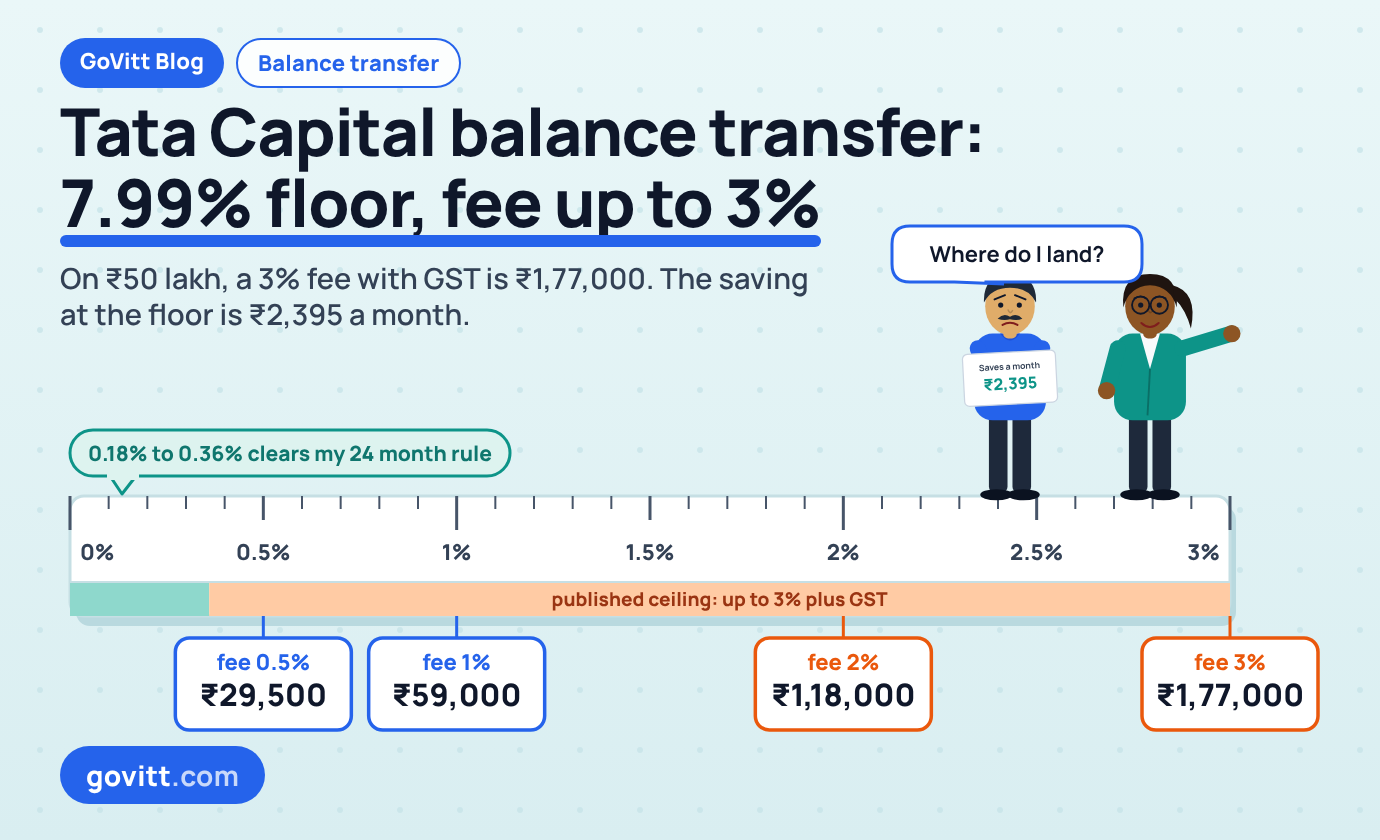
The Tata Capital home loan balance transfer interest rate starts at 7.99% on its own pages, and the same pages say the processing fee can be up to 3% plus GST. On a ₹50 lakh loan at 8.75% with 20 years left, 7.99% saves ₹2,395 a month. A 3% fee alone is ₹1,77,000 with GST, which is 74 months of that saving.
The short version: the floor is fine. The fee decides it. My rule is that all-in costs should come back within 24 months, and at 7.99% that allows ₹57,480 in total. After the ₹36,000 to ₹47,000 of charges nobody can waive in Bengaluru, that leaves ₹10,480 to ₹21,480 for the fee with GST, or about 0.18% to 0.36% of the loan before GST. Ask Tata Capital for the fee in rupees before you ask for the rate.
Below: what Tata Capital publishes, what I couldn't verify, what the range does to a ₹50 lakh switch, what a fee of 0.50% to 3% does to the payback, and how IDFC FIRST Bank and Canara Bank compare.
See your real payoff date in 60 seconds
Banks calculate remaining EMIs by simple subtraction. See your actual payoff date and discover how much interest a balance transfer can save.
What Tata Capital publishes
I read Tata Capital's home loan rates and charges page and its balance transfer page on 23 November 2026. These are the figures they print.
| Item | What the page says |
|---|---|
| Interest rate, salaried | 7.99% to 13% a year, loans of ₹5 lakh to ₹7.5 crore |
| Interest rate, self-employed | 8.25% to 13% a year, same loan range |
| Balance transfer page | "Start from just 7.99% per annum" |
| Processing fee | Up to 3% of the loan amount plus GST, no minimum or maximum given |
| Floating to fixed switch | 1% plus GST on the principal outstanding |
| Top-up with a transfer | Offered. Amount and rate depend on your eligibility |
| Age and property | 18 to 65 years. The property should be ready for possession or already occupied |
The page also says self-employed applicants may see rates 0.25% to 0.50% higher. A table of the rates is on the page, but there are no credit score bands in it, no loan size bands, and no benchmark or spread.
What I couldn't verify
There's no date. Nothing on either page tells you when the table or the fee line was set. RBI raised the repo rate to 5.50% on 7 October 2026, and I can't tell whether the table moved after it.
There's no balance transfer rate of its own. The transfer page repeats the 7.99% starting rate and no range. So 7.99% is a floor for a fresh loan, and a transfer may sit anywhere from there to 13%. Ask for the rate on a transfer in writing.
There's no fee amount. The page says the fee is up to 3%. It doesn't say what most borrowers pay, and it doesn't give a minimum or a maximum. I didn't read Tata Capital's "Most Important Terms and Conditions" document, which may have more.
What the range does to a ₹50 lakh switch
Same base case as my other transfer posts: ₹50 lakh outstanding, 20 years left, 8.75% today, EMI ₹44,186. EMIs are monthly reducing balance, rounded to the rupee.
| Where you land | Rate | New EMI | Change from ₹44,186 | Over the remaining 20 years |
|---|---|---|---|---|
| Salaried floor | 7.99% | ₹41,791 | Saves ₹2,395 a month | ₹5,74,800 saved |
| Self-employed floor | 8.25% | ₹42,603 | Saves ₹1,583 a month | ₹3,79,920 saved |
| Floor plus 0.50% (illustration) | 8.49% | ₹43,360 | Saves ₹826 a month | ₹1,98,240 saved |
| Ceiling | 13.00% | ₹58,579 | Costs ₹14,393 a month more | ₹34,54,320 more |
The floor saves ₹2,395. Half a point above it saves ₹826. At the ceiling you'd pay ₹14,393 more every month, which is why the quote at your credit score is the only number that counts. I wrote about how wide the bands run in how a credit score moves your home loan rate.
What "up to 3%" does to the payback
Tata Capital publishes only the ceiling. So here are four fee levels. The 0.50%, 1% and 2% rows are my illustrations, not Tata Capital's fees. GST at 18% is included. The all-in column adds ₹36,000 to ₹47,000 for legal and valuation, MODT stamp duty, registration and small charges on ₹50 lakh in Bengaluru, from my charges post. The payback is the all-in cost divided by the monthly saving, rounded up.
| Fee | Fee with GST | All-in cost | Payback at 7.99% (saves ₹2,395) | Payback at 8.25% (saves ₹1,583) |
|---|---|---|---|---|
| 0.50% (illustration) | ₹29,500 | ₹65,500 to ₹76,500 | 28 to 32 months | 42 to 49 months |
| 1% (illustration) | ₹59,000 | ₹95,000 to ₹1,06,000 | 40 to 45 months | 61 to 67 months |
| 2% (illustration) | ₹1,18,000 | ₹1,54,000 to ₹1,65,000 | 65 to 69 months | 98 to 105 months |
| 3% (the published ceiling) | ₹1,77,000 | ₹2,13,000 to ₹2,24,000 | 89 to 94 months | 135 to 142 months |
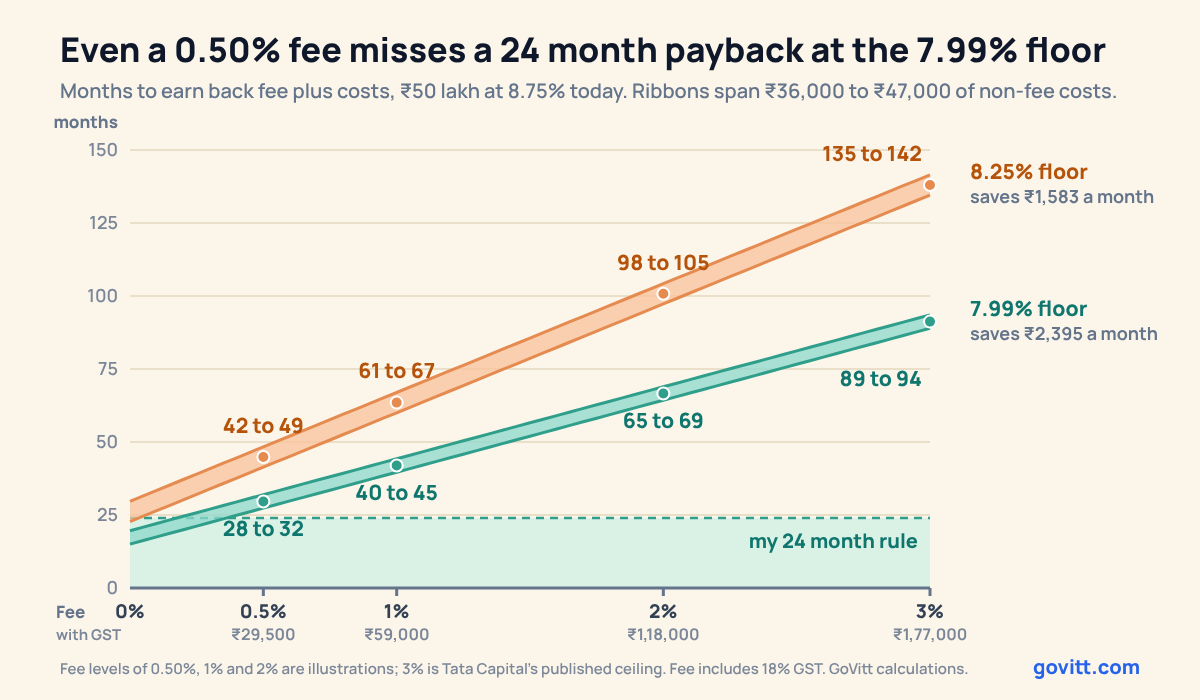
Even a 0.50% fee misses my 24 month rule at the 7.99% floor. At 3% the fee on its own takes 74 months to earn back, before you count a rupee of stamp duty. At the self-employed floor of 8.25%, the payback runs from 42 months to 142 months.
The most you can pay and still clear my rule
Run the rule backwards. The saving at 7.99% is ₹2,395 a month, and 24 months of it is ₹57,480. Take away the non-fee charges of ₹36,000 to ₹47,000 and what's left is the most the fee can be, with GST: ₹10,480 to ₹21,480. That's about 0.18% to 0.36% of ₹50 lakh before GST.
At 8.25% the saving is ₹1,583 a month, 24 months of it is ₹37,992, and the non-fee charges of ₹36,000 already use most or all of it. A salaried borrower at the floor can negotiate a fee. A self-employed borrower at 8.25% has almost no room.
The rate you pay today decides it
The 8.75% base case is a modest gap. If you pay more today, the same 7.99% floor works harder. All-in cost here uses a 1% fee, which is my illustration.
| Rate you pay today | EMI today | Saving at 7.99% | Payback with a 1% fee (₹59,000 with GST) | Most the fee can be to clear 24 months |
|---|---|---|---|---|
| 8.75% | ₹44,186 | ₹2,395 | 40 to 45 months | ₹10,480 to ₹21,480 |
| 9.25% | ₹45,793 | ₹4,002 | 24 to 27 months | ₹49,048 to ₹60,048 |
| 9.75% | ₹47,426 | ₹5,635 | 17 to 19 months | ₹88,240 to ₹99,240 |
At 9.75% a 1% fee clears my rule comfortably. At 9.25% it sits on the line. At 8.75% it doesn't clear. So the first thing to do is write down the rate on your latest statement.
A five year hold
If you plan to keep the loan for five years, here is what's left after the costs. The saving over 60 months is ₹1,43,700 of lower EMIs plus ₹45,298 of lower balance at the end, which is ₹1,88,998 of interest saved in all. I take the all-in costs off that.
| Fee | Fee with GST | Net after five years |
|---|---|---|
| 0.50% (illustration) | ₹29,500 | Saves ₹1,12,498 to ₹1,23,498 |
| 1% (illustration) | ₹59,000 | Saves ₹82,998 to ₹93,998 |
| 2% (illustration) | ₹1,18,000 | Saves ₹23,998 to ₹34,998 |
| 3% (the published ceiling) | ₹1,77,000 | Loses ₹24,002 to ₹35,002 |
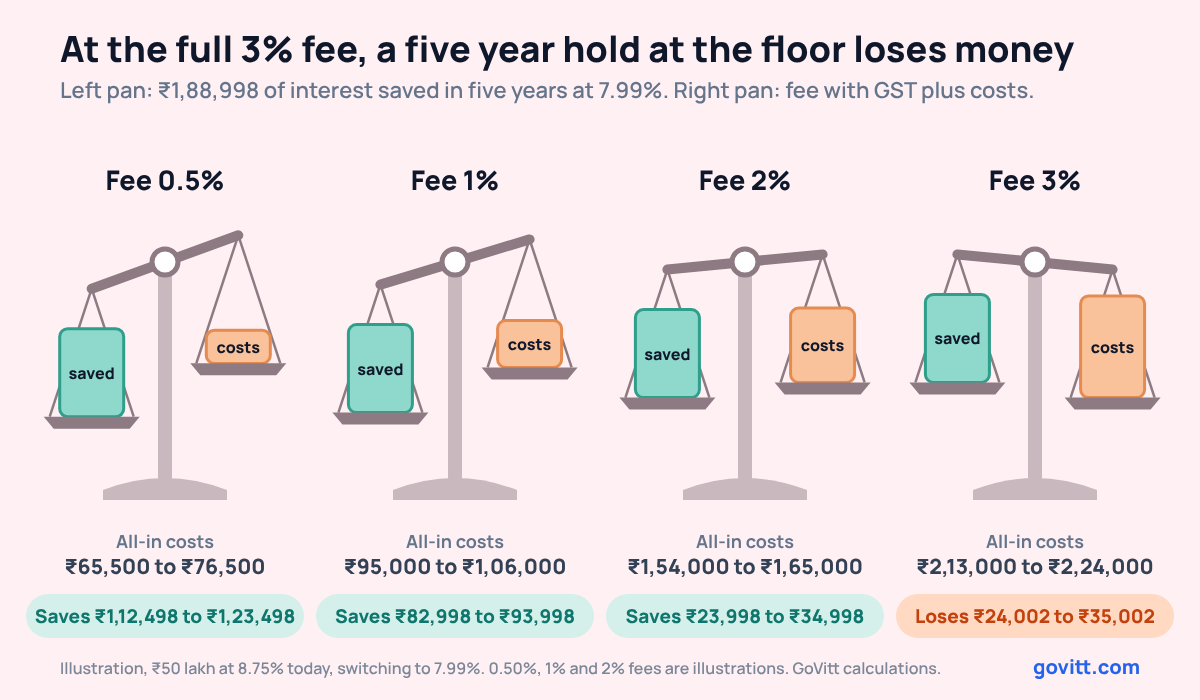
At the full 3% fee, a five year hold at the floor loses money. At 1% it still nets ₹82,998, even at the costlier end of the non-fee charges. The fee turns a good switch into a bad one, with the rate unchanged.
How IDFC FIRST Bank and Canara Bank compare
Tata Capital isn't the only lender with a high ceiling. IDFC FIRST Bank's balance transfer page says the same thing about the fee. I read its page on 23 November 2026, on the bank's new idfcfirst.bank.in address.
| Lender | Rate it publishes for a transfer | Processing fee | Other terms on the page |
|---|---|---|---|
| Tata Capital | From 7.99%, no transfer table | Up to 3% plus GST | Floating to fixed 1% plus GST. Top-up offered |
| IDFC FIRST Bank | None on the page. It says the rate is the same as for a home loan | "Up to 3% of the amount borrowed, plus relevant taxes" | Part-payment and foreclosure charges "Nil". Top-up at the same rate, capped at 100% of the transfer amount, "limited period" |
| Canara Bank (read 21 November) | 7.55% on a loan up to ₹50 lakh, or 7.50% with its 0.05% takeover concession | 0.50%, minimum ₹1,500, maximum ₹10,000 plus GST. Waived until 31 December 2026 | ₹11,800 with GST normally on ₹50 lakh |
IDFC FIRST's sentence ends "whichever one is higher" with no second figure, so I can't tell you what the other number is. Ask.
The gap between the two ceilings and Canara's cap is the story. On ₹50 lakh the cap holds Canara's fee to ₹11,800, and 3% would be ₹1,77,000. That's ₹1,65,200 more for the same loan. A public sector bank's floor is within 0.60% of Tata Capital's on a good profile, and its fee is a fraction. For a salaried borrower with a clean record, I'd ask a bank for a written takeover quote first. My post on the best banks for a transfer compares them on spread, fees and top-up.
Bank or HFC?
Tata Capital Housing Finance is a housing finance company, not a bank. An HFC can make sense when a bank has said no, or when your income is hard to document. For a salaried borrower with a clean record, the published floors are close, and the fees are not. My posts on bank vs HFC vs NBFC and on moving a loan from an HFC to a bank cover when paying more is worth it, and the reverse move.
If you want a top-up with the transfer, remember that stamp duty is charged on the full sanctioned amount, so the top-up adds to the MODT cost. I explain how to price that in balance transfer and top-up and the MODT part in MODT charges in Karnataka.
What I'd do before asking Tata Capital for a quote
- Write down your current rate and your outstanding amount. The same 7.99% is worth very different amounts at 8.75% and at 9.75%.
- Ask for the processing fee in rupees, with GST. Ask for it in writing, along with the rate and the benchmark it's linked to.
- Ask where you sit in the range. The page gives no score bands, so ask what rate you'd get at your score.
- Ask whether the fee is negotiable or waived. Neither page mentions a waiver.
- Get a bank's written takeover quote at the same time. Compare the fee as well as the rate.
- Add the all-in cost and divide by your monthly saving. Under 24 months is a yes. Over 36 months, walk away.
FAQ
What is the Tata Capital home loan balance transfer interest rate? Tata Capital's own pages, read on 23 November 2026, list 7.99% to 13% a year for salaried borrowers and 8.25% to 13% for self-employed ones. Its balance transfer page says rates "start from just 7.99%". The pages carry no date, no score bands and no balance transfer table.
What is Tata Capital's processing fee for a home loan balance transfer? Its rates page lists up to 3% of the loan amount plus GST, with no minimum or maximum. On ₹50 lakh the ceiling is ₹1,77,000 with GST. Ask for the amount in rupees before you apply, because the fee is part of the cost that decides your payback.
Is Tata Capital cheaper than a bank for a balance transfer? Not on the published fee. Its 7.99% floor is close to the 7.40% to 7.50% that public sector banks print, and Canara Bank's fee is capped at ₹10,000 plus GST, which is ₹11,800 on ₹50 lakh. The quote at your credit score is the only comparison that counts.
Can I get a top-up with a Tata Capital balance transfer? Tata Capital says it offers a transfer with a top-up, and that the amount and rate depend on your eligibility. IDFC FIRST Bank says it offers a top-up at the same rate, capped at 100% of the transfer amount, for a limited period. Stamp duty is charged on the full sanctioned amount.
What does it cost to switch a Tata Capital loan from floating to fixed? Its rates page lists 1% plus GST on the principal outstanding, which is ₹59,000 on ₹50 lakh. The page doesn't say what the fixed rate would be.
Want to see your own saving at the floor and at the floor plus 0.50%? Run the Payoff & Transfer Calculator with your outstanding amount, rate and years left. GoVitt compares 50+ banks and charges you 0% commission.
Figures are for ₹50 lakh outstanding, 20 years left, 8.75% today, monthly reducing balance, EMI rounded to the rupee. Tata Capital and IDFC FIRST Bank terms are from their own pages, read on 23 November 2026, and carry no effective date. Fee levels of 0.50%, 1% and 2% and the rate of 8.49% are illustrations, not Tata Capital's offers. Canara Bank's fee is from its own page, read on 21 November 2026. Bengaluru costs are the illustrative ranges from GoVitt's charges post (16 October 2026). Confirm every figure in writing with the lender before you act. This is general information, not financial advice.
Ready to take the next step?
Find out your loan options and check your eligibility with GoVitt today.