
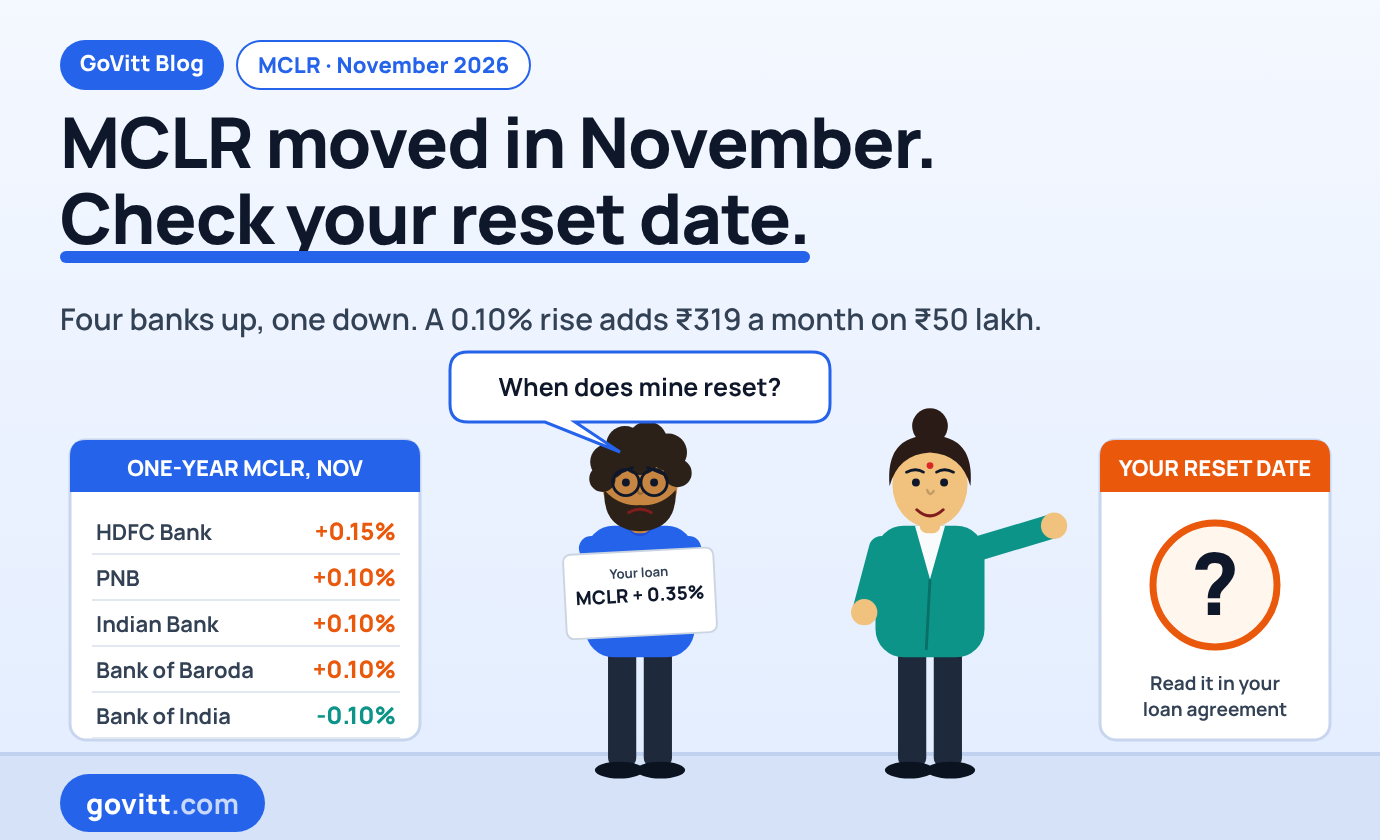
The MCLR November 2026 revisions raised the one-year rate at HDFC Bank, Punjab National Bank, Indian Bank and Bank of Baroda, by 0.10% to 0.15%, and cut it by 0.10% at Bank of India. On a ₹50 lakh loan with 20 years left at 8.75%, a 0.10% rise adds ₹319 a month to the EMI, a 0.15% rise adds ₹479, and a 0.25% rise adds ₹800.
The short version: if your home loan is linked to MCLR, none of this hits you today. It hits you on your reset date, which is written in your loan agreement and could be months away. So the job this week is not to panic about the notice. It is to find your reset date, work out your spread, and check whether a repo-linked quote is far enough below your rate to make a switch worth the cost.
Below: who moved and by how much, what a move costs in rupees, how the reset works, and the gap between an MCLR loan and a repo-linked quote, which is much bigger than any of the November moves.
See your real payoff date in 60 seconds
Banks calculate remaining EMIs by simple subtraction. See your actual payoff date and discover how much interest a balance transfer can save.
Who moved in November, and by how much
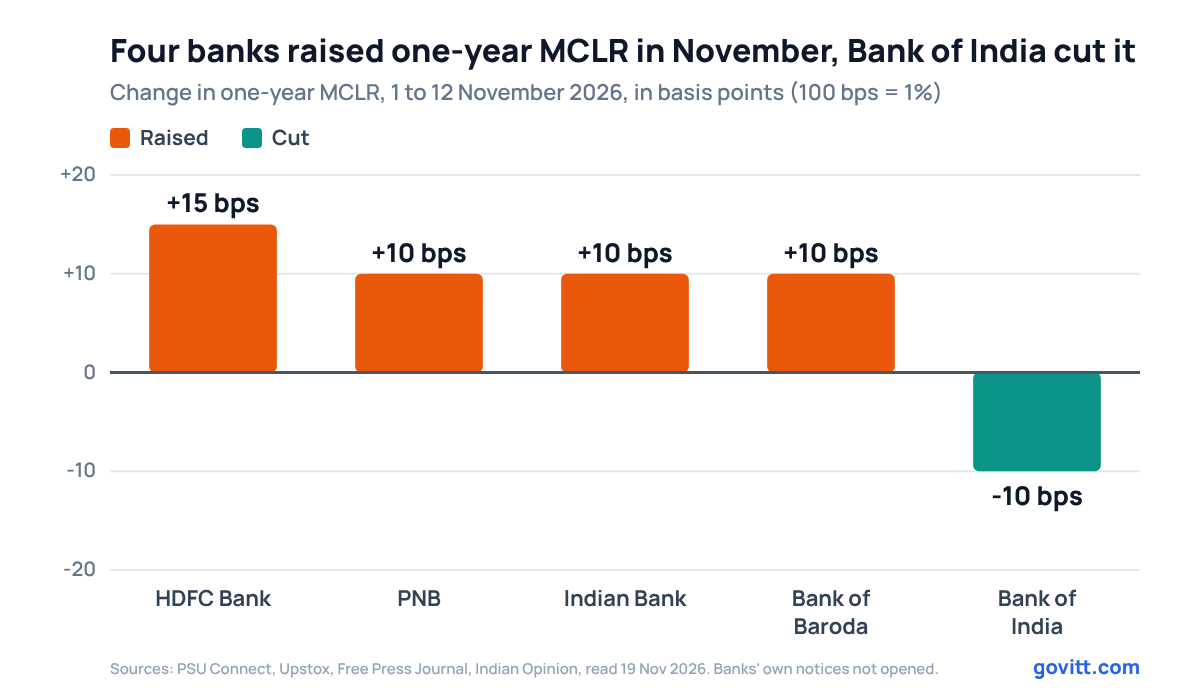
These are one-year MCLR figures, the benchmark most MCLR home loans reset against. The reports are dated 2 to 11 November and I read them on 19 November. I could not open the banks' own notices, so every row below carries its source.
| Bank | One-year MCLR before | One-year MCLR now | Change | Effective | Source |
|---|---|---|---|---|---|
| HDFC Bank | 8.30% | 8.45% | Up 0.15% | 7 Nov 2026 | Free Press Journal (10 Nov), Indian Opinion (11 Nov) |
| Punjab National Bank | 8.80% | 8.90% | Up 0.10% | 1 Nov 2026 | Upstox (2 Nov) |
| Indian Bank | 8.85% | 8.95% | Up 0.10% | 3 Nov 2026 | PSU Connect (2 Nov) |
| Bank of Baroda | 8.75% | 8.85% | Up 0.10% | 12 Nov 2026 | PSU Connect (9 Nov) |
| Bank of India | 8.90% | 8.80% | Down 0.10% | 1 Nov 2026 | Upstox (2 Nov), one source only |
A few details sit behind those rows. HDFC Bank's overall range went from 7.75% to 8.55% up to 7.85% to 8.70%, with the six-month, one-year, two-year and three-year rates all up 0.15%. PNB raised every tenor by 0.10%. Bank of India's cut covered its three-month, six-month, one-year and three-year rates, while its overnight and one-month rates stayed put. SBI isn't in this table because it moved earlier, on 15 October, to 8.85% on the one-year rate. I covered that in SBI raised its MCLR on 15 October.
The date that matters is your reset date
An MCLR loan doesn't reprice when the bank's notice comes out. It reprices on the reset date in your loan agreement, usually every 6 or 12 months. Until then, you pay the rate you already have. My post on moving from MCLR to a repo-linked rate has the full comparison.
Three things follow from that.
First, the change you see at reset is today's MCLR against the MCLR your loan used at its last reset, plus your spread. That can be bigger or smaller than the November move. If your last reset was a year ago, you pick up a year of changes at once.
Second, which day's MCLR your bank applies depends on the contract. Some banks use the rate in force on the reset date, others use a rate from earlier. Read the clause, or ask the branch in writing.
Third, a bank that cut, like Bank of India, doesn't hand you the cut early either. It also waits for your reset.
What a change costs, in rupees
Same base case throughout: ₹50 lakh outstanding, 20 years left, 8.75% today. EMI is monthly reducing balance, rounded to the rupee. The last column shows what happens if you keep paying your old EMI and let the tenure move instead.
| MCLR change at your reset | New rate | New EMI | Change in EMI | Tenure if EMI stays the same |
|---|---|---|---|---|
| Down 0.10% | 8.65% | ₹43,867 | Down ₹319 | 5 months shorter |
| Up 0.10% | 8.85% | ₹44,505 | Up ₹319 | 5 months longer |
| Up 0.15% | 8.90% | ₹44,665 | Up ₹479 | 7 months longer |
| Up 0.25% | 9.00% | ₹44,986 | Up ₹800 | 13 months longer |
| Up 0.50% | 9.25% | ₹45,793 | Up ₹1,607 | 28 months longer |
Small moves look harmless in a statement. They aren't harmless in total. A 0.15% rise that you absorb through the tenure is about seven extra EMIs of ₹44,186, which is ₹3.09 lakh you didn't plan to pay. My post on why your payoff date moved shows how that happens without anyone telling you.
Now the same exercise on a loan priced at MCLR plus a spread. I'll use a 0.35% spread, the same illustration as in my earlier MCLR post. Your spread will differ. Look at your loan agreement for it.
| Bank | Rate before | Rate after | EMI before | EMI after | Change |
|---|---|---|---|---|---|
| HDFC Bank | 8.65% | 8.80% | ₹43,867 | ₹44,345 | Up ₹478 |
| Punjab National Bank | 9.15% | 9.25% | ₹45,470 | ₹45,793 | Up ₹323 |
| Indian Bank | 9.20% | 9.30% | ₹45,631 | ₹45,955 | Up ₹324 |
| Bank of Baroda | 9.10% | 9.20% | ₹45,308 | ₹45,631 | Up ₹323 |
| Bank of India | 9.25% | 9.15% | ₹45,793 | ₹45,470 | Down ₹323 |
Those are changes against each bank's own previous figure. They land on you only if your reset falls after the notice.
What RBI's rules say about your EMI and tenure
RBI's circular of 18 August 2023 on floating-rate resets asks lenders to tell you at sanction how a benchmark change can move your EMI, your tenure or both, and to tell you straight away when it does. It lets you choose a higher EMI, a longer tenure or a mix, and it lets you part-prepay at any time. It also asks for a quarterly statement showing how many EMIs are left.
One caveat. The circular's text speaks of EMI-based floating-rate personal loans. It doesn't name home loans. I'd still ask your bank, in writing, to confirm that the same options apply to yours, and to tell you which one it applies by default. When the rate rises, the default is often a longer tenure, and you find out from the end date. My post on part-prepayingshows which choice costs less.
The bigger gap: your MCLR loan against a repo-linked quote
The November moves are small next to the gap to a new loan. The top-band quotes I read on 19 November 2026 at five large public-sector banks start between 7.40% and 7.50%. Take 7.50%, the high end, so I'm not flattering the switch.
On an MCLR loan priced at MCLR plus 0.35%, each bank's one-year rate gives the following, for ₹50 lakh with 20 years left. The comparison EMI at 7.50% is ₹40,280. The last two columns divide an all-in transfer cost of ₹53,700 to ₹76,500 (the Bengaluru range from my balance transfer charges post) by the monthly gap.
| Your bank | One-year MCLR | Your rate at MCLR + 0.35% | Your EMI | Extra a month over 7.50% | Cost back in |
|---|---|---|---|---|---|
| HDFC Bank | 8.45% | 8.80% | ₹44,345 | ₹4,065 | 14 to 19 months |
| Bank of India | 8.80% | 9.15% | ₹45,470 | ₹5,190 | 11 to 15 months |
| SBI | 8.85% | 9.20% | ₹45,631 | ₹5,351 | 11 to 15 months |
| Bank of Baroda | 8.85% | 9.20% | ₹45,631 | ₹5,351 | 11 to 15 months |
| Punjab National Bank | 8.90% | 9.25% | ₹45,793 | ₹5,513 | 10 to 14 months |
| Indian Bank | 8.95% | 9.30% | ₹45,955 | ₹5,675 | 10 to 14 months |
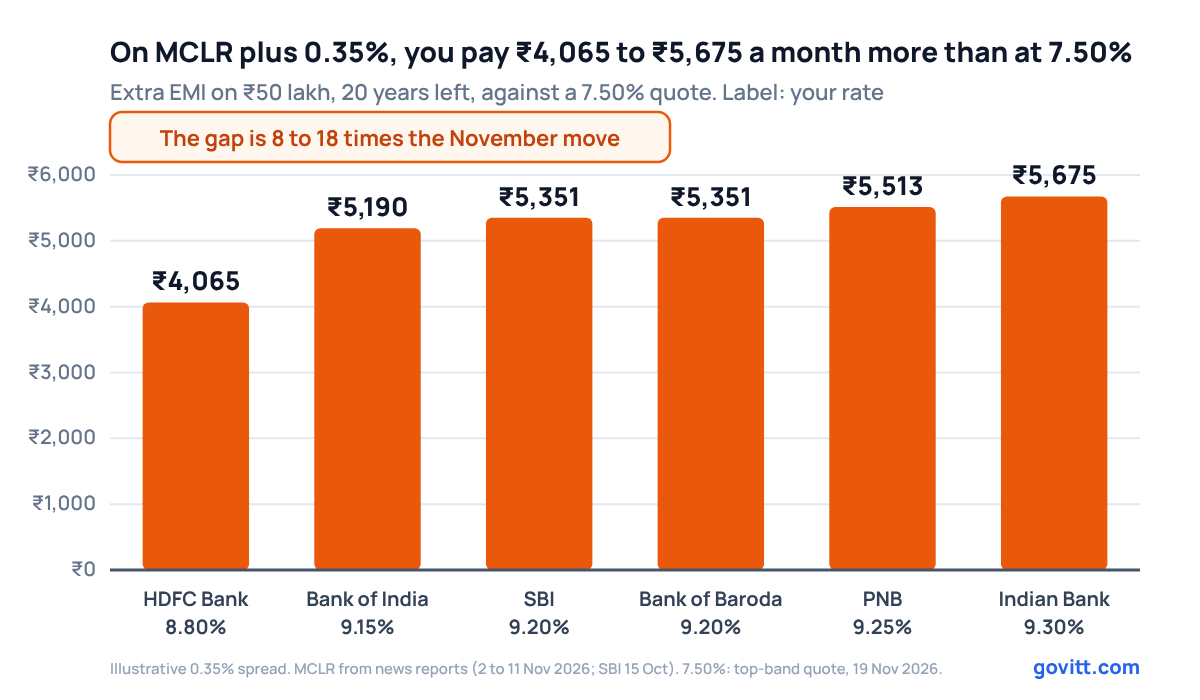
Read that carefully. A 0.10% rise adds about ₹320 a month. The gap to a 7.50% quote is ₹4,065 to ₹5,675. The gap is eight to eighteen times the November move at the same bank. And it doesn't depend on which way MCLR goes next month.
Three limits apply. The 7.50% is a top-band rate for a new loan, not a takeover quote, and your credit score decides your own band. My post on how a credit score moves your rate shows how wide the bands run. Your spread may be lower than 0.35%, which shrinks the gap. And the cost column uses a Bengaluru all-in figure that includes a fresh MODT. If your own bank will move you to its repo-linked rate for a small fee, the cost is far lower. That's the first thing to ask, as I explain in the MCLR post linked above, and I'd compare it with a transfer using best banks for home loan balance transfer in 2026.
What comes next, in other people's words
I don't forecast RBI. Here is what others have said, with names and dates. On 13 November, Business Standard reported that Barclays expects a 0.25% hike in December and another in February, taking the repo rate to 6%. On 16 November it reported that J.P. Morgan's Sajjid Chinoy expects 0.25% at each of the December, February and April meetings, with a terminal rate of 6.25%, and sees a "non-trivial risk" of 0.50% in December. These are their views, not mine, and economists have been wrong before.
What I can do is the arithmetic. If a repo move reaches your benchmark, each 0.25% adds about ₹800 a month on this loan. A repo-linked loan feels it within three months. An MCLR loan feels it at your next reset, so the lag works in your favour while rates rise and against you when they fall. I covered the October version of this in Rates just went up. RBI decides on 4 December.
What I'd do this week
- Find the line on your loan statement that names your benchmark. If it says EBLR, RLLR or repo, this post isn't about your loan. If it says MCLR, carry on.
- Find your reset date in the loan agreement or ask your bank for it in writing. Note which MCLR date the contract uses.
- Work out your spread. Your current rate minus the one-year MCLR your bank applied at your last reset.
- Ask your bank to confirm, in writing, whether your next reset changes your EMI or your tenure, and which one is the default.
- Get one written repo-linked quote for your credit score, from your own bank and from one other lender. Ask for the spread, not the headline.
- Divide the total cost by the monthly gap. If it comes back in 24 months or less, move. If your reset is close, run this before it, not after.
FAQ
What is the HDFC Bank MCLR in November 2026? HDFC Bank's one-year MCLR rose by 0.15% to 8.45% from 7 November 2026, according to Free Press Journal's report of 10 November. Its range across tenors is now 7.85% to 8.70%, up from 7.75% to 8.55%. A home loan linked to HDFC's MCLR feels it at its next reset date.
Which banks raised MCLR in November 2026? HDFC Bank (0.15%), Punjab National Bank (0.10%), Indian Bank (0.10%) and Bank of Baroda (0.10%) raised their one-year MCLR. Bank of India cut its one-year rate by 0.10%. These figures come from news reports of the banks' notices, as listed in the table.
When does an MCLR hike reach my home loan EMI? On your reset date, which is set in your loan agreement and is usually 6 or 12 months apart. Until then your rate stays where it is. At reset, your new rate is the MCLR your contract names plus your spread.
How much does a 0.10% MCLR hike add to my EMI? On ₹50 lakh with 20 years left at 8.75%, it adds ₹319 a month, or about five extra EMIs if you keep paying your old EMI and let the tenure stretch. Your own figure depends on your balance, tenure and rate.
Should I switch from an MCLR loan to a repo-linked loan? Only if the all-in rate you are offered is lower than the one you pay now, and the cost comes back in 24 months or less. A same-rate switch just changes how fast future hikes reach you, as I show in the MCLR post.
Want to see what your own reset and a lower rate do to your loan? Run the Payoff & Transfer Calculator with your outstanding amount, rate and years left. GoVitt compares 50+ banks and charges you 0% commission.
Figures are for ₹50 lakh with 20 years left at 8.75% unless a table says otherwise, monthly reducing balance, EMI rounded to the rupee. MCLR figures are from news reports of the banks' notices, dated 2 to 11 November 2026 and read on 19 November 2026. I could not confirm them against the banks' own pages. The 0.35% spread and the 7.50% quote are illustrations. Transfer costs are the Bengaluru range from GoVitt's charges post. Confirm every figure in writing with your lender. This is general information, not financial advice.
Ready to take the next step?
Find out your loan options and check your eligibility with GoVitt today.