
A reader messaged me on Friday. His home loan is from 2018, with SBI, and he had read that SBI raised its lending rates. He checked his EMI, saw no change, and wanted to know if he had escaped.
He hadn't escaped anything. He had been given a delay, and the length of that delay depends on one date he did not know, which is his reset date, the day the bank is allowed to change his rate. That date decides when the hike hits him, and it is also the best moment to ask whether he should be on this kind of loan at all.
See your real payoff date in 60 seconds
Banks calculate remaining EMIs by simple subtraction. See your actual payoff date and discover how much interest a balance transfer can save.
Here is what SBI changed, why your EMI has not moved yet, and what to do before it does.
What SBI changed on 15 October
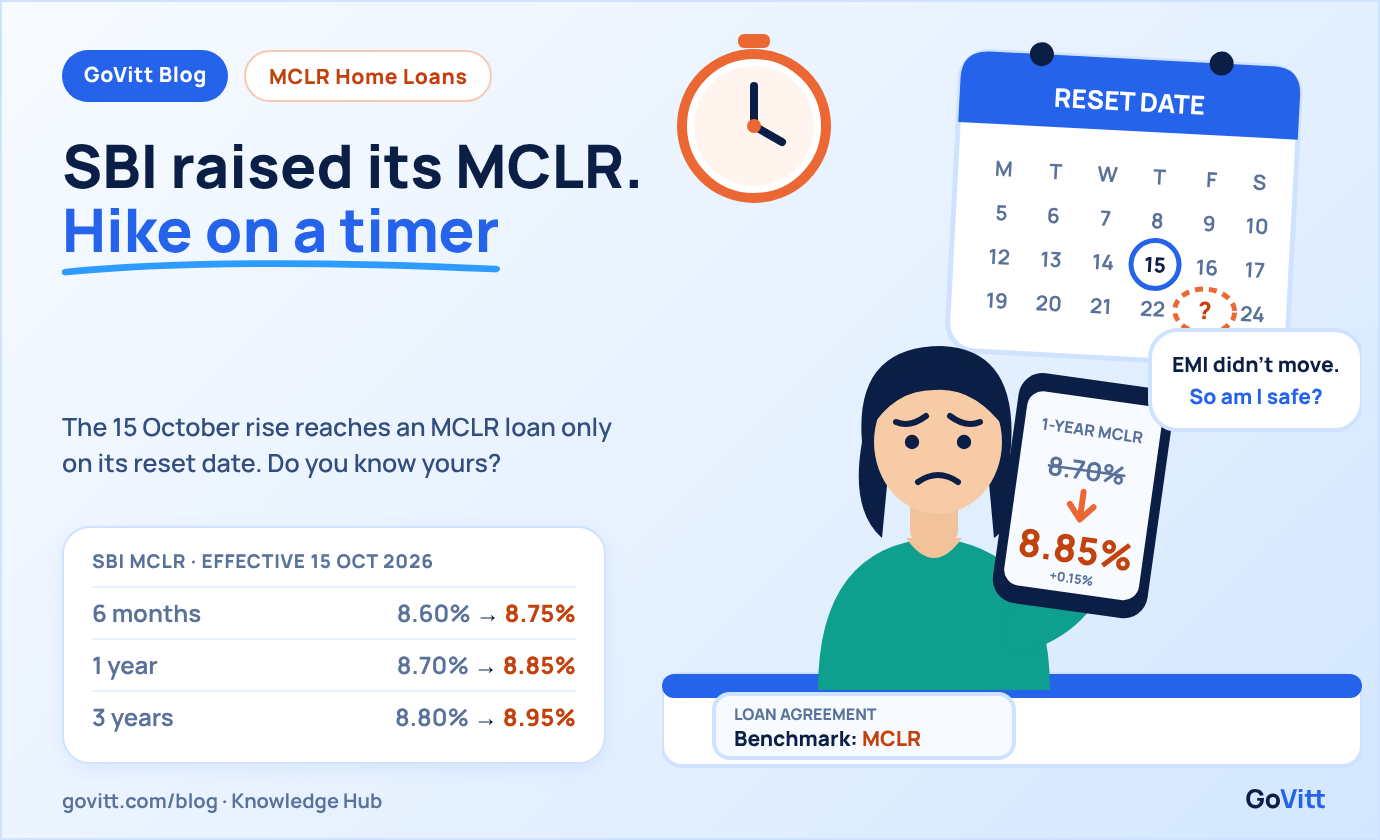
SBI raised its marginal cost of funds based lending rate, MCLR, by 0.15% on most tenors, effective 15 October 2026. The overnight and one-month rates stayed at 7.85%. The three-month rate went from 8.25% to 8.40%, six months from 8.60% to 8.75%, one year from 8.70% to 8.85%, two years from 8.75% to 8.90%, and three years from 8.80% to 8.95%.
On the same day SBI raised its external benchmark lending rate, EBLR, from 7.90% to 8.15%. That one is 0.25%, the full size of the RBI repo hike on 7 October. SBI is not alone. Reports say PNB, Bank of India, Indian Bank, Bank of Baroda and Canara Bank have also revised their repo-linked rates this month.
So the same bank moved its two benchmarks by different amounts, and the two kinds of loan will feel the change at very different speeds.
Why your EMI has not changed yet
An EBLR loan is tied to the repo rate and resets at least once every three months. A hike reaches those borrowers fast.
An MCLR loan works differently. The bank sets the rate when your loan starts, adds your spread, and then leaves it alone until your reset date. Many agreements reset every six months or every year. If your loan reset in September, the 15 October hike will not touch you until next March or September. If it resets next week, it will.
That is why the hike feels like nothing today. It has not gone away, it is only waiting in a queue behind your reset date.
To find your reset date, open your sanction letter or loan agreement and look for the words "reset" or "review", and check your lender's annual statement of account, which usually shows the benchmark and the spread as well. If you cannot find it, ask in writing. The bank has to tell you how a rate change can affect your EMI, your tenure, or both, and it has to tell you immediately when either one goes up.
What the hike costs, and what the gap costs
Take a loan of ₹40 lakh with 15 years left, on MCLR at 9.00%. The EMI today is ₹40,571. At the next reset the rate becomes 9.15%, which is the 0.15% rise.
Your EMI goes up by about ₹358 a month, or ₹4,292 a year, which most people would shrug at. If the bank leaves the EMI alone and stretches the loan instead, the loan ends about three and a half months later, and you may never notice that either. That costs about ₹1.40 lakh in extra interest, compared with about ₹64,000 if you pay the higher EMI and keep the original end date. Your lender must give you the choice, so ask for the one you want before the letter arrives.
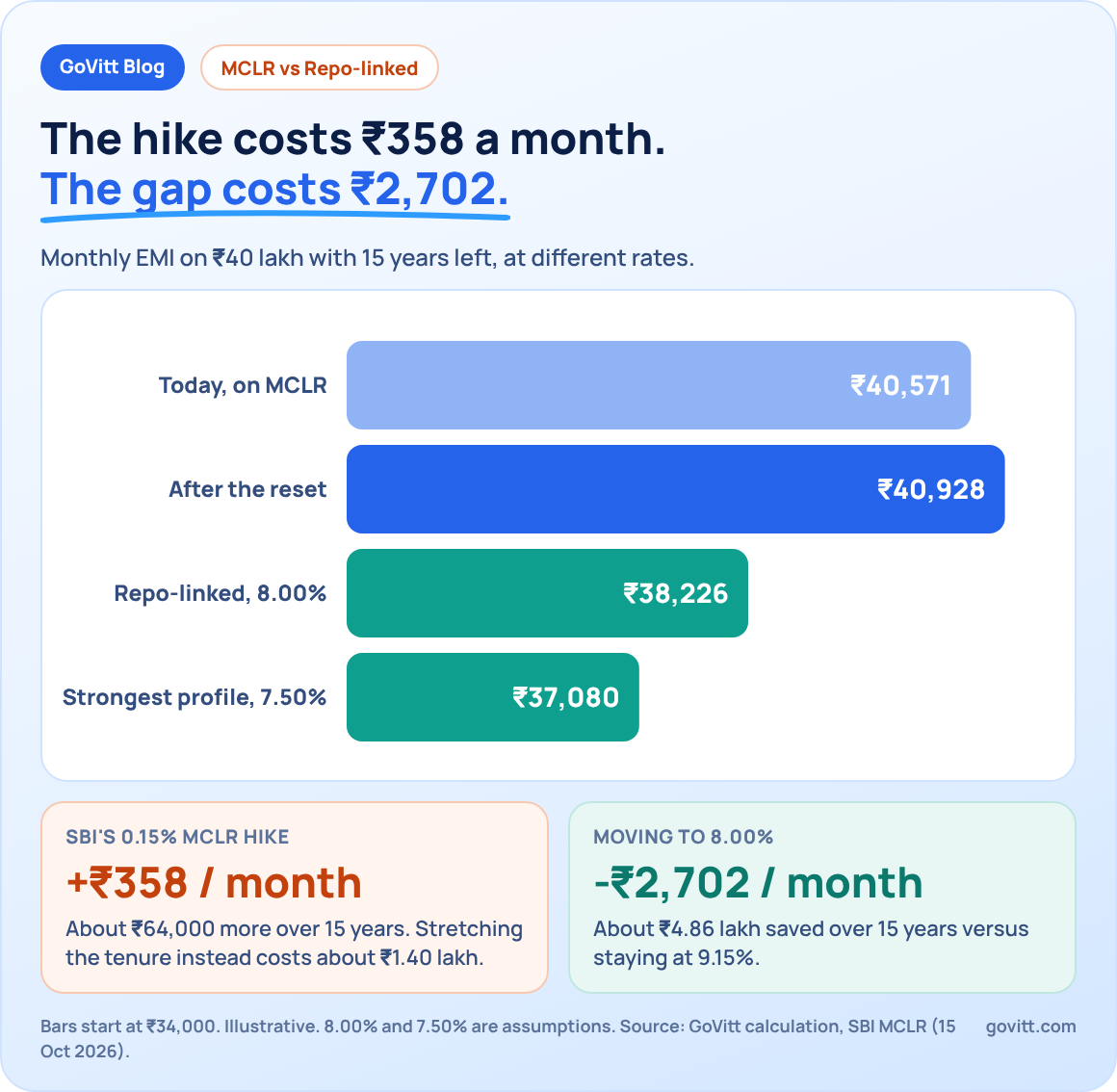
Monthly EMI on ₹40 lakh with 15 years left, at different rates. Illustrative figures. The bars start at ₹34,000 to make the gaps visible. The 8.00% and 7.50% rows are assumptions, not offers.
Now look at the bottom of the chart. The hike costs ₹358 a month. The gap between your MCLR rate and what a repo-linked loan could cost you is much bigger. If you moved to 8.00%, the EMI falls to ₹38,226, which is ₹2,702 a month below where you will be after the reset. Over the remaining 15 years that is about ₹4.86 lakh. At 7.50%, which only the strongest profiles get, it is ₹3,848 a month and about ₹6.93 lakh.
That gap exists because MCLR loans carry a spread that was set years ago, and the benchmark itself moves slowly. A new borrower with a good credit score is priced off today's market, while you are priced off the day you signed.
How to move off MCLR
There are two routes, and both are open to you on a floating rate loan without any prepayment charge.
The first is to ask your own bank to switch you to its external benchmark rate. Under RBI's 2019 rules for banks, a switch from MCLR should cost only reasonable administrative and legal charges, and the new rate should match what the bank charges a new loan of the same type, tenure and amount. It does not happen on its own, you have to ask, and the switch cannot be reversed. Ask for the new rate and the spread in writing before you agree. Some banks quote a flat fee.
The second is to move the loan to another lender, which usually takes three to four weeks, with charges that depend on your city and loan size. If it costs ₹50,000 in total, a saving of ₹2,702 a month pays that back in about 19 months. Our post on how the transfer process works shows each step, and this worked example of a ₹50 lakh transfer lists every charge.
Compare both routes before you pick one, because your own bank may well match a competitor's offer once it sees that you have one in hand.
What RBI's draft would change in 2027
There is a second reason to look at this now. On 12 August 2026, RBI released draft directions on interest rates on loans. If they are finalised as drafted, from 1 April 2027 most floating rate loans would have a benchmark that resets at least every three months. MCLR itself would be calculated on a three-month moving average of funding costs.
Existing loans would be moved to the new system by 1 April 2029, with your consent and without a fee or a rate increase just for being moved. The comment period closed on 11 September, and I could not find final directions, so this is still a draft.
It cuts both ways. Faster resets mean a rate cut reaches you sooner, and a rate hike does too, so the rule would speed up the pass-through without lowering your rate on its own. If you are paying a high spread, waiting for a rule to fix that costs you money every single month until then.
What I would do this week
Find your reset date and your current spread. Work out what your EMI will be after the reset, and decide now whether you want the EMI raised or the tenure extended. Then ask your bank for a switch rate in writing, and get one offer from another lender so you have something to compare it with.
If the gap is only a few hundred rupees a month, you can stay put and save yourself the paperwork. If it is ₹2,000 a month or more, it is worth a proper look. On the rate-hike posts we have already written, the message has been the same: the hike itself is small, and what you were paying before it is the bigger number. See how fixed and floating rates compare after the inflation jump if you are also thinking about locking a rate.
Where GoVitt fits in
If you are not sure whether your loan is on MCLR, EBLR or an older base rate, WhatsApp us your latest statement. We will tell you your benchmark, your reset date and what a switch could save you, using offers from 50+ banks and housing finance companies.
- WhatsApp: +91 70194 17854
- Payoff & Transfer Calculator: govitt.com/post-loan-dashboard
- EMI calculator: govitt.com/home-loan-emi-calculator
- Bank offers: govitt.com/bank-offers
GoVitt doesn't charge you any commission.
Figures in this post are illustrative and rounded. The example loan is hypothetical, and the 8.00% and 7.50% rates are assumptions, not offers. This is general information, not financial advice. Check your own loan agreement and talk to your lender.
Questions people usually ask
What did SBI change on 15 October 2026? SBI raised its MCLR by 0.15% on tenors from three months to three years, and left the overnight and one-month rates at 7.85%. The one-year MCLR went from 8.70% to 8.85%. SBI also raised its EBLR from 7.90% to 8.15%.
Will my EMI go up right away if my home loan is on MCLR? No. An MCLR loan changes only at your reset date, which is often every six months or every year. The new rate applies from that date, and your lender has to tell you what it means for your EMI or tenure.
How do I find my home loan reset date? Check your sanction letter, loan agreement or annual statement for the words "reset" or "review". If you cannot find it, ask your lender in writing.
Should I choose a higher EMI or a longer tenure when my rate goes up? A higher EMI costs less in total interest. On a ₹40 lakh loan with 15 years left, a 0.15% rise costs about ₹64,000 more if you pay the higher EMI, and about ₹1.40 lakh more if you keep the EMI and let the loan run about three and a half months longer.
Can I move from MCLR to a repo-linked rate with my own bank? Yes, in most cases you can ask. You have to request it, the switch is one way, and the bank may charge a fee. Ask for the new rate and spread in writing first.
Is there a prepayment penalty if I transfer an MCLR loan to another bank? Not on a floating rate home loan taken by an individual. RBI rules bar prepayment and foreclosure charges on those loans, so the old lender cannot charge you for closing it.
What is RBI's three month reset proposal? It is a draft from 12 August 2026. If finalised, most floating rate loans would reset at least every three months from 1 April 2027, and existing loans would move over by 1 April 2029 with your consent.
Ready to take the next step?
Find out your loan options and check your eligibility with GoVitt today.