
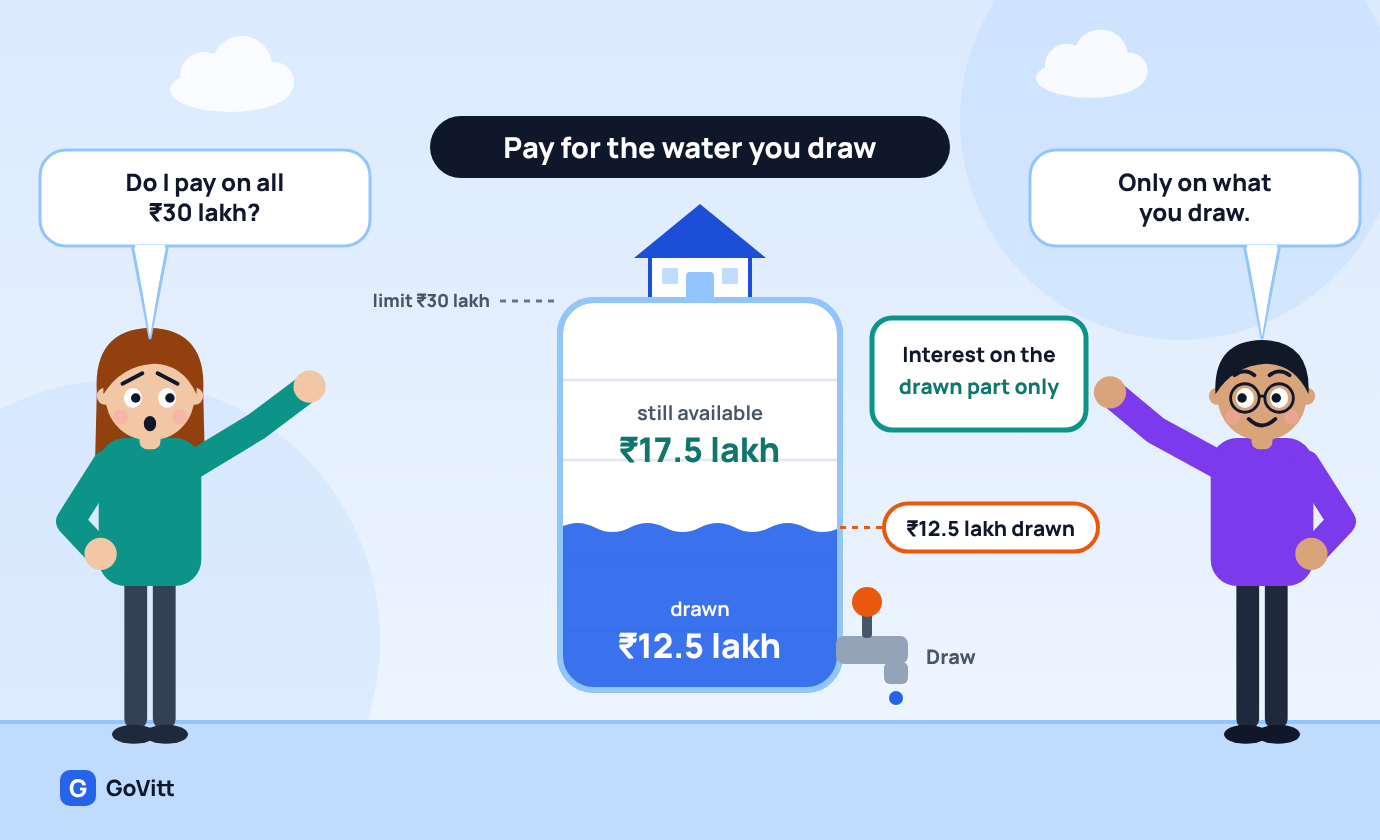
OD against property is a credit limit secured on a property you own. The bank sanctions a limit, say ₹30 lakh, and you draw from it as you need, pay interest on what you've drawn, and repay when cash comes in. A regular loan against property (LAP) hands you the whole amount on day one and charges interest on all of it. That is why an overdraft against property suits money you need in bursts.
The catch is the price and the rules. No lender I read publishes a separate rate for it. Shriram Finance says it costs the LAP rate plus 2% to 3%. The limit is renewed or reviewed every year at Axis Bank and Kotak, and both offer a version where the limit steps down each year. On a ₹30 lakh limit, with a 10% term LAP to compare, an overdraft that costs 1% more wins only while you average below 89.1% of the limit.
Below: how it works, what lenders' paperwork says, the break-even by premium, when it loses, and what to ask before you sign. The term loan version is in loan against property in 2026: rates, how much you can borrow, and the fine print.
See your real payoff date in 60 seconds
Banks calculate remaining EMIs by simple subtraction. See your actual payoff date and discover how much interest a balance transfer can save.
First, the honest part
I couldn't find a lender page that publishes an overdraft against property rate on its own. ICICI Bank says its home overdraft follows floating home loan rates. Godrej Capital says the structure is "generally aligned" with a regular LAP and gives no figure. HDFC Bank's page showed only "up to ₹10 crore for MSMEs" when I read it, and Axis Bank's overdraft pages loaded without terms, so for Axis I used its LAP product guide, which is undated.
The pages also disagree with each other:
- Tenure. Shriram Finance says the repayment period is "usually 12 to 18 months", extendable to 36 to 48. SMFG Grihashakti says usually 10 to 15 years with periodic reviews. Axis's guide uses a 10 year example. Godrej Capital gives no figure.
- How interest is counted. ICICI Bank, Godrej Capital and SMFG Grihashakti say interest runs on the daily utilised balance. Kotak's agreement says the average monthly balance. That copy still mentions service tax, so I use it for how the contract is built and not for fees.
So the break-even below uses assumed premiums. Treat it as the method, and put your lender's numbers in.
How an OD against property works, in plain words
The bank values your property and sanctions a limit against it. SMFG Grihashakti says lenders may offer up to 50% to 70% of the market value, and Godrej Capital says the limit follows the assessed value, loan to value norms and your income and credit profile. You get an overdraft account, draw within the limit, and repay whenever cash comes in. Repaid money restores the limit, so you can draw it again. There are no fixed EMIs.
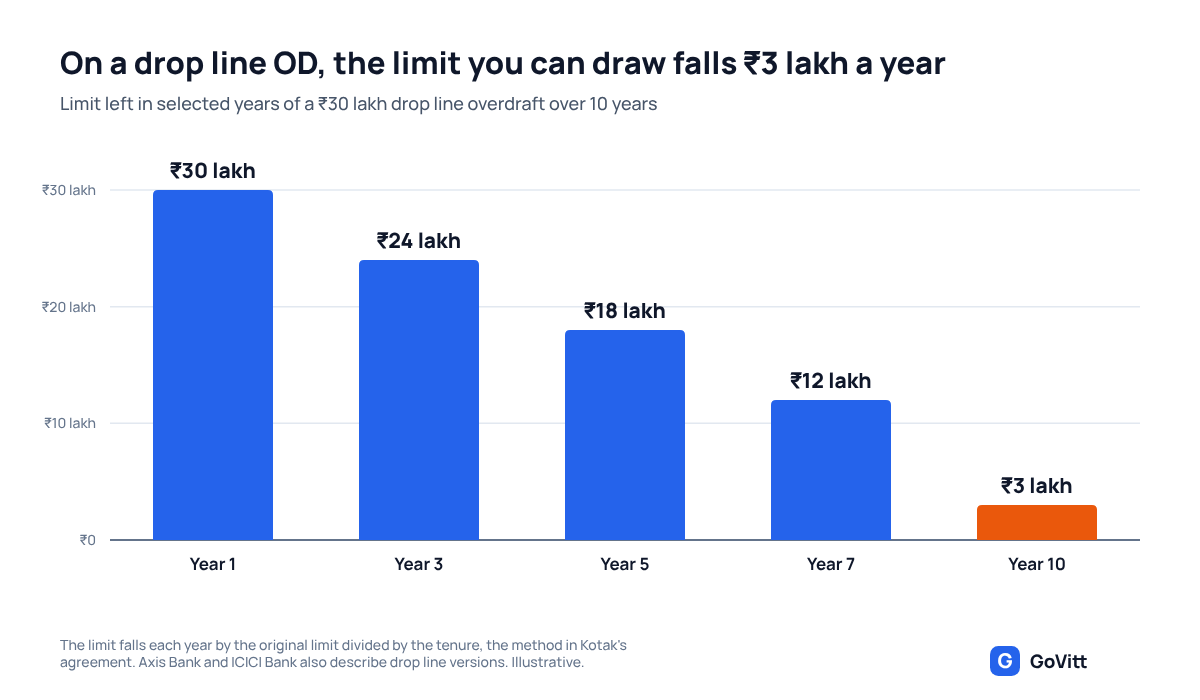
It comes in two shapes. In a straight line facility the limit stays the same for the tenure. In a drop line facility the limit steps down every year. Axis Bank and Kotak describe both, and ICICI Bank's home overdraft repays on a drop line schedule.
| OD against property | Regular LAP | |
|---|---|---|
| Money | A limit, drawn as needed | The full amount on day one |
| Interest | On the amount drawn | On the whole amount, from day one |
| Repayment | Flexible; repaid money can be drawn again | Fixed EMIs |
| The limit | Reviewed every year; may step down every year | Fixed for the tenure |
| Suits | Money you need in bursts | One-off, planned spending |
What the lenders' paperwork says
| Lender and source | What it says |
|---|---|
| ICICI Bank, home overdraft FAQ (read 3 November 2026) | Interest on the daily utilised amount. Rate follows floating home loan rates. Commitment charge on the unused amount, no figure on the page. Salaried borrowers can't use it for business. A higher limit needs a fresh application. |
| Axis Bank, LAP product guide (undated) | Straight line or drop line. Processing fee 1% or ₹10,000, whichever is higher. No part payment charge. Foreclosure 2% of that year's limit. Renewal every 12 months at 0.5% of drawing power or ₹5,000, whichever is lower, plus GST. On a straight line facility, 0.10% a quarter on the shortfall if average use is under 25%. |
| Kotak, overdraft against property agreement (older copy) | Interest on the average monthly balance. Limit reduces each year by the original limit divided by the tenure, or stays constant. Bank reviews yearly and may demand repayment or continue on changed terms. Recall on 7 working days' notice. |
| Shriram Finance (8 September 2025) | Rate is the base LAP rate plus 2% to 3%. Repayment "usually 12 to 18 months". Interest-only payments keep the principal unchanged. |
| Godrej Capital (7 August 2026) | Interest on the daily utilised balance. Limit follows assessed value, loan to value norms, income and credit profile. Possible annual review or renewal charge. The account generally needs interest to be paid regularly. |
| SMFG Grihashakti (updated 10 June 2026) | Interest on the daily utilised amount. Limit up to 50% to 70% of market value. Tenure usually 10 to 15 years with periodic reviews. Suggested score of at least 700. |
On ₹30 lakh, Axis Bank's schedule works out to a ₹30,000 processing fee (₹35,400 with GST) and a ₹5,000 renewal charge a year (₹5,900 with GST), because 0.5% of ₹30 lakh is ₹15,000 and the lower figure applies.
When an OD against property beats a regular LAP
The fair comparison is with a term loan whose ₹30 lakh stays outstanding all year. That is what working capital looks like: you can prepay a term loan in a quiet month, but you can't borrow it back. The rest is arithmetic. I assume a 10.00% term LAP, an overdraft that costs the term rate plus a premium, and the ₹5,900 renewal charge.
| Premium over the LAP rate | Extra interest a year at full use | The OD is cheaper while you average below |
|---|---|---|
| 0.50% | ₹15,000 | ₹28.01 lakh (93.4% of the limit) |
| 1.00% | ₹30,000 | ₹26.74 lakh (89.1%) |
| 2.00% | ₹60,000 | ₹24.51 lakh (81.7%) |
| 3.00% | ₹90,000 | ₹22.62 lakh (75.4%) |
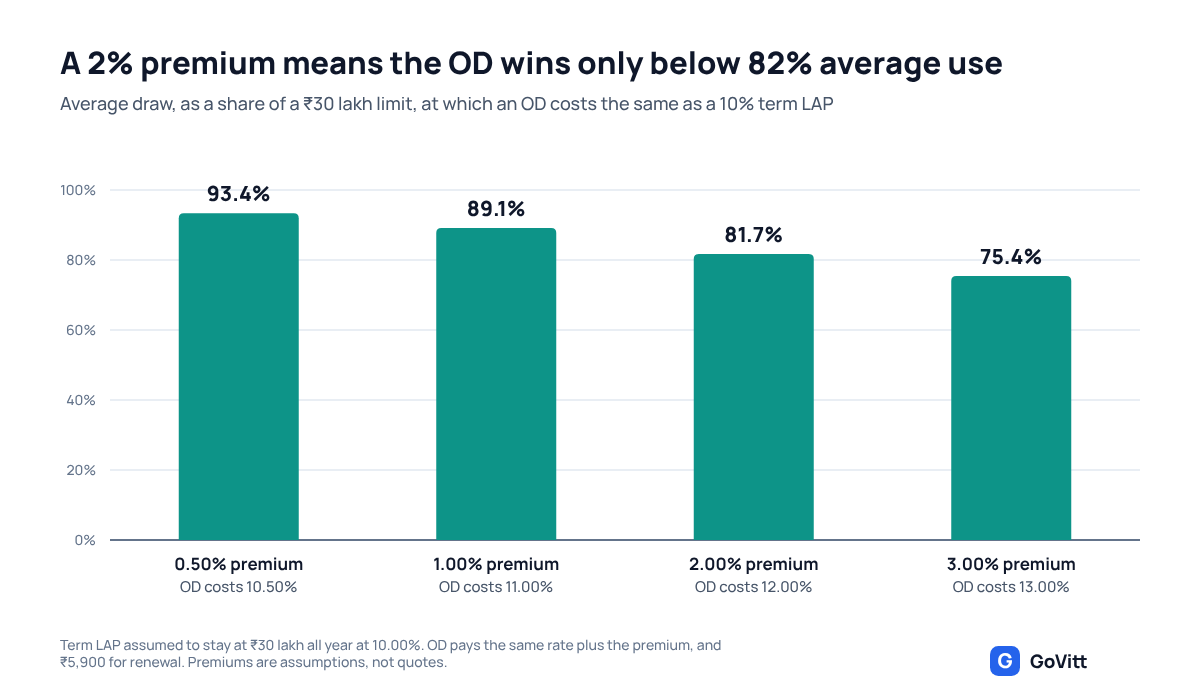
At Shriram's 2% to 3% premium you need to average below 75% to 82% of the limit. At 0.50% you have room up to 93%.
Here is a pattern where it wins by a wide margin. A trader needs ₹30 lakh for 2 months of festive stock, ₹15 lakh for the next 4 months and ₹5 lakh for the other 6. The average draw is ₹12.5 lakh. At 10.50% the overdraft costs ₹1,31,250 in interest plus ₹5,900 for renewal, which is ₹1,37,150. A ₹30 lakh term LAP at 10.00% kept outstanding all year costs ₹3,00,000. That is ₹1,62,850 apart. The example is illustrative and ignores the processing fee both would charge.
When it loses
- You need the full amount for years. The premium comes back every year on the full draw: ₹30,000 a year at 1% on ₹30 lakh, and the bank gets a yearly say on whether the facility continues.
- The limit shrinks. On a drop line facility, Kotak's formula takes the original limit divided by the tenure off every year. A ₹30 lakh limit over 10 years falls ₹3 lakh a year, so by year 10 you can draw ₹3 lakh.
- The bank can review and recall. Kotak's agreement lets it review the facility yearly, demand repayment or continue on changed terms, and recall on 7 working days' notice. Ask what your lender's agreement says before you rely on the limit for a payroll month.
- An idle limit costs money. ICICI Bank charges a commitment fee on the unused amount, and Axis Bank charges 0.10% a quarter on the shortfall below 25% use on a straight line facility. At 10% average use on a ₹30 lakh drawing power, the shortfall to 25% is ₹4.5 lakh and the charge is ₹450 a quarter.
- Interest-only can turn into permanent debt. Shriram Finance's page notes that interest-only payments keep the principal unchanged. A term loan forces the principal down. An overdraft doesn't.
Closing it: the prepayment rule
RBI's Pre-payment Charges Directions, 2025, apply to loans and advances "sanctioned or renewed on or after January 1, 2026". An overdraft renews every year, so a limit you renewed after that date is within that wording. Its paragraphs on cash credit and overdraft facilities say that where a charge is allowed at all, it applies on closure before the due date and on no more than the sanctioned limit. They also say no charge applies if you tell the lender you won't renew and the facility closes on the due date.
Axis Bank's guide lists a 2% charge on the limit set for the year you close, which is ₹60,000 on a ₹30 lakh limit in year 1. The guide is undated. Ask your lender which clause applies to you after 1 January 2026. The same rule for term LAPs is in loan against property for business, including a new business, and for home loans in your bank can't charge you for prepaying a floating rate home loan.
On tax: interest on money used in a business is generally a business expense, and on personal use there is no deduction. Ask your CA. This is a summary, not tax advice.
Who it suits, and who should look elsewhere
It can suit you if you:
- Are self-employed with lumpy receipts and need standby money for stock, payroll or timing gaps
- Already have a LAP and want flexibility in how you use the money
- Can show an average draw well below the break-even for your premium
Look elsewhere first if you:
- Need a fixed sum for one planned expense, such as machinery or a wedding. A term LAP or a home loan top-up is simpler, and the comparison is in top-up vs loan against property vs personal loan
- Are salaried and want the money for a business. ICICI Bank says its overdraft for salaried customers can't be used for business
- Are tempted to treat an open limit as spending money. An open limit feels smaller than a ₹30 lakh loan, and it is the same debt
If you'd rather borrow against a home loan you already have, can a home loan overdraft actually save you interest? covers that version.
What I'd ask the lender
- Straight line or drop line? If it drops, ask for the year by year limit in writing.
- How is interest counted? Daily utilised balance, or monthly average.
- What is the premium over your term LAP rate? In writing, with the benchmark and spread.
- What does renewal cost, and who decides? The yearly fee, the review date, and what happens if the bank doesn't renew.
- What do I pay on the unused part? Commitment or non-utilisation charge.
- What is the closing clause after 1 January 2026? Which charge, on what amount, and what notice avoids it.
FAQ
What is an OD against property and how does it work? It is a credit limit secured on your property. You draw from it as needed, pay interest on the amount drawn, and repaid money restores the limit. There are no fixed EMIs. SMFG Grihashakti says lenders may offer up to 50% to 70% of the property's market value.
Is an overdraft against property cheaper than a loan against property? Only if you use a fraction of the limit. With a 10% term LAP and a ₹30 lakh limit, an overdraft with a 1% premium is cheaper while you average below 89.1% of the limit. At a 3% premium the line drops to 75.4%.
How is interest charged on an overdraft against property? On the amount you've drawn. ICICI Bank, Godrej Capital and SMFG Grihashakti say daily utilised balance. Kotak's agreement uses the average monthly balance. Ask which your lender uses.
What is the tenure of an overdraft against property? Pages disagree: Shriram Finance says usually 12 to 18 months, SMFG Grihashakti 10 to 15 years with periodic reviews. Axis Bank renews every 12 months. Whatever the headline tenure, the limit is reviewed every year.
Can I use an overdraft against property for business? ICICI Bank says the overdraft for salaried customers can't be used for business, and the one for self-employed customers on a current account can. Other lenders have their own rules.
Is there a prepayment charge on an overdraft against property? It depends on the lender and the date it was sanctioned or renewed. RBI's 2025 Directions cover facilities sanctioned or renewed on or after 1 January 2026, and say no charge applies if you give notice of non-renewal and close on the due date. Axis Bank's undated guide lists 2%.
Not sure whether a limit or a lump sum fits your cash flow? Talk to an advisor on WhatsApp with your property value and how your cash needs move through the year. GoVitt compares 50+ banks and charges you 0% commission.
Lender pages read on 3 November 2026; undated pages are marked. The 10.00% term LAP rate, the premiums of 0.50% to 3.00%, the 10.50% trader example and the ₹5,900 renewal charge are assumptions, not quotes. Interest is simple annual interest on the balance and ignores the processing fee that both products would charge. Break-even draw is the average balance at which the two cost the same. Fees with GST use 18%. Your lender's rate, fees and rules will differ, so check your sanction letter and Key Facts Statement. This is information, not financial or tax advice.
Ready to take the next step?
Find out your loan options and check your eligibility with GoVitt today.