
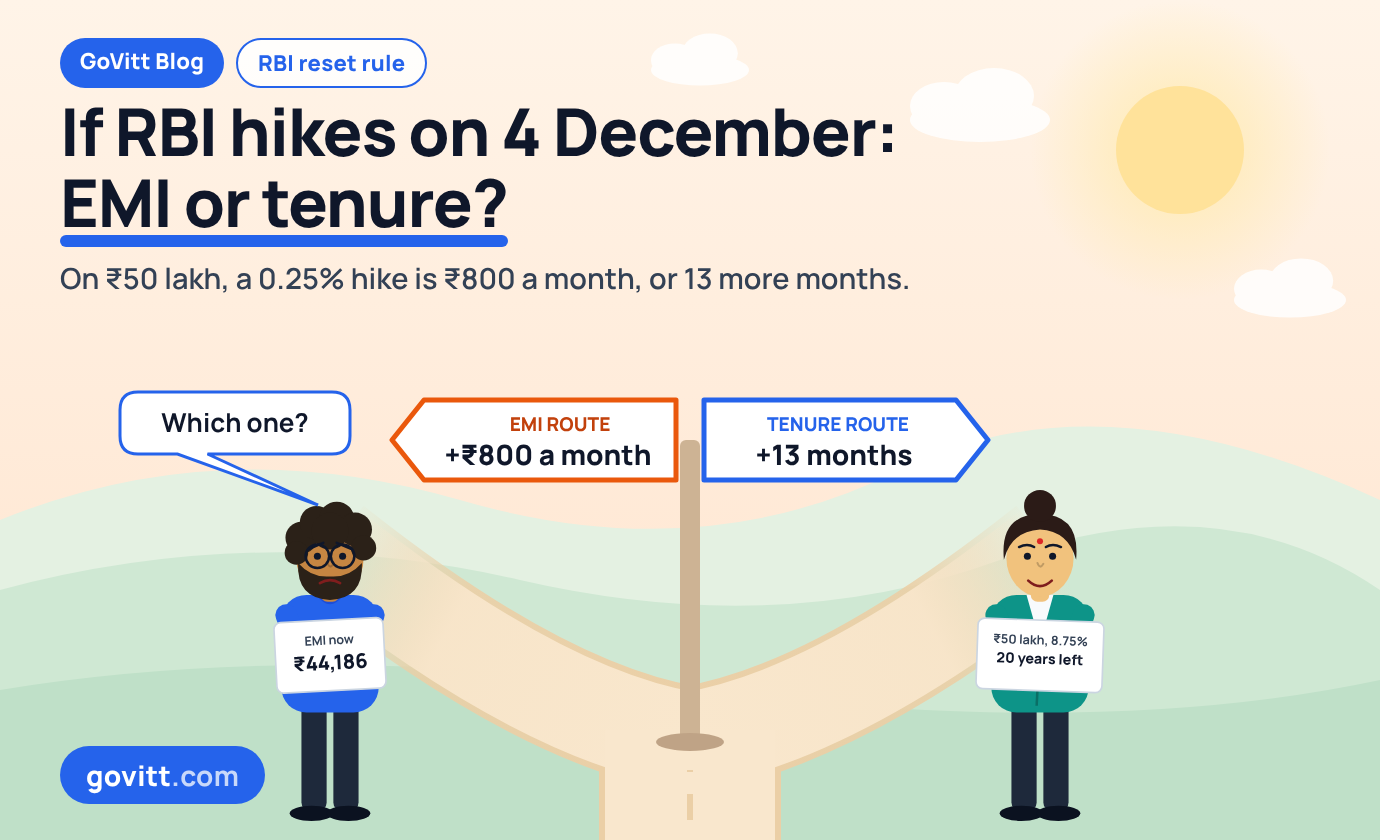
If RBI raises the repo rate on 4 December, your home loan EMI or tenure after a rate hike will change, and which one changes depends on your lender. On a ₹50 lakh loan at 8.75% with 20 years left, a 0.25% hike is ₹800 more a month, or 13 more months if the EMI stays at ₹44,186. The months route costs ₹5.62 lakh in extra interest. The EMI route costs ₹1.92 lakh.
RBI does have a reset rule that gives you that choice. It is written for personal loans, and I could not find home loans named in it.
The short version: if you can pay the higher EMI, take it, or keep the EMI and prepay the difference. A longer tenure feels free and costs 2.9 to 4.8 times the interest. Ask your lender in writing what it does at a reset, because the RBI rule may not decide that for a home loan. And if your rate after a hike is well above what new borrowers are quoted, price a transfer.
See your real payoff date in 60 seconds
Banks calculate remaining EMIs by simple subtraction. See your actual payoff date and discover how much interest a balance transfer can save.
What the economists expect for 4 December
RBI raised the repo rate from 5.25% to 5.50% on 7 October 2026. The next decision is on 4 December. I'm not forecasting it, and nobody should treat this post as a forecast. These are other people's views.
In a Reuters poll published on 20 November 2026, 56 of 61 economists expected a 0.25% hike on 4 December. Three expected no change and two expected 0.50%. SBI Research took a harder line in a report dated 21 October 2026, reported by Business Today. It proposed a 0.50% hike to 6.00%, and also set out an option of 0.25% with a wider corridor for RBI's liquidity facilities. That report is a month old, and SBI Research called the second option a policy choice, not an RBI plan.
Either way, a hike of 0.25% to 0.50% is the range being discussed. So the tables below start at 0.25% and run up to 1.00%, which is the size of a whole cycle of hikes.
What a hike does to a ₹50 lakh loan
Base case, same as my other posts: ₹50 lakh outstanding, 20 years (240 months) left, 8.75% today, EMI ₹44,186. EMIs use monthly reducing balance and are rounded to the rupee. For each new rate I show the two routes. On the EMI route the tenure stays at 20 years and the EMI goes up. On the tenure route you keep paying ₹44,186 and the loan runs longer.
| Rate after the hike | EMI if the tenure stays | Extra a month | Months left if the EMI stays | Extra months |
|---|---|---|---|---|
| 9.00% (up 0.25%) | ₹44,986 | ₹800 | 253 (21 years and 1 month) | 13 |
| 9.25% (up 0.50%) | ₹45,793 | ₹1,607 | 268 (22 years and 4 months) | 28 |
| 9.50% (up 0.75%) | ₹46,607 | ₹2,421 | 287 (23 years and 11 months) | 47 |
| 9.75% (up 1.00%) | ₹47,426 | ₹3,240 | 312 (26 years) | 72 |
| 10.00% (up 1.25%) | ₹48,251 | ₹4,065 | 346 (28 years and 10 months) | 106 |
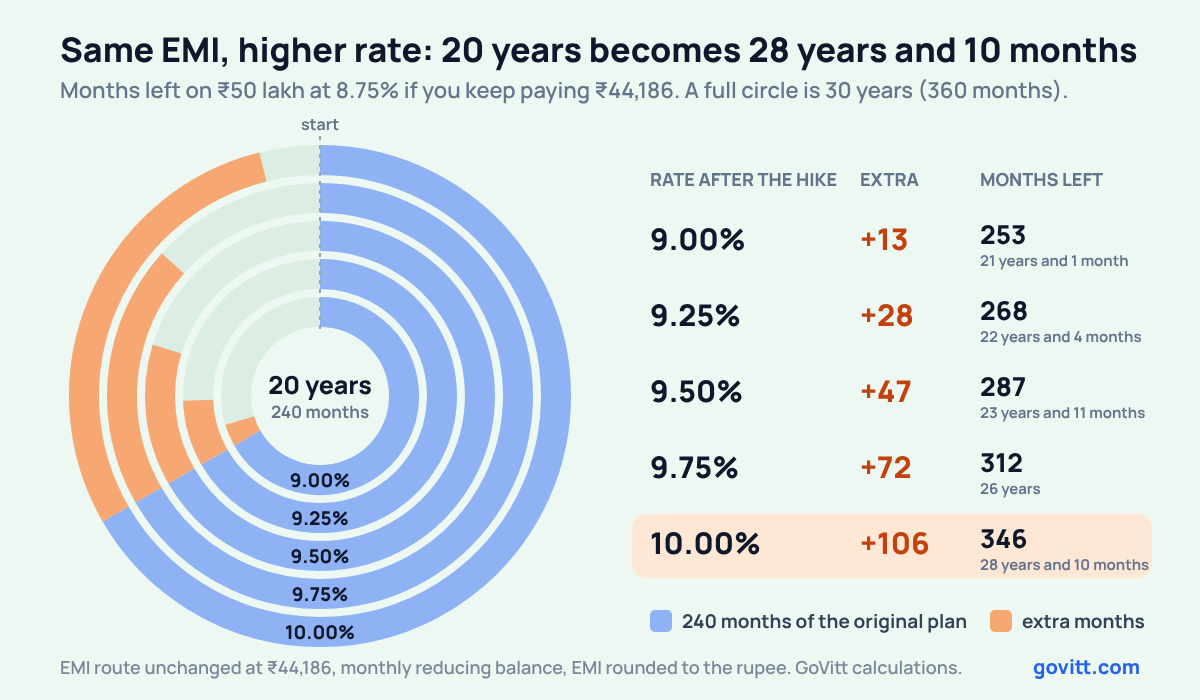
The first two rows are the ones in play on 4 December. A 0.25% hike is ₹800 a month or 13 months. A 0.50% hike is ₹1,607 a month or 28 months. Neither number looks frightening on its own. The last rows show why you should not stop there. A rise of 1.25% in total stretches the loan from 20 years to 28 years and 10 months.
The longer tenure costs far more than it seems
Every extra month is a month of interest on a big balance. So the tenure route is not the same money spread differently. It is more money.
| Rate after the hike | Extra interest, EMI route | Extra interest, tenure route | Tenure route costs |
|---|---|---|---|
| 9.00% | ₹1.92 lakh | ₹5.62 lakh | 2.9 times as much |
| 9.25% | ₹3.86 lakh | ₹12.36 lakh | 3.2 times as much |
| 9.50% | ₹5.81 lakh | ₹20.69 lakh | 3.6 times as much |
| 9.75% | ₹7.78 lakh | ₹31.47 lakh | 4.0 times as much |
| 10.00% | ₹9.76 lakh | ₹46.47 lakh | 4.8 times as much |
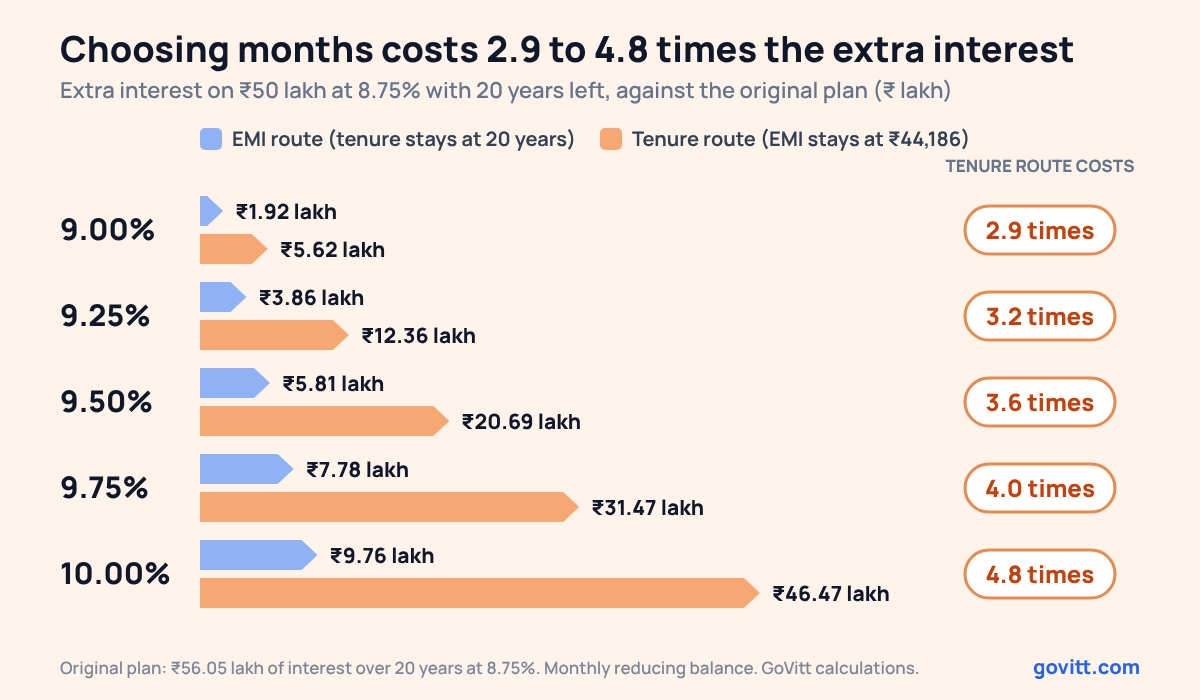
The extra interest is measured against your original plan, which is ₹56.05 lakh of interest over the 20 years at 8.75%.
There is also a ceiling. At a rate of about 10.60%, an EMI of ₹44,186 only just covers the monthly interest on ₹50 lakh. Past that rate the loan can never end. RBI's circular says stretching the tenure on a floating rate loan must not cause negative amortisation, which means the EMI has to cover at least the interest. So well before that rate, your EMI would have to go up as well. The tenure route buys you time. It does not buy you a way out.
What RBI's reset rule says
The rule is RBI's circular of 18 August 2023, "Reset of Floating Interest Rate on Equated Monthly Instalments (EMI) based Personal Loans". RBI's page shows it as updated on 1 October 2025. I read it and RBI's FAQ on rbi.org.in on 23 November 2026. In plain words, it says this:
- You get a choice. When the rate resets, the lender gives you the option of a higher EMI, a longer tenor or a mix of both. It also gives you the option to prepay part or all of the loan at any point.
- You get told. At sanction the lender must explain what a change in the benchmark does to your EMI or tenor. A later increase has to be communicated to you straight away.
- You get a statement. Every quarter it shows principal and interest recovered, your EMI, the number of EMIs left and the annualised rate.
- No negative amortisation. A longer tenor must not leave you owing more than before.
- A fixed rate switch is the lender's call. Since an amendment dated 29 September 2025, effective 1 October 2025, a lender may offer to switch you to a fixed rate. It does not have to. If it does, its charges must be disclosed in your sanction letter.
Now the part that matters for you. The circular is titled for personal loans. RBI's FAQ says it applies to personal loans only and is not applicable to other types of loans. The FAQ does extend it to housing loans of urban co-operative banks. I could not find housing loans named for any other lender, in the circular or in the 2025 amendment. The circular's list of addressees includes housing finance companies, but that only tells you who received it. Paragraph 3 extends the instructions to equated instalment loans "of different periodicities". My reading is that this is about how often you pay, not what the loan is for.
One news site, indianpaycalculator.in, said on 7 November 2026 that the rule covers home loans. I could not confirm that from RBI's own pages. So I'd treat the choice on a home loan as something your lender may or may not give you, until you have it in writing. In earlier hike cycles, the usual default I saw was an unchanged EMI and a longer tenure. Your quarterly statement tells you which one your lender picked.
When the new rate reaches you depends on your benchmark. Repo-linked loans reset at least every three months, and MCLR loans reset on the date in your contract, often six or twelve months. If you're still on MCLR, my post on moving to a repo-linked rate covers that.
A fixed rate is not the way out
The rule's fixed rate option sounds like an escape from a hiking cycle. It is expensive, and a lender doesn't have to offer it.
- Tata Capital says a switch from floating to fixed attracts 1% plus GST on the principal outstanding. On ₹50 lakh that's ₹59,000. Its rates page has no date, and I read it on 23 November 2026.
- Kotak Mahindra Bank's rate page lists 12% a year onwards for existing customers moving from a floating to a fixed rate. At 12% on ₹50 lakh over 20 years the EMI is ₹55,054, which is ₹10,868 more than your ₹44,186 today. The page has no date and came through a summary, so check it.
You'd pay a fee to lock a rate that is far above where floating rates sit. I wrote about that choice after the last inflation print in should you switch to a fixed rate.
What I'd pick, by situation
| Your situation | What I'd do |
|---|---|
| You can absorb the higher EMI | Take the higher EMI. The tenure stays at 20 years and the extra interest is ₹1.92 lakh on a 0.25% hike |
| Cash is tight this year | Take the longer tenure, then prepay the difference when you can. A floating rate loan carries no prepayment charge for an individual |
| You have a bonus or a lump sum | Part-prepay once and the lender shortens the loan. My post on reducing the EMI or the tenure when you prepay has the choice |
| Your rate after the hike is 1% or more above a new borrower's quote | Price a transfer. See the next section |
The prepaying rule is in your bank can't charge you for prepaying a floating rate home loan. If the lender stretches the tenure by default, you can undo it. Pay ₹800 more every month and you're back on the 20 year track, with no rule needed.
Where a transfer fits
A hike moves every lender's rate, so the gap between what you pay and what a new borrower is quoted tends to stay put. I covered that in rates just went up, does switching still make sense. Take an illustration. You're at 8.75% and a lender quotes 7.50% in writing. That's an EMI of ₹40,280 against ₹44,186, which is ₹3,906 a month.
Now use the same trick in reverse. Move to 7.50% and keep paying ₹44,186. The loan closes in 198 months instead of 240. That's 42 months early, and it cuts the interest by ₹18.93 lakh before costs. The all-in cost in Bengaluru is ₹53,700 to ₹76,500 on ₹50 lakh, from my post on every balance transfer charge. My rule is that costs should come back within 24 months. At ₹3,906 a month, ₹53,700 to ₹76,500 comes back in 14 to 20 months.
After a 0.25% hike, if new quotes also rise 0.25%, you'd be at 9.00% against 7.75%. The EMI would be ₹44,986 against ₹41,047. The gap is ₹3,939 a month. So the hike doesn't close the case for a transfer. It leaves it where it was.
How to see what your lender actually did
- Open your latest quarterly statement. Look for the rate, your EMI, the number of EMIs left and the interest recovered.
- Compare it with the last one. A higher rate with an unchanged EMI and more EMIs left means your lender took the tenure route.
- Check the schedule. My post on reading your amortisation schedule shows what to look for.
- Ask for the options in writing. Ask whether you can choose the EMI route, and what it charges.
For the mechanics of why the payoff date moves, see you think 15 years are left on your home loan, the math says 18.
What I'd do this week
- Find out which benchmark your loan is on. Your sanction letter says repo-linked or MCLR. The reset date follows from that.
- Read your last quarterly statement. Note your EMI and the number of EMIs left today.
- Decide your route before 4 December. If the hike comes, you want to know whether you'll pay ₹800 more or accept 13 more months.
- Ask your lender for the choice in writing. If it says the RBI rule doesn't cover home loans, ask what its own policy is.
- Get one written quote from another lender. Divide the all-in cost by the monthly saving.
- If you take the tenure route, set up a standing extra payment of the difference. You can switch it off any month.
FAQ
Does my home loan EMI or tenure go up after a rate hike? It depends on your lender. On a ₹50 lakh loan at 8.75% with 20 years left, a 0.25% hike means either ₹800 more a month with the same tenure, or the same ₹44,186 EMI with 13 more months. RBI's reset rule gives borrowers this choice on personal loans, and I couldn't confirm it covers home loans.
Can I choose a higher EMI instead of a longer tenure on my home loan? RBI's circular says a lender should offer a higher EMI, a longer tenor or both at a reset, and also let you prepay part or all of the loan. It is written for personal loans. Ask your lender in writing. Whatever it says, you can undo a longer tenure by paying the difference as a prepayment on a floating rate loan.
How many months does a 0.25% hike add to a ₹50 lakh home loan? 13 months, if you keep paying ₹44,186 at 9.00%. A 0.50% hike adds 28 months. A 1.00% hike adds 72 months.
Does RBI's reset rule cover home loans? The circular's title and RBI's FAQ say personal loans. The FAQ extends it to housing loans of urban co-operative banks. I could not find housing loans named for other lenders, in the circular or in its 2025 amendment. Ask your lender what its policy is.
Should I switch my home loan to a fixed rate before the RBI decision? A lender doesn't have to offer a switch, and it can charge for it. Tata Capital lists 1% plus GST on the principal outstanding, which is ₹59,000 on ₹50 lakh. Kotak's page lists 12% onwards for existing customers moving to fixed. Compare that with the extra EMI from the hike, which is ₹800 a month at 0.25%.
Is a balance transfer worth it after a rate hike? A hike moves every lender's rate, so the gap to a new quote tends to stay. At 8.75% against a written 7.50%, you save ₹3,906 a month on ₹50 lakh, and ₹53,700 to ₹76,500 of costs comes back in 14 to 20 months.
Want to see what a written 7.50% quote does to your own loan? Run the Payoff & Transfer Calculator with your outstanding amount, rate and years left. GoVitt compares 50+ banks and charges you 0% commission.
Figures are for ₹50 lakh outstanding, 20 years left, 8.75% today, monthly reducing balance, EMI rounded to the rupee. Extra interest is measured against the original plan. Rates of 7.50% and 7.75% are illustrations, not offers. Economists' views are theirs, are not a forecast and are as reported on 20 November and 21 October 2026. RBI circular and FAQ read on rbi.org.in on 23 November 2026. Tata Capital and Kotak figures are from their own pages, read on 23 November 2026, and carry no effective date. Bengaluru transfer costs are the illustrative range from GoVitt's charges post. Check your sanction letter and your lender's policy before you act. This is general information, not financial or legal advice.
Ready to take the next step?
Find out your loan options and check your eligibility with GoVitt today.