
Every time someone books an under-construction flat, there's a moment a few weeks after the sanction letter when the bank asks a question nobody prepared them for.
"Sir, pre-EMI or full EMI?"
Most people say pre-EMI. It's the smaller number, they're still paying rent, and the flat isn't ready anyway. Why pay a full EMI for a house you can't live in?
See your real payoff date in 60 seconds
Banks calculate remaining EMIs by simple subtraction. See your actual payoff date and discover how much interest a balance transfer can save.
I get it. A couple I spoke to last month were paying ₹32,000 rent in HSR Layout and had just booked a 2BHK off Sarjapur Road. Paying full EMI on top of rent felt impossible. But before they said yes to pre-EMI, I showed them the numbers below. They changed their mind on one part of it.
What the two options mean
With an under-construction flat, the bank doesn't release the whole loan on day one. It pays the builder in parts as construction moves along, slab by slab.
Pre-EMI means you only pay interest on whatever has been released so far. Nothing goes towards the principal. Your actual EMI starts after possession.
Full EMI means your regular EMI starts right away, calculated on the amount released so far, and it goes up as more is released. Part of every payment reduces the loan from the very first month.
One way to think about it. With pre-EMI, the loan's 20 year clock only starts when you get the keys. With full EMI, it starts with the first disbursement.
The numbers on a ₹64 lakh loan
Say you've booked an ₹80 lakh flat and taken a ₹64 lakh loan at 8.25%. The bank releases it in five equal parts of ₹12.8 lakh, every six months over two years. Possession is promised at 30 months, and you've chosen a 20 year tenure.
On pre-EMI, your first payment is ₹8,800 a month. By the time the whole loan is out, it's ₹44,000. Over those 30 months you pay about ₹7.9 lakh, and every rupee of it is interest. On possession day you still owe the full ₹64 lakh, and your EMI becomes ₹54,532 for the next 20 years.
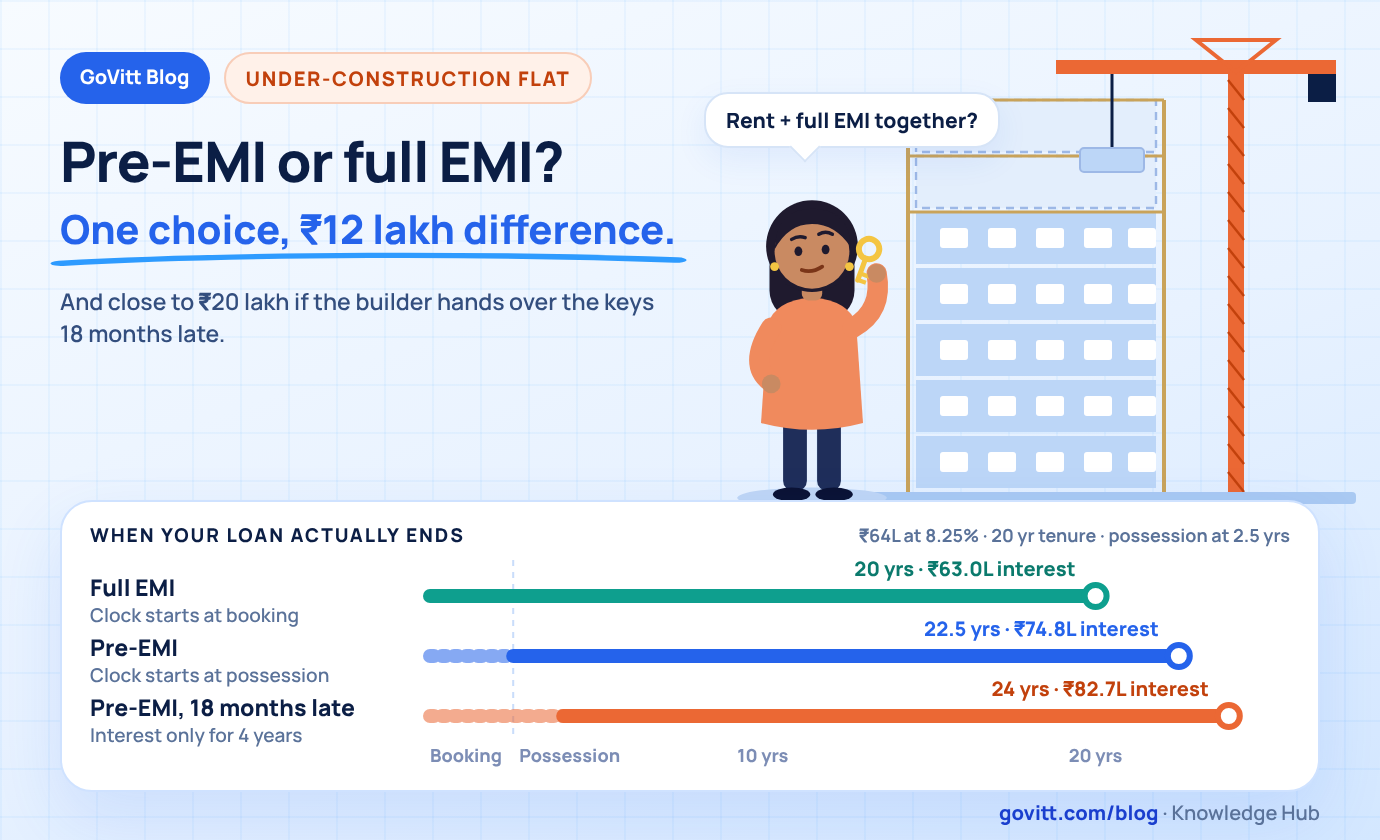
On full EMI, your first payment is ₹10,906 and it climbs to ₹55,712. Over the same 30 months you pay about ₹10 lakh, so roughly ₹2 lakh more. But by possession you owe ₹61.8 lakh, not ₹64 lakh, and the loan finishes two and a half years sooner.
Add it all up and full EMI costs about ₹63 lakh in total interest. Pre-EMI costs about ₹74.8 lakh. That's nearly ₹12 lakh more, mostly because you've quietly added two and a half years to your loan.
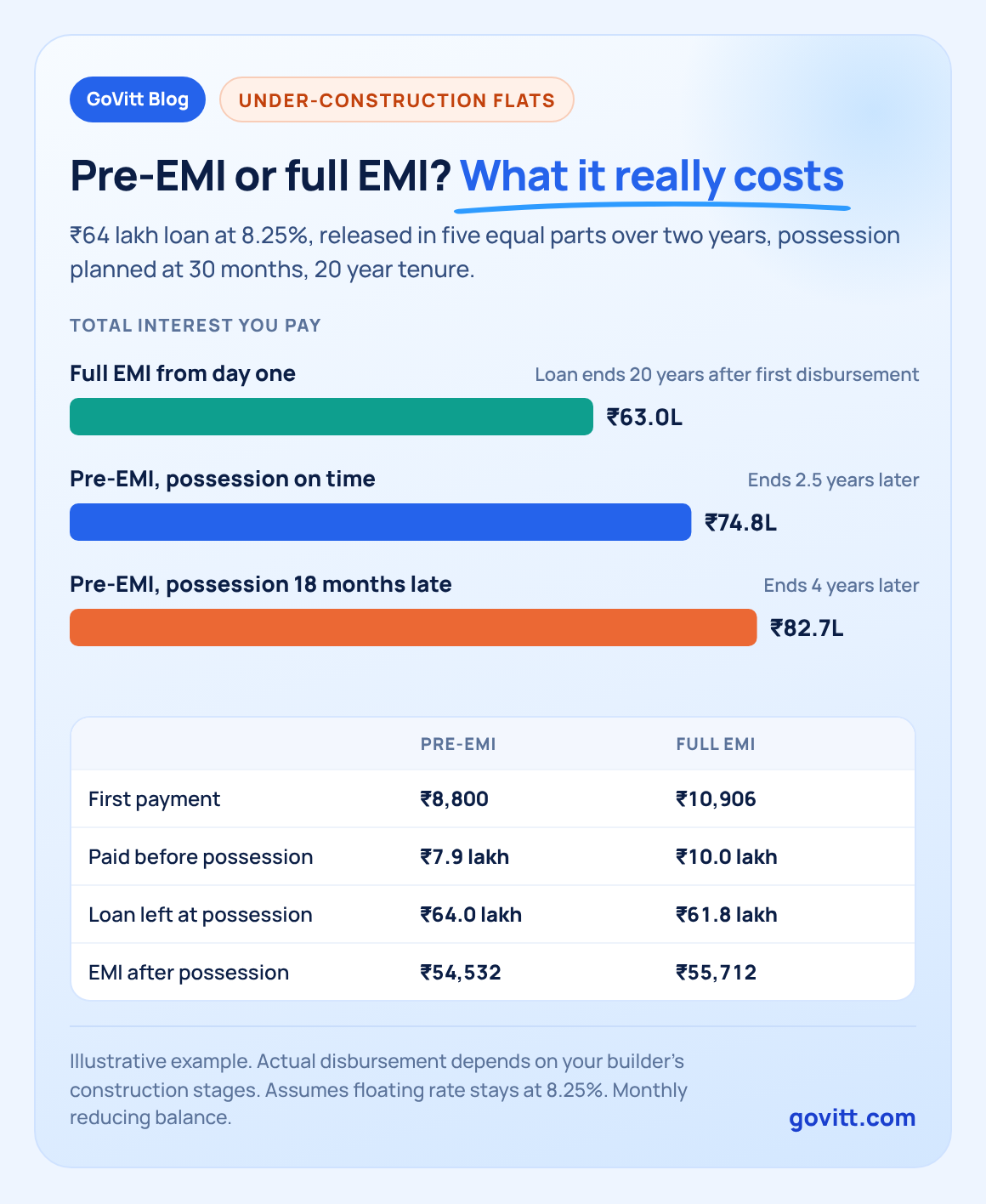
The bottom bar is the one people don't plan for.
The part that hurts more: delays
The example above assumes the builder hands over the flat on time. In Bengaluru, I wouldn't bet my budget on that.
If possession slips by 18 months, the pre-EMI phase just keeps going. You keep paying ₹44,000 a month of pure interest on the full ₹64 lakh, and your loan hasn't come down by a rupee. In that case pre-EMI costs about ₹82.7 lakh in total interest, almost ₹20 lakh more than full EMI. And your real EMIs only start four years after you'd have finished with full EMI.
On full EMI, a delay is annoying but it doesn't cost you extra interest in the same way. Your loan keeps coming down every month regardless of what the builder does.
If you remember one thing from this post, make it this. Pre-EMI makes the builder's delay your problem.
"But I get a tax benefit on pre-EMI interest"
This one comes up every single time, so let me be careful with it.
Under the old tax regime, the interest you pay before possession can be claimed, in five equal parts, starting from the year you get possession. In our example, ₹7.9 lakh becomes about ₹1.58 lakh a year for five years.
Sounds good. The catch is that it shares the same ₹2 lakh a year limit as your regular home loan interest on a self-occupied house. In the first year after possession, the regular interest on a ₹64 lakh loan is already about ₹5.2 lakh. You've hit the ₹2 lakh cap many times over before the pre-EMI interest even comes into the picture.
So for most people with a loan of this size, the pre-construction interest deduction adds nothing at all. And on the new tax regime there's no deduction for a self-occupied house anyway. Don't choose pre-EMI for the tax. There's usually no tax to be had.
If the flat is going to be rented out, the rules are different and it can matter more. Talk to your CA in that case.
So which should you choose?
If you can afford full EMI along with your rent, take full EMI. It's cheaper, it protects you from delays, and your loan ends sooner.
If you really can't, and for a lot of people paying Bengaluru rent that's simply the truth, there's a middle path. This is what the couple I mentioned ended up doing.
Start on pre-EMI while the payments are small. Then switch to full EMI once more of the loan has been released, or as soon as your rent stops. Most banks let you switch, sometimes for a small fee, so ask before you sign.
Or stay on pre-EMI but prepay whatever you can along the way. A bonus here, an FD maturing there. Every rupee you prepay during construction is a rupee that never earns interest for the bank. There are no prepayment charges on floating rate home loans to individuals.
And whatever you choose, keep the final tenure in mind. If you go with pre-EMI, ask the bank whether the tenure is counted from the first disbursement or from possession. It changes your end date by years.
A couple of things to check before booking
Look at the builder's payment plan. A construction-linked plan, where you pay as each stage is done, keeps your interest down. A plan that asks for 50% or more early on means more of the loan is released before there's much of a building, and you pay interest on it for longer.
If the builder offers to pay your pre-EMIs till possession, read the fine print properly. The loan is still in your name. If the builder stops paying, the bank comes to you, not to the builder. Some buyers learnt this the hard way a few years ago.
And check which banks have approved the project. A project approved by several big banks is easier to get disbursements on, and easier to transfer later if you find a better rate. I've covered the other checks in this post on buying from a builder.
Want us to work this out for your flat?
WhatsApp us the flat price, your loan amount, the builder's payment plan and the promised possession date on +91 70194 17854. We'll show you what pre-EMI and full EMI will actually cost you, and which of our 50+ partner banks and housing finance companies have approved the project. You can also play with your numbers on our EMI calculator. GoVitt doesn't charge you any commission.
Figures are illustrative. They assume a ₹64 lakh loan at 8.25% released in five equal parts over two years, a 20 year tenure, no change in the floating rate, and monthly reducing balance. Your builder's demand schedule and your lender's terms decide your actual numbers. Tax treatment is under the old regime for a self-occupied house. This is general information, not tax advice.
Questions people usually ask
What is pre-EMI in a home loan? Pre-EMI is the interest-only payment on the part of the loan that has been disbursed so far for an under-construction property. It doesn't reduce the principal. Your regular EMI starts after possession or once the full loan is disbursed.
Is pre-EMI or full EMI better for an under-construction flat? Full EMI is usually cheaper, because the principal starts coming down from the first payment and the loan ends sooner. On a ₹64 lakh loan at 8.25%, full EMI can save about ₹12 lakh in interest over the loan, and close to ₹20 lakh if possession is delayed by 18 months.
Can I claim tax deduction on pre-EMI interest? Under the old tax regime, interest paid before possession can be claimed in five equal parts starting from the year of possession. For a self-occupied house, it falls within the same ₹2 lakh annual limit as regular home loan interest, so many borrowers with larger loans get no extra benefit from it.
Can I switch from pre-EMI to full EMI later? Most lenders allow it, sometimes for a small fee. Many borrowers start on pre-EMI while payments are small and switch to full EMI once more of the loan is disbursed or when their rent ends.
What happens to pre-EMI if possession is delayed? You keep paying interest-only pre-EMIs until possession, so the total interest you pay goes up and your loan doesn't reduce at all during the delay. On full EMI, your loan keeps reducing every month regardless of the builder's timeline.
Is it safe to accept a builder's offer to pay pre-EMI? Be careful. The home loan is in your name, so if the builder stops paying, the lender will ask you to pay. Read the tripartite agreement closely and make sure you can afford the payments yourself if needed.
Ready to take the next step?
Find out your loan options and check your eligibility with GoVitt today.