
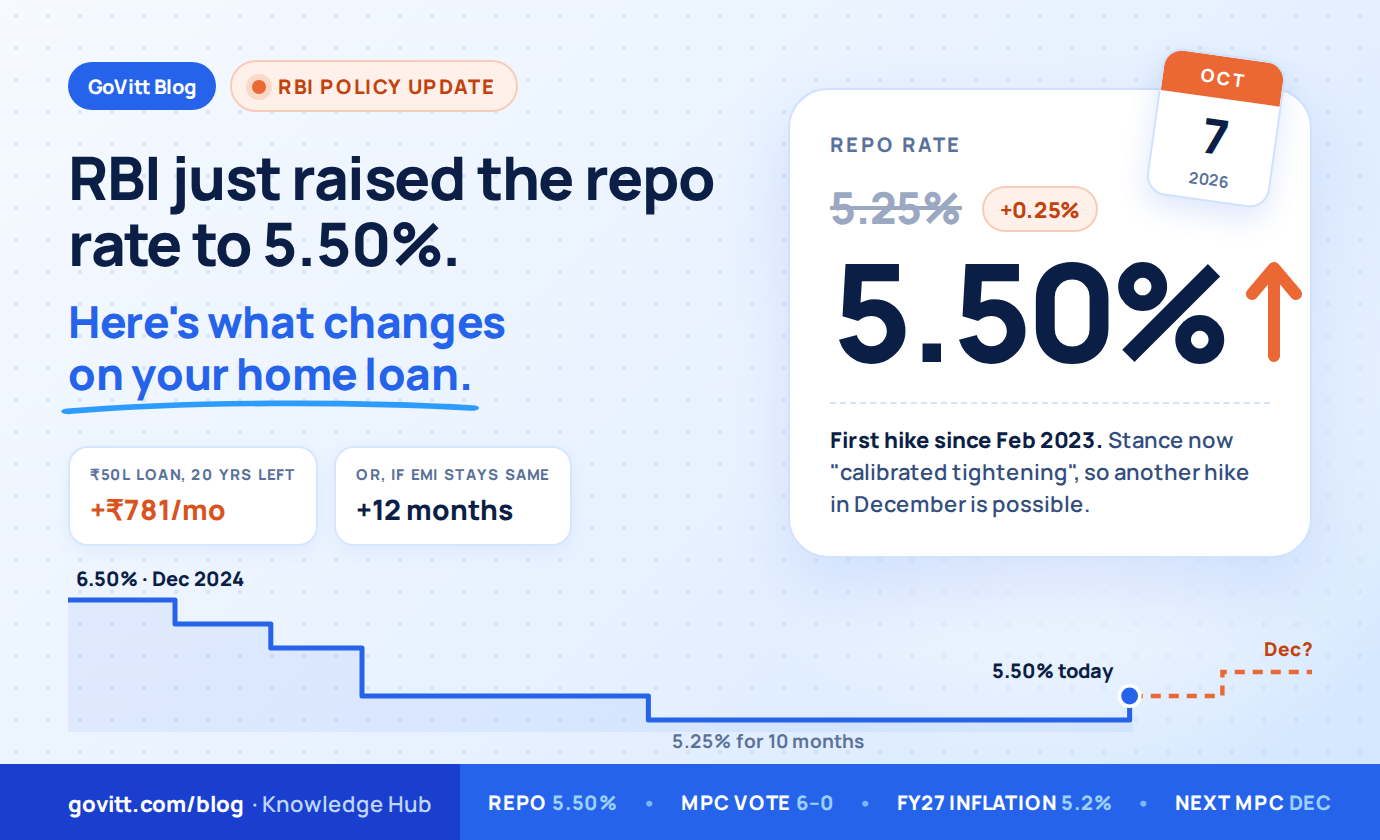
It's done. This morning RBI raised the repo rate by 0.25%, from 5.25% to 5.50%. It's the first hike since February 2023.
Three weeks ago I wrote that RBI may hike in October and again in December. The first half of that has now happened. The second half is more likely than it was yesterday, and I'll explain why in a minute.
If you have a home loan, or you're about to take one, here's what actually changes for you.
See your real payoff date in 60 seconds
Banks calculate remaining EMIs by simple subtraction. See your actual payoff date and discover how much interest a balance transfer can save.
What RBI announced
The six members of the Monetary Policy Committee voted unanimously for the hike. In the governor's words, the committee "unanimously decided in favour of hike in policy interest rate."
RBI raised its inflation forecast for this year to 5.2%, up from 5%. Retail inflation has now been above its 4% target for three months running, crude averaged somewhere around $114 to $116 a barrel in September, and the rupee has been weak. Growth, meanwhile, is strong. GDP grew 7.8% in April to June and RBI expects 7.1% for the full year. When growth is fine and inflation is rising, RBI has room to hike, and it used it.
The bigger news for borrowers is not the 0.25%. It's the change in stance. RBI moved from "neutral" to "calibrated tightening." Two of the six members voted against that change, but the majority carried it. So RBI is telling you that cuts are not coming any time soon, and more hikes are possible.
The next policy meeting is in early December. A lot of economists had already pencilled in a second 0.25% hike there.
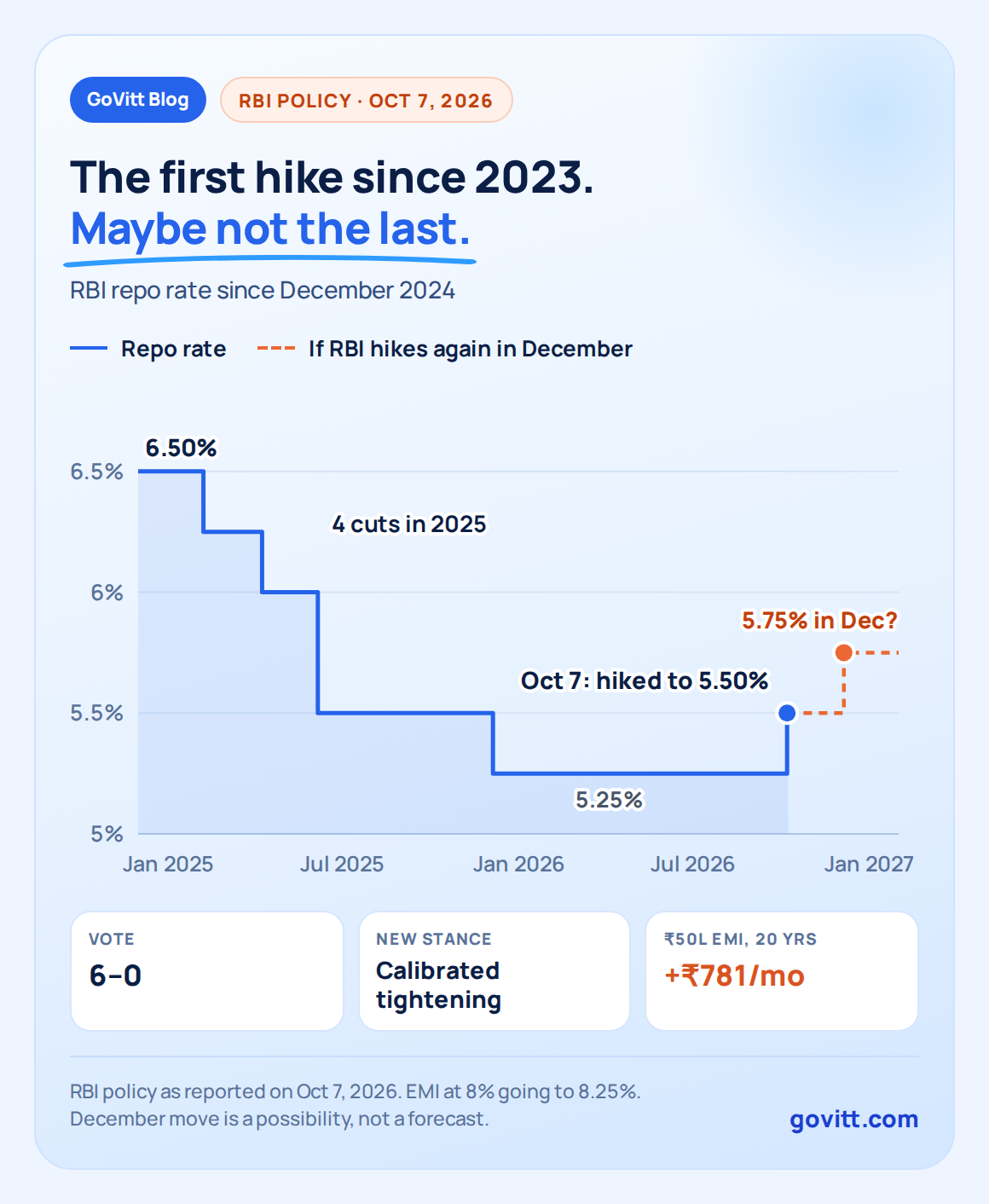
After four cuts in 2025, rates are going the other way. Today's hike takes the repo rate back to where it was in mid-2025.
What it does to your EMI
For a loan with 20 years left at 8% today, a 0.25% hike takes you to 8.25%.
| Loan outstanding | EMI now | EMI after hike | Or the loan runs longer by |
|---|---|---|---|
| ₹30 lakh | ₹25,093 | ₹25,562 | about 12 months |
| ₹50 lakh | ₹41,822 | ₹42,603 | about 12 months |
| ₹75 lakh | ₹62,733 | ₹63,905 | about 12 months |
| ₹1 crore | ₹83,644 | ₹85,207 | about 12 months |
₹781 a month on ₹50 lakh doesn't sound like much. But look at the last column. If your bank keeps your EMI the same and stretches the loan instead, you pay for about a year longer.
Over the life of the loan, paying the extra ₹781 a month costs you about ₹1.88 lakh more in interest. Letting the tenure stretch costs about ₹4.96 lakh. Same hike, almost three times the cost, depending on one choice that most people never actively make.
And if December brings another 0.25%, the extra EMI on ₹50 lakh becomes ₹1,569 a month, or about 26 extra months if the tenure stretches instead.
When will it reach your loan?
That depends on what your loan is linked to.
If your loan is linked to the repo rate, which is most bank home loans taken after October 2019, the hike reaches you at your next reset date. RBI requires these loans to reset at least once every three months, so by January at the latest.
If it's an MCLR loan, it changes on your reset date, usually once a year, and by however much your bank's MCLR has moved by then. Banks often raise MCLR slowly after a hike, but they do raise it.
If your loan is with a housing finance company, the company decides when and how much to pass on through its own benchmark.
If your loan has been sanctioned but not disbursed yet, or you're buying an under-construction flat where money is released in stages, the rate is worked out at each disbursement. So the hike is already in your rate from the next release.
What I'd do this week
Find out your reset date. Open your loan statement or the bank app. Two minutes. You can't plan for something if you don't know when it arrives.
Tell your bank you want the EMI increased, not the tenure. Do it in writing, before the reset date. RBI's rules on floating rate loans give you the right to choose. If you don't choose, many lenders will quietly stretch the tenure, and that's the ₹4.96 lakh option. I wrote about how that quietly happened to a lot of borrowers in 2022 and 2023 in this post on your real payoff date.
If you're paying 8.5% or more, look at your rate gap now, not later. The hike gets added on top of whatever you already pay. At 8.75%, after this hike, you're paying about ₹3,900 a month more on ₹50 lakh than someone at 7.50%. That gap was there before today, but every hike makes staying put a little more expensive. Lenders also tend to tighten the spreads they offer new customers when rates start rising, so the best transfer deals may not last. I did the full maths, charges included, in this post on moving from 8% to 7.20%, and the transfer process is here.
If you have spare cash, prepay. There are no prepayment charges on floating rate home loans taken by individuals. Every rupee you prepay is a rupee the new rate can't charge interest on.
If you're about to buy, recheck your budget at 8.5%, not today's rate. The same EMI now buys you a slightly smaller loan, about ₹1.3 lakh less on a ₹48,000 EMI over 25 years. The full breakdown is in how much home loan you can get on your salary. If you're shopping for a flat this festive season, also read this one first, because the price you agree on matters more than this hike.
And if you have FDs, don't rush to reinvest. Deposit rates don't move automatically with the repo rate. Banks raise them based on how much money they need, and that usually takes a few weeks. Existing FDs stay at whatever rate you booked.
What I would not do
Don't panic into a fixed rate loan. Fixed rates usually start higher than floating, they can carry prepayment charges, and if this cycle is just two hikes, you may lock in a higher rate for years for no reason.
Don't stop prepaying or cut your SIPs out of worry. A 0.25% hike is not a crisis. It's a reason to make two or three small decisions this week instead of ignoring them.
Check what it means for your loan
If you want to know exactly what today's hike does to your loan and whether a transfer now makes sense, WhatsApp your outstanding amount, current rate and years left to us on +91 70194 17854. Or put the same numbers into our free Payoff & Transfer Calculator. GoVitt works with 50+ banks and housing finance companies, and we don't charge you any commission.
Policy details are as reported on October 7, 2026. EMI figures assume a loan with 20 years left at 8% before the hike, monthly reducing balance, and full pass-through of the hike. Your lender's reset dates, benchmark and spread decide your actual numbers.
Questions people usually ask
What is the repo rate now? 5.50%. RBI raised it by 0.25% from 5.25% on October 7, 2026. It's the first increase since February 2023.
How much will my home loan EMI go up? On a ₹50 lakh loan with 20 years left at 8%, the EMI goes up by about ₹781 a month. As a rough rule, every 0.25% adds about ₹15 to ₹16 a month for each ₹1 lakh you owe.
When will the rate hike affect my home loan? Repo-linked loans reset at least once every three months, so within three months. MCLR-linked loans change at your reset date, usually once a year. Housing finance companies decide on their own timing.
Should I increase my EMI or my tenure after the hike? Increase the EMI if you can afford it. On a ₹50 lakh loan, a higher EMI costs about ₹1.88 lakh extra over the loan, while stretching the tenure costs about ₹4.96 lakh. Tell your lender your choice in writing before your reset date.
What does "calibrated tightening" mean? It means RBI is in a rate-raising phase but will move carefully, depending on data. In practice, rate cuts are unlikely in the near term and further hikes are possible.
Will RBI hike again in December? Nobody can say for sure. Many economists had expected a second 0.25% hike in December, and the change in stance makes that more likely. It will depend on inflation, crude prices and the rupee over the next two months.
Will FD rates go up now? Possibly, but not automatically or immediately. Banks set deposit rates based on their funding needs. Existing FDs keep the rate you booked until they mature.
Ready to take the next step?
Find out your loan options and check your eligibility with GoVitt today.