
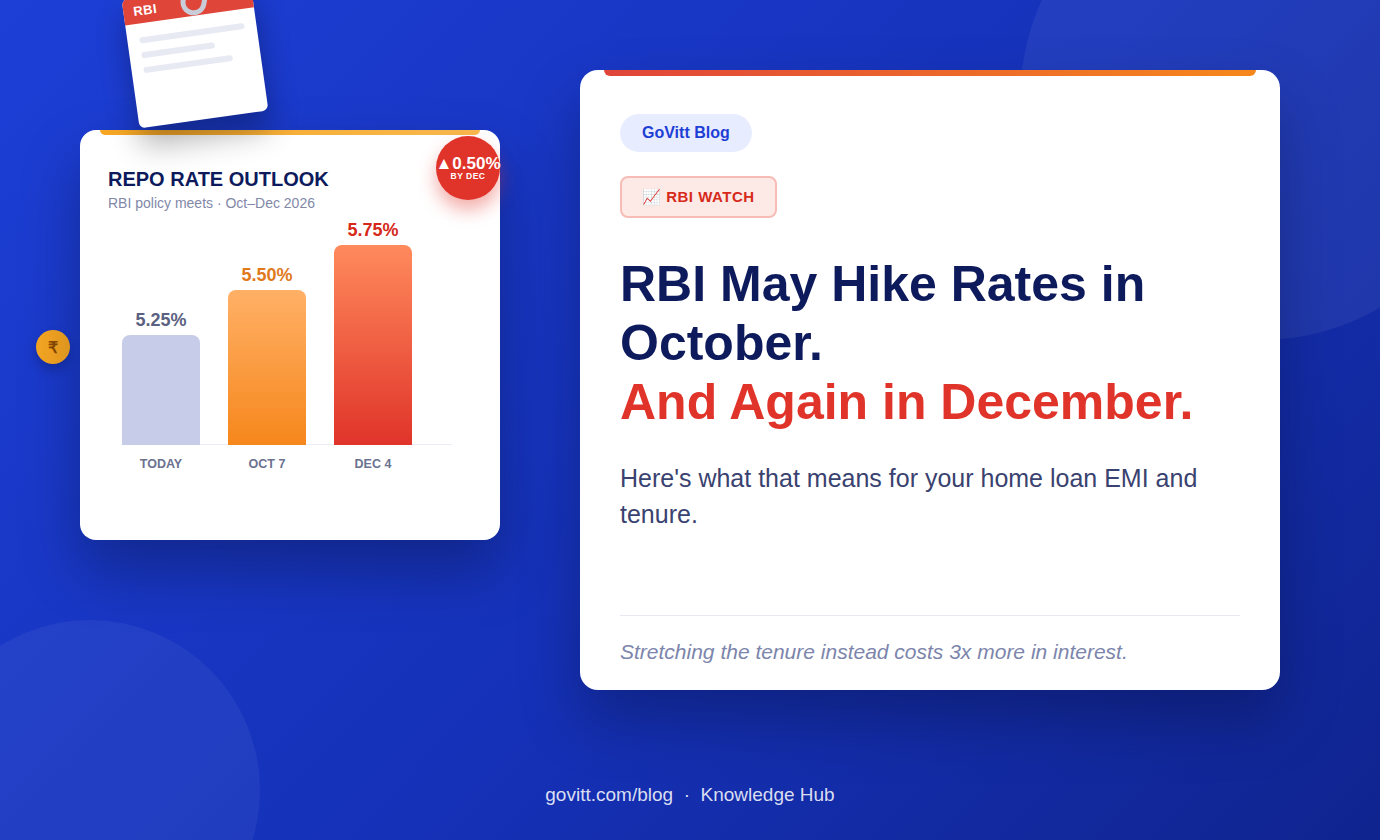
For almost two years, the home loan news I read was about rate cuts, or about RBI holding rates. This week that changed.
On September 16, the US Federal Reserve raised interest rates for the first time since July 2023. Just before that, India's retail inflation for August came in at 4.82%. And now a long list of economists expect RBI to raise the repo rate at its next meeting on October 5 to 7, and once more in December. Economic Times summed it up in its headline: 25 basis points each in October and December.
If you have a floating rate home loan, this affects you. So here's what is happening, what a hike would do to your EMI in rupees, and what I'd do about it right now.
See your real payoff date in 60 seconds
Banks calculate remaining EMIs by simple subtraction. See your actual payoff date and discover how much interest a balance transfer can save.
What just happened
The US Fed hiked. On September 16, the Fed raised rates by 0.25% to a range of 3.75% to 4.00%. It was the first hike since July 2023, and the Fed's own projections point to one more before the end of 2026 (Fox Business). As experts told Business Standard, the key point is not the size of the increase but the change in direction.
Why should a US decision matter for your EMI here? When US rates go up and Indian rates don't, the gap between the two gets smaller. That can put pressure on the rupee, and a weaker rupee makes imports like crude oil costlier. Costlier oil feeds into inflation, and inflation is what RBI is supposed to control.
Inflation is climbing at home too. Retail inflation rose to 4.82% in August from 4.45% in July, and food inflation was 5.66% (Business Standard). Wholesale inflation is at 9.92%. According to SBI Research, the Indian crude basket went from about $82 a barrel in July to $90 in August and nearly $110 in September, and retail inflation could cross 6.5% in the coming months (Business Today).
RBI had already warned about this. At the August policy, Governor Sanjay Malhotra said inflation "is expected to peak in Q3 of this year, primarily again due to food and fuel" (Business Standard). Q3 means October to December. That's exactly when the next two policy meetings are.
Who expects what
Here's what analysts are saying as of this week:
| Who | What they expect |
|---|---|
| HSBC | 0.25% in October and 0.25% in December |
| Nomura | Changed its call from a hold to 0.25% each in October and December |
| SBI Research | 0.25% each in October and December, 0.50% to 0.75% in total |
| Axis Capital | 0.50% in 2026 split between October and December, with the whole cycle limited to 0.75% |
| Emkay Global | A 0.25% hike in October looks more likely |
| MUFG | 0.25% in December and 0.25% in February, with some risk of 0.75% in total |
Not everyone is sure, though. Nikunj Saraf, CEO of Choice Wealth, told Business Standard: "A 25bps RBI rate hike is possible, but not a certainty. The key trigger would be persistent inflation, particularly if elevated crude prices start feeding into domestic inflation and put pressure on the rupee."
So the base case in the market right now is the repo rate going from 5.25% to 5.75% by December. That's the path in the chart below.
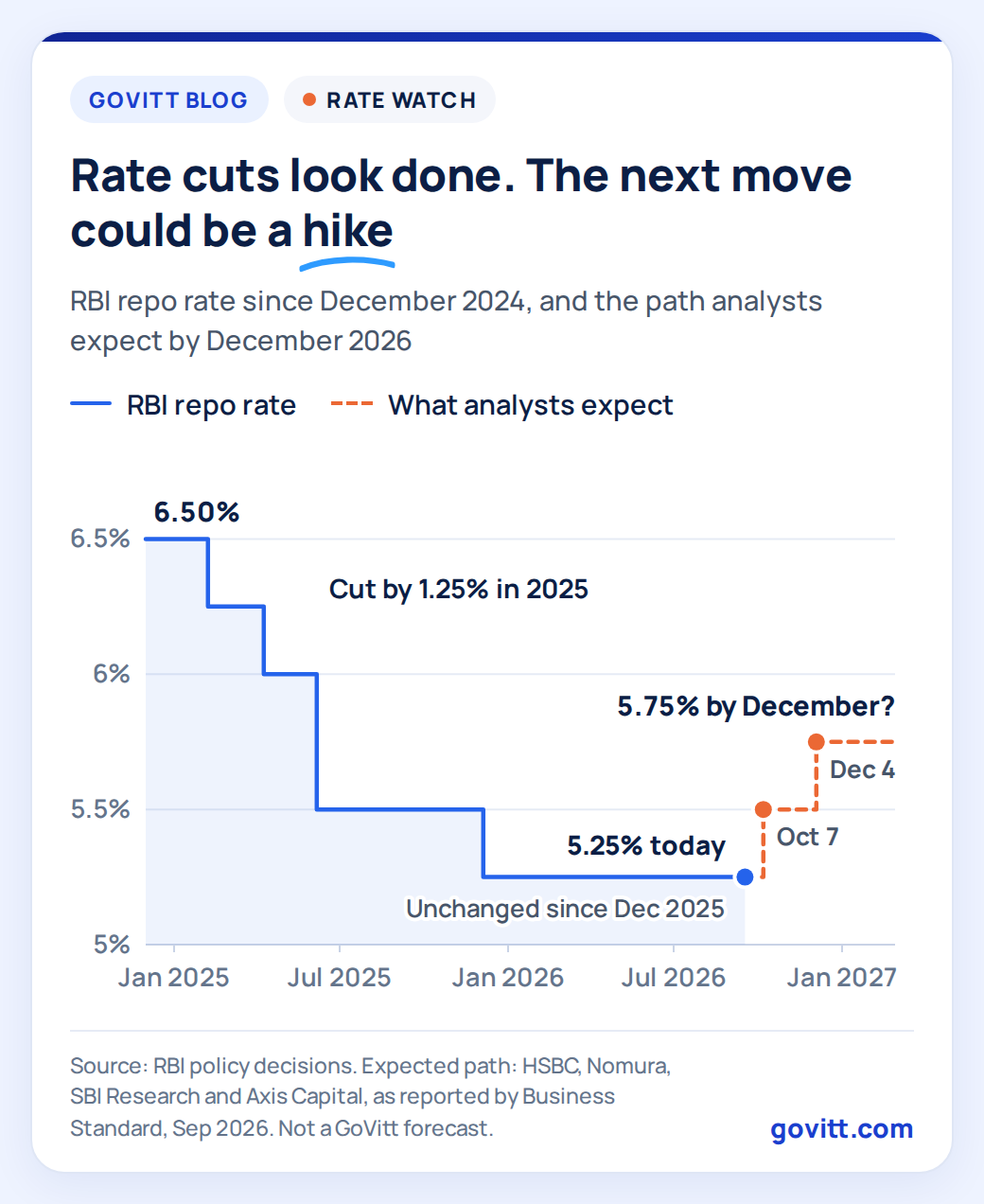
A little context helps here. In 2022 and 2023, RBI raised the repo rate by 2.50% in under a year. On a 20-year loan of ₹50 lakh, that took the EMI from ₹38,018 at 6.75% to ₹45,793 at 9.25%. What analysts expect now is 0.50%, maybe 0.75%. It's a much smaller move, but it's still a move in the wrong direction for borrowers.
When will a hike reach your loan?
It depends on what your loan is linked to. Your sanction letter or loan statement will tell you.
- Repo-linked loans. Most bank home loans taken after October 2019 are linked to the repo rate. RBI's rule is that these reset at least once every three months, so a hike on October 7 will reach your loan within three months. Your bank's reset date decides exactly when.
- MCLR-linked loans. These reset on your reset date, usually once a year, at whatever the bank's MCLR is then. MCLR has already been creeping up. The median one-year MCLR of banks went from 8.60% in July to 8.70% in August 2026.
- Housing finance companies. HFCs price loans off their own benchmark rate, so when and how much they pass on is their call.
- Loans not yet disbursed. Your rate is worked out on the benchmark at the time of disbursement. A hike before that means a higher starting rate.
What a hike does to your EMI, in rupees
For a loan with 20 years left at 8% today, this is how much the EMI goes up:
| Loan outstanding | EMI today | 0.25% hike | 0.50% hike |
|---|---|---|---|
| ₹30 lakh | ₹25,093 | +₹469 | +₹942 |
| ₹50 lakh | ₹41,822 | +₹781 | +₹1,569 |
| ₹75 lakh | ₹62,733 | +₹1,172 | +₹2,354 |
| ₹1 crore | ₹83,644 | +₹1,563 | +₹3,138 |
A simple rule of thumb: on a 20-year loan, every 0.25% adds roughly ₹16 to your EMI for each ₹1 lakh you owe.
Okay, ₹1,569 a month on ₹50 lakh doesn't sound scary. The real problem starts if your bank doesn't touch your EMI at all.
The part most people miss: EMI or tenure
When rates go up, your lender can raise the EMI, or keep the EMI the same and stretch the tenure. You notice a higher EMI the same month. Most people never notice a longer tenure. That's exactly what happened to a lot of borrowers in 2022 and 2023, and I wrote about it in this post on your real payoff date.
Here's the same ₹50 lakh loan with 20 years left at 8%:
| Hike | EMI goes up by | Or the loan runs longer by |
|---|---|---|
| 0.25% | ₹781 | 12 months |
| 0.50% | ₹1,569 | 26 months |
| 0.75% | ₹2,364 | 43 months |
And this is what each choice costs you in extra interest over the life of the loan:
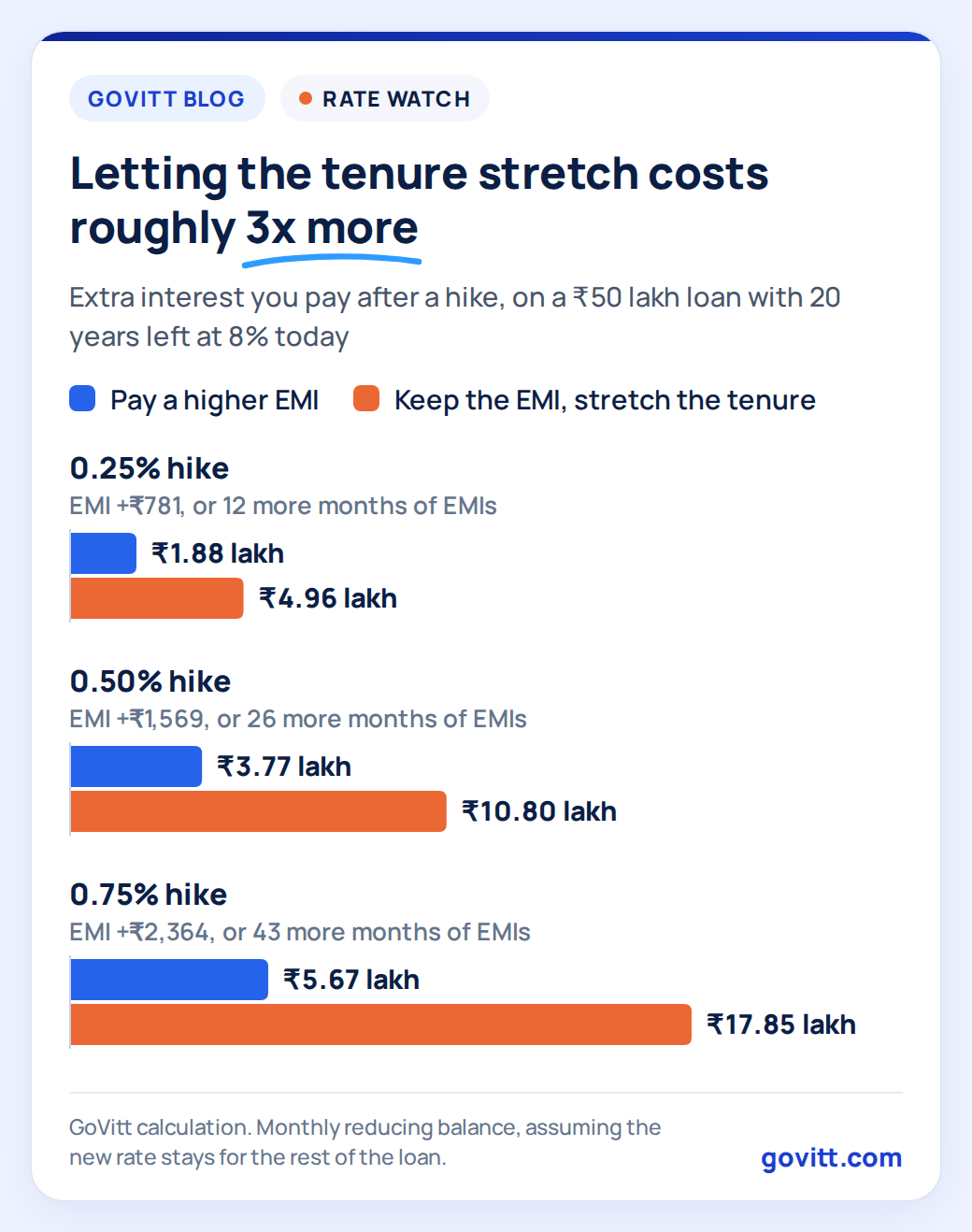
So the "no change in EMI" option is not free. It costs roughly three times more. RBI's rules on floating rate loans give you the right to choose at every reset: a higher EMI, a longer tenure or a mix of both. Use that right. When your bank tells you about the new rate, reply in writing that you want the EMI increased, not the tenure.
What I'd do if I had a home loan right now
1. Find out what your loan is linked to, and your reset date. It takes two minutes with your loan statement or the bank app. You can't plan for a hike if you don't know when it will reach you.
2. Pick a higher EMI over a longer tenure. If a ₹1,569 increase really doesn't fit your budget right now, take a mix of both and prepay later when you can.
3. If you're paying 8.5% or more, fix the rate before the hikes come. A hike gets added on top of whatever you pay today. At 8.50%, a 0.50% hike takes you to 9.00%, and the EMI on ₹50 lakh becomes ₹44,986. If you move to 7.20% first, the same hike takes you to 7.70%, and your EMI is ₹40,893. That's ₹4,093 less every month, hike included. A balance transfer does come with charges, around ₹54,000 to ₹77,000 on ₹50 lakh in Bengaluru, and I did the full math on that here. Ask your own bank to cut your rate first.
4. Prepay if you have spare cash. There are no prepayment charges on floating rate home loans taken by individuals. Every rupee you prepay now is a rupee a higher rate can't charge interest on. When you prepay, ask the bank to reduce the tenure.
5. Think twice before jumping to a fixed rate. Some lenders offer fixed or hybrid home loans. Fixed rates are usually higher than floating rates to start with, and they can carry prepayment charges. HDFC Bank, for example, charges 2% on fixed rate home loans if you prepay with money borrowed from another lender. If analysts are right and this cycle stops at 0.50% to 0.75%, locking into a higher fixed rate for years may not work in your favour. Run your own numbers before signing anything.
If you're about to buy a home
Rising rates cut into how much you can borrow. Say your budget allows an EMI of ₹41,822. At 8%, that gets you a ₹50 lakh loan for 20 years. At 8.5%, the same EMI only gets you about ₹48.2 lakh. That's ₹1.8 lakh less, just from a 0.50% change.
Two things to keep in mind:
- On a floating rate loan, your sanction letter usually fixes the spread, not the benchmark. If the repo rate goes up before disbursement, your starting rate goes up with it.
- Don't borrow right up to your maximum eligibility. Leave room in your monthly budget for one or two more hikes.
If you have FDs
The Moneycontrol piece on this also looks at fixed deposits, so a quick word on that. FD rates usually go up after repo hikes, but slowly. If you're about to put money into a long FD, some people split it across shorter tenures so they can reinvest if rates rise, and others lock in today's rate. There's no single right answer. It depends on when you need the money. And if you're sitting on FDs while paying a home loan at 8% or more, compare what the FD earns after tax with what the loan costs you.
Don't panic, but don't ignore it
A 0.50% hike is not 2022 all over again. Analysts are talking about a short, shallow cycle, and some think RBI may not hike at all. But for the first time since 2023, the next move on your home loan rate is more likely up than down.
The most useful thing you can do this week is spend five minutes with your loan statement. Know your rate, your benchmark, your reset date and your real payoff date.
You can put your numbers into our free Payoff & Transfer Calculator to see your real payoff date and what a lower rate would save you. Or WhatsApp your current rate, outstanding amount and years left to us on +91 70194 17854, and we'll tell you what a hike means for your loan and whether a transfer makes sense. GoVitt works with 50+ banks and housing finance companies, and we don't charge you any commission.
Data and analyst views are as of 17 September 2026. Analyst expectations are not certainties, and RBI may decide differently. EMI figures assume monthly reducing balance and are for illustration only.
Questions people usually ask
Will RBI increase the repo rate in October 2026? Nobody knows for sure until the decision on October 7. HSBC, Nomura, SBI Research and Axis Capital expect a 0.25% hike in October and another in December, which would take the repo rate to 5.75%. Others, like Choice Wealth, say a hike is possible but not certain.
How much will my home loan EMI go up if RBI hikes by 0.25%? On a 20-year loan at 8%, roughly ₹16 for every ₹1 lakh you owe. For ₹50 lakh, that's ₹781 a month. A 0.50% hike adds ₹1,569.
When will a repo rate hike show up in my home loan? Repo-linked loans reset at least once every three months, so within three months. MCLR-linked loans change on your reset date, usually once a year. Housing finance companies decide on their own.
Should I increase my EMI or my tenure after a rate hike? Increase the EMI if you can afford it. On a ₹50 lakh loan, a 0.50% hike costs about ₹3.77 lakh in extra interest if you pay a higher EMI, and about ₹10.80 lakh if you stretch the tenure instead.
Is it a good time to switch to a fixed rate home loan? It depends on the rate and the terms. Fixed rates usually start higher than floating rates and can carry prepayment charges. If this hiking cycle turns out to be short, a fixed rate may end up costing more. Compare the numbers for your own loan first.
Why does a US Fed rate hike affect home loans in India? It narrows the gap between US and Indian interest rates, which can pressure the rupee and make imports like crude oil costlier. That pushes up inflation, and RBI may respond by raising the repo rate, which reaches repo-linked home loans within three months.
Ready to take the next step?
Find out your loan options and check your eligibility with GoVitt today.