
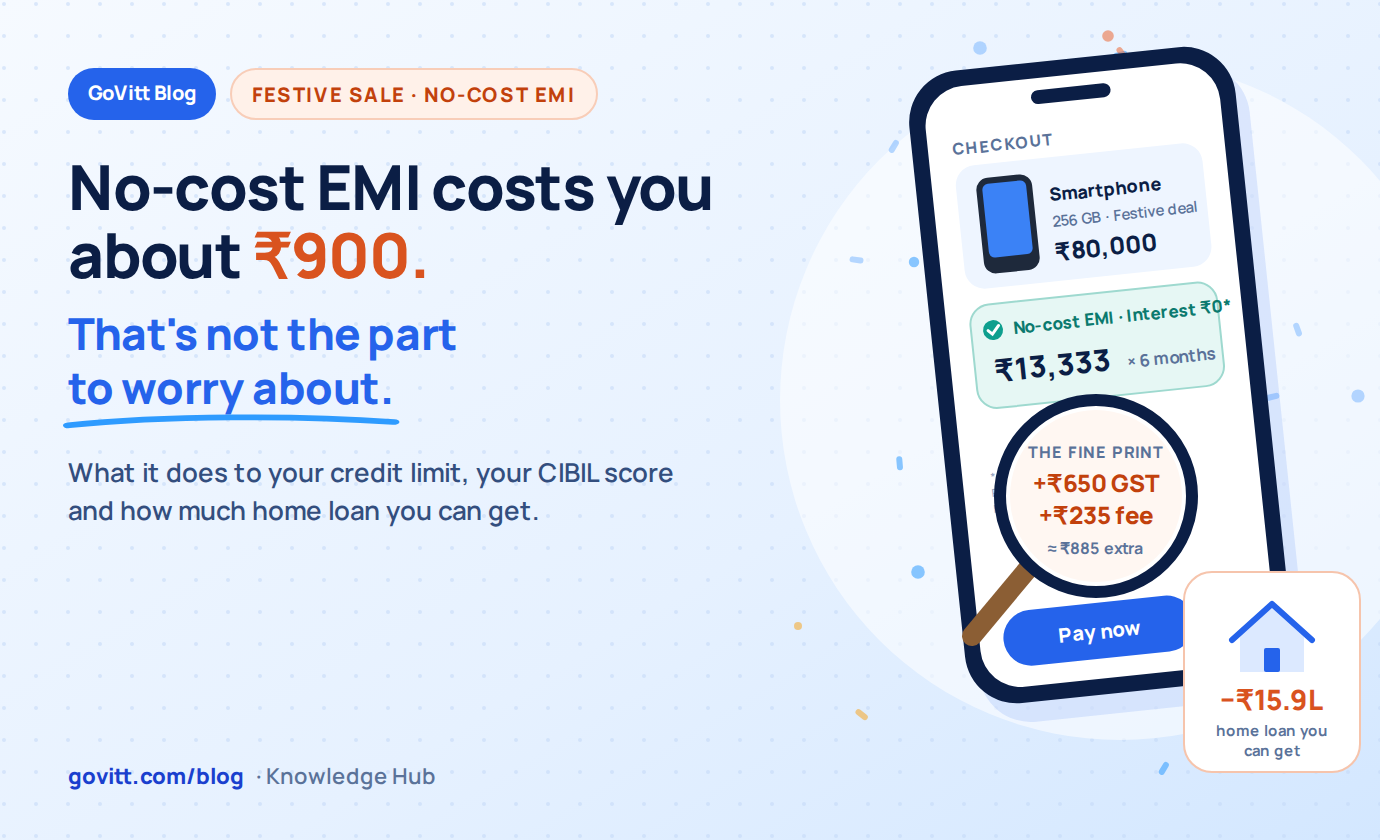
The festive sales have started, and every checkout page has the same little green line under the price. No-cost EMI. Pay ₹13,333 a month for six months instead of ₹80,000 today.
Most posts on this topic will tell you no-cost EMI is a scam, there's hidden interest, the bank is fooling you. That's half true. There is a cost, and I'll show you exactly what it is. But on its own it's small.
What people don't think about is what that EMI does to everything else. Your credit card limit, your credit score, and if you're planning to buy a house in the next year or so, how much home loan you can get. That's the part I want to talk about, because it's where I see people actually get hurt.
See your real payoff date in 60 seconds
Banks calculate remaining EMIs by simple subtraction. See your actual payoff date and discover how much interest a balance transfer can save.
How "no-cost" actually works
There's no such thing as an interest-free loan from a bank. RBI said as much back in 2013, when it told banks that "the very concept of zero per cent interest is non-existent."
So here's what really happens. The bank lends you money for six months and charges its normal card EMI interest. To make it look free, the seller gives you a discount on the product equal to that interest. You pay ₹80,000 in total, the bank gets its interest, and the seller has quietly cut its price to pay for it.
Three things don't get cancelled out though.
GST. Interest is a financial service, and there's 18% GST on it. The seller's discount covers the interest. It doesn't cover the GST on the interest. That shows up on your card statement every month.
The processing fee. Most banks charge something like ₹199 plus GST to convert a purchase into EMI. Some sellers waive it, most don't.
And sometimes the bank offer. A lot of sales give an instant discount for paying with a particular card. Read the fine print, because on some deals that discount is only for full payment, not EMI. If it's ₹4,000 off for paying upfront, the "no-cost" EMI just cost you ₹4,000.
The actual numbers
Say you buy an ₹80,000 phone on six months no-cost EMI, and your card's EMI rate is 16% a year.
The bank's interest over six months comes to about ₹3,600, which the seller covers through the discount. The 18% GST on that interest is about ₹650. Add the processing fee with GST, about ₹235.
So you pay around ₹885 more than the sticker price. Roughly 1.1%.
That's not terrible. If ₹13,333 a month genuinely works better for your cash flow than ₹80,000 today, paying ₹900 for that convenience can be a fair deal. I'm not going to tell you never to use it.
But the ₹900 is the visible cost. The other three are the ones nobody mentions on the checkout page.
Cost one: your credit limit gets blocked
When you convert ₹80,000 into EMI on your credit card, the bank blocks the whole ₹80,000 from your limit on day one. It frees it up slowly as you pay each instalment.
If your card limit is ₹2 lakh, you're now using 40% of it before you've bought anything else this month. Credit bureaus look at how much of your limit you use. Somewhere under 30% is generally seen as healthy. Go above that, especially across a few months, and your score can slip a bit.
It's not a disaster. It goes back up once you've paid. But the timing matters if you're about to apply for a big loan.
Cost two: miss one payment and it's not "no-cost" anymore
The discount only covers interest if you pay everything on time. Miss an EMI and you're looking at a late payment fee, interest at the card's regular rate on what's due, and a late payment on your credit report that stays there for years.
And if you decide to close it early, some banks charge a foreclosure fee on card EMIs, and the seller's discount may not carry over to the remaining amount. Check your bank's terms before you assume you can just pay it off next month.
Cost three: your home loan eligibility
This is the one I see in our work all the time.
When you apply for a home loan, the bank adds up every EMI you're paying and subtracts it from what your income can carry. It doesn't care whether the EMI is for a car or a phone, or whether it's "no-cost." An EMI is an EMI.
At 8% for 20 years, every ₹1 of monthly EMI room supports about ₹120 of home loan. So that ₹13,333 phone EMI reduces how much home loan you can get by about ₹15.9 lakh for as long as it's running. Over 25 years, about ₹17.3 lakh.
Now add up a normal festive season. The phone. A ₹60,000 TV on nine months. A ₹45,000 fridge on six months. That's ₹27,500 a month in EMIs, and roughly ₹33 lakh less home loan if you apply while all three are running.
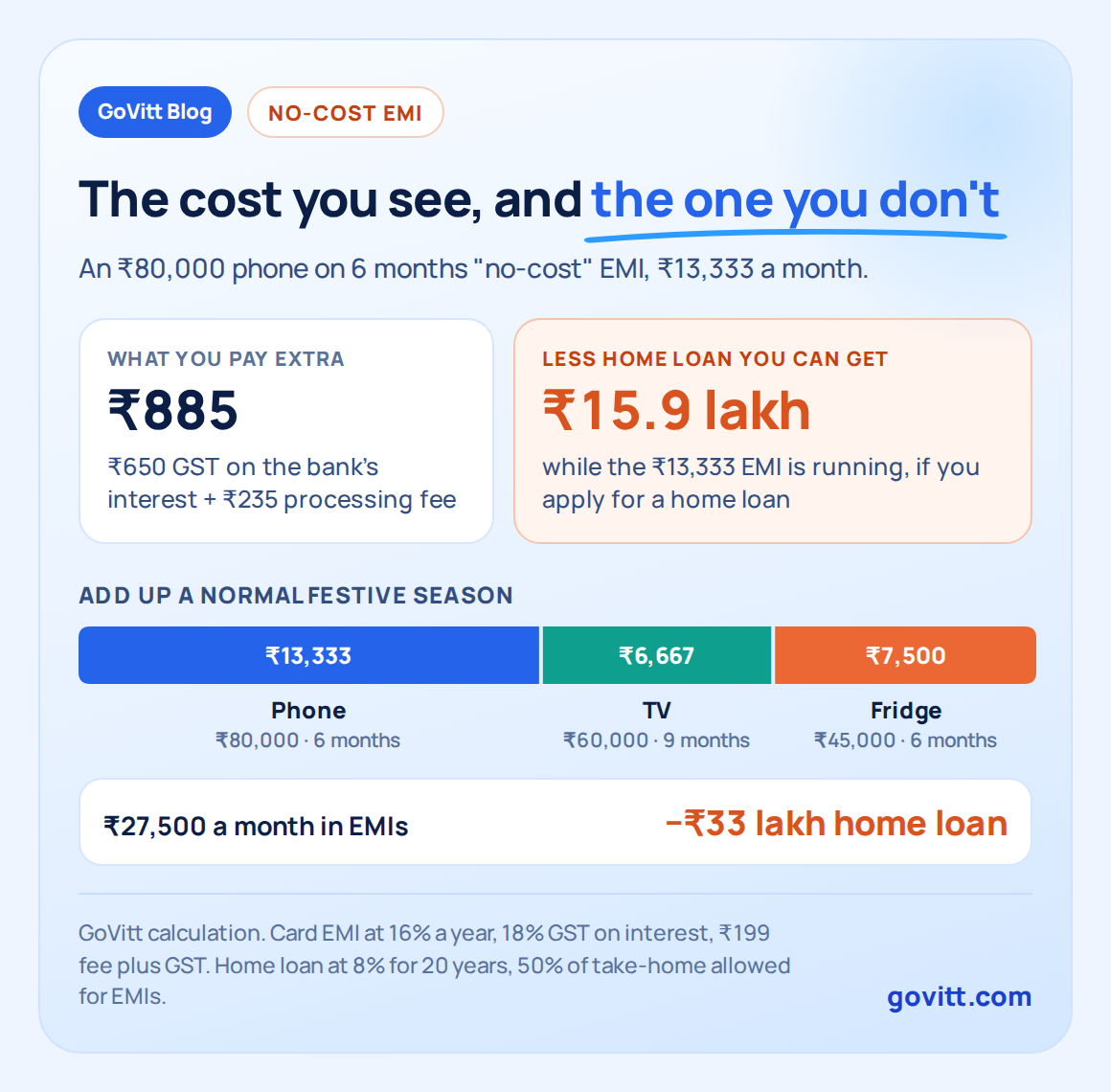
The ₹885 is the cost you see. The ₹15.9 lakh is the one you don't, if you're applying for a home loan while the EMI runs.
Some banks ignore loans with only a couple of EMIs left. Many don't. I wouldn't count on it. I explained how this whole calculation works in this post on how much home loan you can get on your salary.
So if you're planning to apply for a home loan in the next few months, the cheapest phone you can buy this Diwali is the one you pay for in full. Or the one you wait for.
When I think no-cost EMI is fine
It's fine when you could pay in full anyway, the bank offer doesn't disappear on EMI, and you just prefer keeping the cash in your account a few more months. You pay about 1% for that, which is reasonable.
It's fine when it's one purchase, not four, and your total EMIs stay comfortably under a third of your take-home.
It's fine when you're not applying for a home loan, car loan or anything big in the next six to nine months.
When I'd skip it
When you're only buying it because the EMI makes it feel affordable. If ₹80,000 feels like too much but ₹13,333 a month feels okay, it's the same ₹80,000.
When you already have other EMIs running and this pushes your total close to 40% of your take-home.
When you're about to apply for a home loan. Seriously. Wait, or pay upfront.
When the card is already carrying a balance. Then you're stacking a "free" EMI on top of debt that's costing you 36% to 42% a year, and that's the real problem to fix first.
A quick check before you tap "Pay"
Look at the EMI breakdown screen, not just the monthly figure. Most sites show the interest, the discount and the GST if you expand it. Check if the bank discount applies on EMI. See how much of your card limit this will block. And add up all the EMIs you'll have running next month, not just this one.
If you're planning to buy a home in the next year and want to know how your current EMIs affect what the banks will lend you, WhatsApp us your take-home salary and existing EMIs on +91 70194 17854. We'll tell you where you stand with our 50+ partner banks and housing finance companies. You can also run your numbers on our EMI calculator. GoVitt doesn't charge you any commission.
Figures assume a 16% annual card EMI rate, six monthly instalments, 18% GST on interest and a ₹199 processing fee plus GST. Your bank's rate, fees and foreclosure terms may be different. Home loan figures assume 8% and are illustrative. This is general information, not financial advice.
Questions people usually ask
Is no-cost EMI really free? Not completely. The seller gives a discount equal to the bank's interest, but you still pay 18% GST on that interest and usually a processing fee. On an ₹80,000 purchase over six months, that's around ₹800 to ₹1,000. You may also lose an instant bank discount that applies only on full payment.
Why is there GST on no-cost EMI? The bank still charges interest, which is a financial service, so 18% GST applies to it. The seller's discount covers the interest, not the GST, so the GST appears on your card statement.
Does no-cost EMI affect my CIBIL score? It can. The full amount is blocked from your credit card limit, which raises your credit utilisation until you pay it down. A missed EMI hurts your score more seriously. Paid on time, any dip is usually temporary.
Does no-cost EMI affect home loan eligibility? Yes. Banks count all running EMIs when working out how much home loan you can get. A ₹13,333 monthly EMI can reduce your home loan eligibility by about ₹16 lakh over 20 years at 8%, for as long as it's running.
Can I close a no-cost EMI early? Usually yes, but some banks charge a foreclosure fee on card EMIs, and the seller's discount may not apply to the amount you prepay. Check your card's terms before you do it.
Is it better to use no-cost EMI or pay in full? If you have the money and the card offer applies only on full payment, paying in full is cheaper. If you prefer to spread the payment, have no other big loans coming up and pay every EMI on time, no-cost EMI costs you only around 1% extra.
Ready to take the next step?
Find out your loan options and check your eligibility with GoVitt today.