
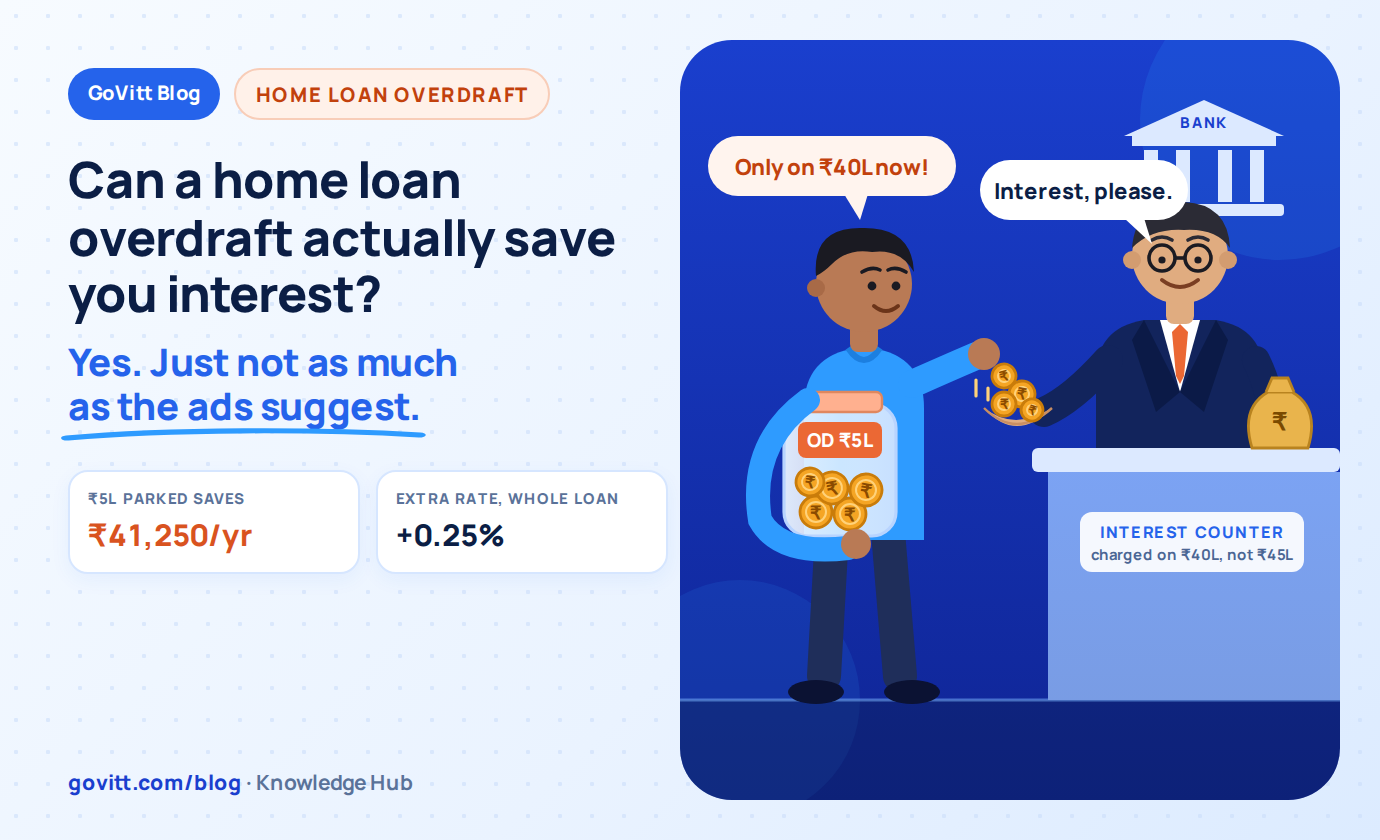
Here's something most salaried people with a home loan do without noticing. Salary lands in the savings account on the 1st. It sits there, slowly getting spent, earning 2.5% a year. And on the other side, the same person is paying 8% on a home loan.
So you're lending money to your bank at 2.5% and borrowing it back at 8%. Put like that it sounds a bit silly, and it is.
See your real payoff date in 60 seconds
Banks calculate remaining EMIs by simple subtraction. See your actual payoff date and discover how much interest a balance transfer can save.
A home loan overdraft is the product built to fix exactly that. SBI calls its version MaxGain, ICICI Bank has Home Overdraft, and a few other lenders have their own. I get asked about these a lot, usually by people who've seen a video or a relative swears by it. So here's how it works, what it really saves, and the cases where you're better off without it.
How it actually works
It's still a normal home loan with a normal EMI. The difference is that the loan comes with an account attached to it.
Any money you put in that account gets knocked off your outstanding loan for the purpose of calculating interest. Owe ₹45 lakh and have ₹5 lakh sitting in the account? Interest is charged on ₹40 lakh. The bank works this out on your daily balance, so even money that sits there for two weeks counts.
The bit that makes it different from simply prepaying is this: the money is still yours. You can pull it back out whenever you need it, through netbanking, like any other account. Prepay ₹5 lakh into a regular home loan and it's gone for good, it's reduced your loan and there's no taking it back. Park ₹5 lakh in an overdraft and you get most of the same saving, with an undo button.
That undo button is what you're paying for. Because there's always a catch.
The catch is the rate
Overdraft versions of home loans usually cost a little more than the same bank's regular home loan. How much more varies. Some sources quote barely 0.05% to 0.10%, some banks charge more, and it changes with your profile and the loan amount. Get the exact gap in writing before you decide anything, because the whole calculation turns on it.
And the higher rate applies to your whole loan, not just the part you've covered with your own money. That's what people miss. If you're paying 0.25% extra on ₹50 lakh, that's ₹12,500 a year gone before you've saved a rupee.
So the question isn't "does an overdraft save interest". It does. The question is whether the money you park is big enough to beat the extra you pay on everything else.
What it actually saves, in rupees
Let's take a ₹50 lakh loan for 20 years. Regular home loan at 8%. The overdraft version at 8.25%.
Keep nothing in the account and the overdraft is simply the more expensive loan. You'd pay about ₹1.88 lakh more in interest over 20 years for the privilege of an account you never use.
Keep ₹5 lakh in it on average for the life of the loan and it's a completely different story. Total interest drops by about ₹14.83 lakh compared to the regular loan, and the loan finishes in roughly 15 years 10 months instead of 20. That's a big number, and it's the number that makes these products look so good in videos.
But compare it with the obvious alternative. Take the same ₹5 lakh and prepay it into the regular loan on day one. That saves about ₹15.85 lakh and finishes at almost the same time.
So the overdraft costs you roughly ₹1 lakh more than prepaying, spread over 16 years. That's the price of being able to take your money back whenever you want. For a lot of people that's a very fair price. Emergency money you can't touch isn't really emergency money.
Where your spare cash does the most
Most people aren't choosing between an overdraft and prepaying, though. They're choosing between an overdraft and whatever they do now with their spare money, which is usually a savings account or an FD.
Here's what ₹5 lakh does for you in the first year, next to that same ₹50 lakh loan, if you're in the 30% tax bracket.
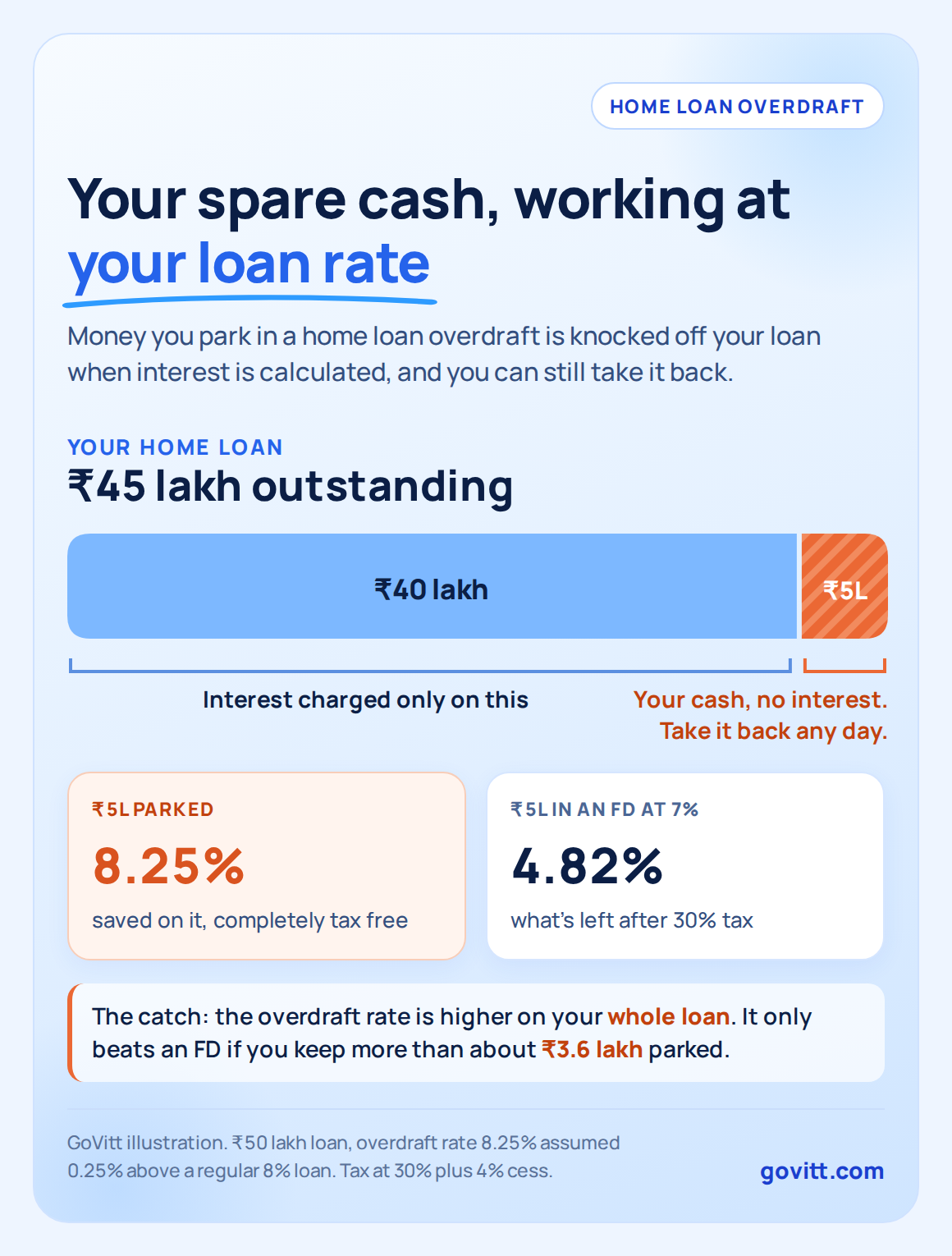
Park ₹5 lakh and you pay interest on ₹40 lakh instead of ₹45 lakh, but the higher rate on the whole loan means you need a decent balance for it to beat an FD.
In a savings account, ₹5 lakh earns about ₹8,600 after tax. Against that, the overdraft is a clear win.
In an FD at 7%, it earns about ₹24,080 after tax. The overdraft saves ₹41,250 in interest, but after paying the extra 0.25% on the full ₹50 lakh you're left with ₹28,750. Still better than the FD. Just not by the kind of margin that changes your life.
Run the maths backwards and at a 0.25% gap you need to keep more than about ₹3.6 lakh parked on average for the overdraft to beat an FD. Below that, you'd do better with a regular loan and an FD. If the gap is only 0.10%, that break-even falls to around ₹1.5 lakh, and the overdraft starts looking a lot more attractive. Which is why I keep saying, find out the gap first.
And if you're in a lower tax bracket, the FD looks better after tax, so the overdraft's edge gets thinner still.
The tax part, which most videos skip
Four things here, and the first one works strongly in the overdraft's favour.
The interest you save is effectively tax free. FD interest gets added to your income and taxed at your slab. Interest you didn't have to pay on your home loan is simply money that stayed in your pocket. At the 30% slab that's the whole reason the overdraft can beat an FD that looks close on paper.
Parking money does reduce the interest you pay, and so in theory the interest you can claim under Section 24(b). In practice, for most people with a decent sized loan it makes no difference. The deduction for a self-occupied house is capped at ₹2 lakh a year, and on our ₹50 lakh loan the first year's interest is about ₹4.09 lakh without any money parked and ₹3.66 lakh with ₹5 lakh parked. Both are well above the cap, so you claim ₹2 lakh either way. If your loan is smaller and your interest is already close to ₹2 lakh, this starts to matter a bit. I've explained how that ₹2 lakh cap works in more detail in this post on two home loans.
If you pull money out of the overdraft and spend it on something that isn't the house, like a car or a holiday, don't treat the interest on that money as home loan interest. It was borrowed for something else. The safe approach is to not claim it.
And on the new tax regime there's no 24(b) deduction on a self-occupied house anyway, so this part doesn't apply to you.
Who it's really good for
The overdraft makes the most sense if you'd otherwise keep a big pile of money idle. Some examples.
People with a large emergency fund. If you keep ₹4 or ₹5 lakh aside for emergencies anyway, parking it in the overdraft makes it work at your loan rate instead of FD rates, and it's still there the day you need it.
People who get a big annual bonus but might need it later in the year. Park it, save interest, withdraw if something comes up.
Self-employed people, whose cash comes in lumps. Money waiting to go out for GST, advance tax or supplier payments can sit in the overdraft for weeks at a time and cut your interest while it waits.
People saving up for something specific over the next couple of years, like a car or a child's admission fee, who'd otherwise keep that money in an FD.
And who it isn't for
If you don't have spare money sitting around, an overdraft is just a more expensive home loan. Plenty of people take one because it sounds clever and then never park more than a few thousand rupees in it. That's the worst possible outcome.
And be honest with yourself about discipline. An overdraft is basically an ATM backed by your house. The money is easy to take out, there's no friction, nobody asks why. If you know you'll dip into it for things you don't really need, a regular loan and a locked FD will actually leave you better off.
If you'd rather invest the spare money in equity for the long term, that's a different decision altogether, and nothing to do with this product. Just be clear that the overdraft is a guaranteed return equal to your loan rate, and equity is not guaranteed.
Before you sign up
Ask these, and get the answers in writing.
What exactly is the rate on the overdraft version, and what is it on the regular loan for someone with my profile? The gap between those two numbers decides everything.
How does the limit work? On most of these products the amount you can withdraw is linked to how far ahead of the repayment schedule you are, and the limit reduces over time.
Are there any extra charges? Processing fees can be different, and some overdraft products charge a commitment fee on the unused part of the limit. ICICI mentions this on its own FAQ page for Home Overdraft, so it's worth asking any bank about.
Can my existing loan be converted? Some banks let you switch for a fee. If yours won't, or the rate they're offering you is poor, you can move the whole loan to a lender that offers an overdraft version, through a balance transfer. I've done the full maths, charges included, on moving a ₹50 lakh loan to a lower rate.
So, should you get one?
If you regularly keep a few lakh aside and you'd feel uneasy locking it into a prepayment, yes, it's one of the better products in home lending. It's a very sensible way to make your emergency money pull its weight.
If you don't have that money, or the rate gap is large, or you know you'll treat it like a spending account, skip it. Prepay when you can instead. It's cheaper and it's just as effective.
If you want to know whether an overdraft makes sense on your loan, WhatsApp us your outstanding amount, rate, and roughly how much you usually keep aside, on +91 70194 17854. We'll work out whether an overdraft, a prepayment or a better rate saves you more, and which of our 50+ partner banks and housing finance companies offer an overdraft option. You can also compare what lenders are offering right now. GoVitt doesn't charge you any commission.
Figures assume a ₹50 lakh loan for 20 years, a regular rate of 8%, an overdraft rate of 8.25%, monthly EMIs and a constant average balance in the overdraft. Tax at 30% plus 4% cess, old regime. Your bank's actual rates, limits and charges will decide your numbers. This is general information, not tax advice.
Questions people usually ask
What is a home loan overdraft? It's a home loan with an account linked to it. Money you keep in that account is subtracted from your outstanding loan when interest is calculated, and you can withdraw it whenever you need to. SBI MaxGain and ICICI Home Overdraft are two examples.
Does a home loan overdraft really save interest? Yes, if you keep a meaningful amount parked in it. On a ₹50 lakh loan, keeping ₹5 lakh parked on average for the whole tenure can save around ₹14.8 lakh in interest compared with a regular loan at a rate 0.25% lower. If you keep very little in it, you just pay a higher rate for nothing.
Is a home loan overdraft better than prepayment? Prepayment saves slightly more because the regular loan has a lower rate, about ₹1 lakh more over the loan in our example. The overdraft's advantage is that you can take the money back when you need it. If you'll never need the money, prepay. If you might, the overdraft is worth considering.
Is a home loan overdraft better than keeping money in an FD? It depends on how much you park and how much extra the overdraft rate costs. At the 30% tax slab and a 0.25% higher rate, you need to keep more than about ₹3.6 lakh parked on average for the overdraft to beat an FD at 7%. With a smaller rate gap, it wins at a lower balance.
Does a home loan overdraft affect my tax deduction? It reduces the interest you pay, which could reduce your Section 24(b) claim. But for self-occupied homes the deduction is capped at ₹2 lakh a year, and on most larger loans your interest stays above that cap anyway, so the claim doesn't change. Interest on money withdrawn and used for other purposes shouldn't be claimed as home loan interest.
Can I convert my existing home loan into an overdraft? Some banks allow it, usually for a fee. If your bank doesn't, you can move the loan through a balance transfer to a lender that offers an overdraft version.
Who should not take a home loan overdraft? Anyone who won't keep much spare money in it, or who is likely to dip into it for everyday spending. Without a steady balance parked, it's simply a more expensive home loan.
Ready to take the next step?
Find out your loan options and check your eligibility with GoVitt today.