
Every year around this time a few people message me the same thing. "Bonus has come. Should I prepay the home loan or put it in an FD?"
Most years it feels like a close call. This year it isn't, and it got less close this week.
What changed
On October 7, RBI raised the repo rate to 5.50%. The very next day PNB, Bank of Baroda, Bank of India, Indian Bank and a few others raised their repo-linked lending rates by 0.25%. I've listed who has raised rates so far here. So if your home loan was at 8%, it's going to 8.25% from your next reset.
See your real payoff date in 60 seconds
Banks calculate remaining EMIs by simple subtraction. See your actual payoff date and discover how much interest a balance transfer can save.
FD rates haven't moved. They may not for a while either. SBI's chairman told reporters the day after the policy that "there may not be any rate action on the deposits" for the next two to three months, because banks have enough money right now.
Your loan got costlier in a day. Your FD didn't get any better. That gap is what this whole post is about.
The numbers on ₹3 lakh
Say you have ₹3 lakh you don't need for anything specific. Your home loan is ₹50 lakh with 20 years left, now at 8.25%, and you're in the 30% tax slab.
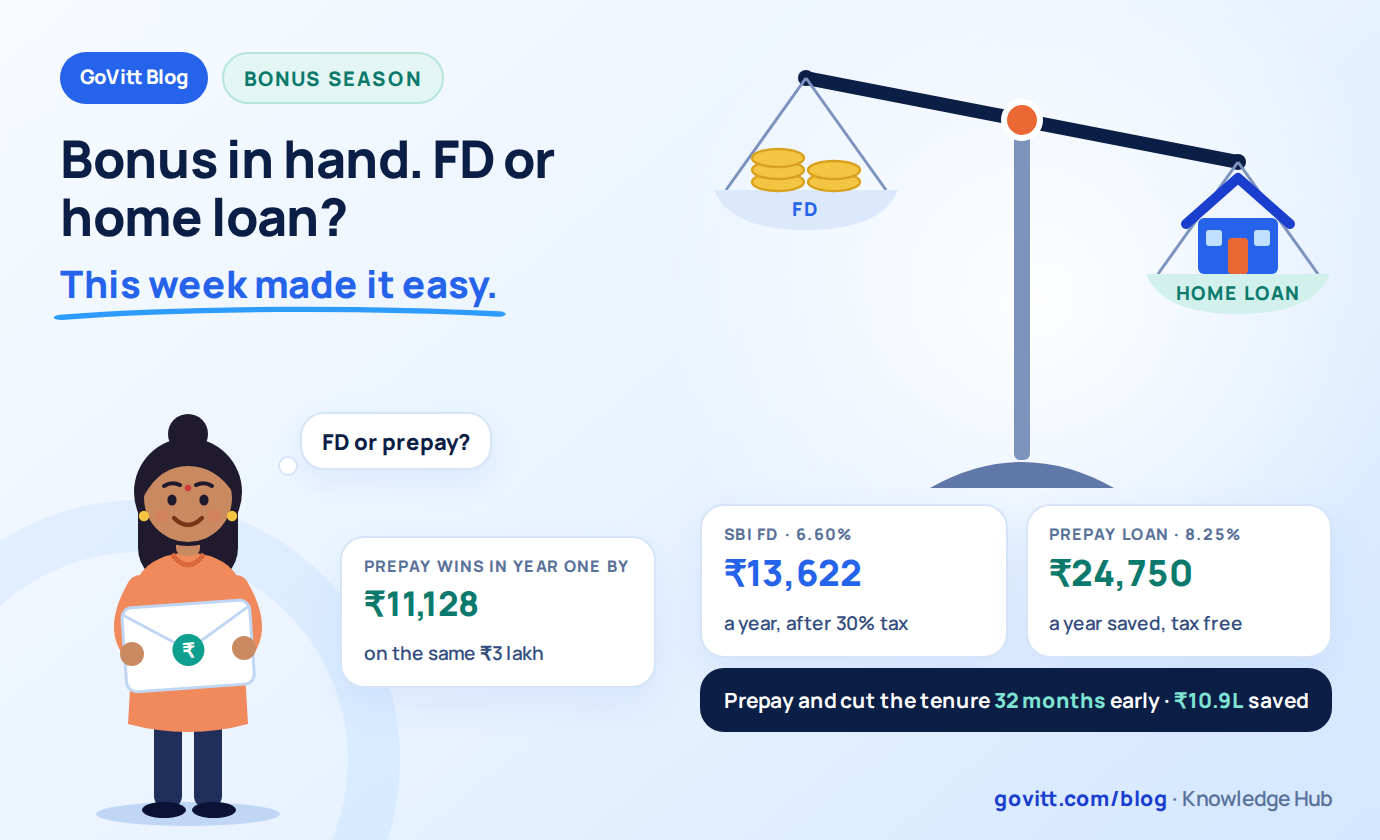
Put it in SBI's best FD right now, the 444-day Amrit Vrishti at 6.60%, and it earns ₹19,800 in a year. After tax and cess you keep about ₹13,600. That works out to 4.54%.
Prepay the same ₹3 lakh into your home loan and you save ₹24,750 of interest in that year. There's no tax on it, because interest you didn't have to pay isn't income.
So the FD leaves you about ₹11,000 behind in year one.
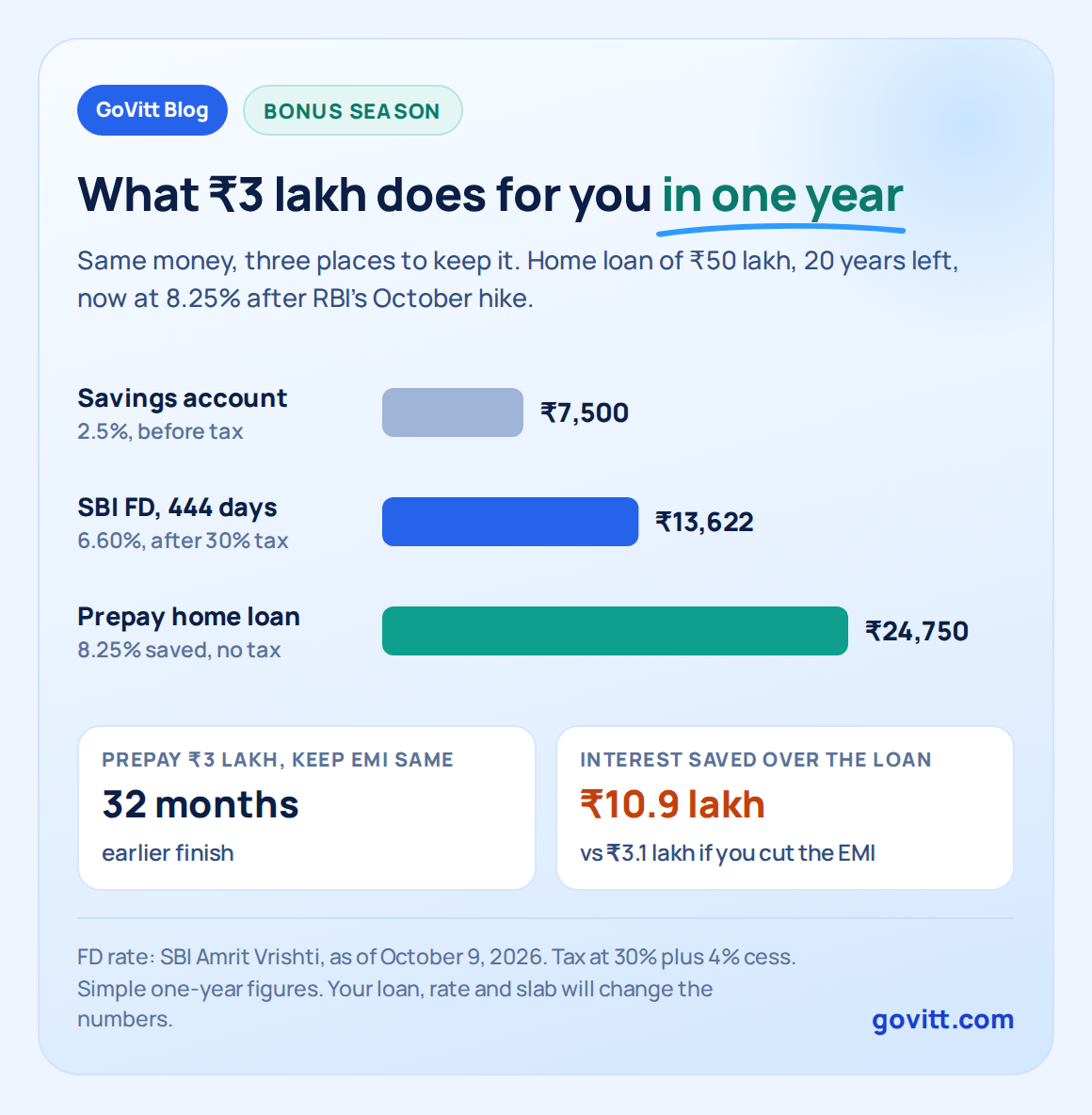
Same ₹3 lakh, three places to keep it. The prepayment wins by a wide margin, and it's tax free.
Over ten years, that gap turns into real money. ₹3 lakh rolled over in FDs at 6.60% grows to about ₹4.68 lakh after tax. The same ₹3 lakh saving you 8.25% on the loan is worth about ₹6.83 lakh. A difference of more than ₹2 lakh from one decision you make in October.
In the 20% slab the FD does a little better, about 5.2% after tax. Still three points behind your loan.
"But I get a tax benefit on the interest"
This is the argument I hear most. For most people it doesn't hold up.
If you're on the old tax regime and live in the house, you can deduct up to ₹2 lakh of home loan interest a year under Section 24(b). On a ₹50 lakh loan at 8.25%, your interest in the first year is about ₹4.09 lakh. Prepaying ₹3 lakh brings that down by about ₹25,000. You're still way over the ₹2 lakh cap, so you claim exactly the same deduction as before. You lose nothing.
On the new tax regime there's no deduction at all for a self-occupied house. So the loan costs you the full 8.25%, and every rupee you prepay saves the full 8.25%.
Where the deduction does matter is a smaller loan, where your yearly interest is already near or below ₹2 lakh. Even then, at the 30% slab, the loan still costs you about 5.7% after the deduction. That's more than the FD pays you after tax.
The one case where the maths really changes is a house you've rented out, because the interest is set off against rent in a different way. If that's you, sit down with your CA before you prepay.
Prepay, but tell the bank what to do with it
When you prepay, the bank either cuts your EMI or cuts your tenure. Sometimes it asks. Sometimes it just picks. Always ask for the tenure to be cut.
On our ₹50 lakh loan, ₹3 lakh prepaid now with the EMI kept the same means the loan ends 32 months earlier and you save about ₹10.9 lakh in interest over its life. Use the same ₹3 lakh to cut the EMI instead and the EMI drops by about ₹2,550 a month, but you only save around ₹3.1 lakh.
Same money. More than three times the saving.
And if you can do it every year? ₹3 lakh every bonus season turns that 20 year loan into one that's done in a little over 8 years. Not everyone can manage that, I know. But if your salary is going up, put your own numbers into our Payoff & Transfer Calculator and see what happens to your end date.
A couple of practical things. There are no prepayment charges on floating rate home loans taken by individuals, so don't let anyone tell you otherwise. Most banks let you prepay through net banking or the app, though some have a minimum amount for a part payment. After you pay, ask for an updated repayment schedule and keep it.
If you're on the old regime, the principal you repay, including a prepayment, counts towards your ₹1.5 lakh Section 80C limit. Most salaried people have already filled that with PF, so don't count on it as a bonus.
When I'd still keep the money out of the loan
Prepaid money is hard to get back. That's the trade you're making, so be sure about it.
If you don't have an emergency fund of at least six months of expenses, EMI included, build that first. Keep it in an FD or a liquid fund where you can get to it quickly. Or look at a home loan overdraft, which cuts your interest and still lets you take the money out.
If you need the money in the next year or two, for a down payment, school admission or a wedding, keep it out of the loan.
If you're carrying anything costlier than your home loan, clear that first. A personal loan, a car loan at 9% or more, credit card dues. They cost more, and every EMI you close also frees up room in your monthly budget.
If your home loan is at 8.75% or more, fix the rate before you prepay. On a ₹50 lakh loan, getting your rate cut from 8.75% to 8% and keeping your EMI the same saves about ₹12.7 lakh over the loan. That's roughly what prepaying ₹3 lakh does, except it doesn't cost you ₹3 lakh. Ask your bank to match the rate it gives new customers, or look at moving the loan. Then prepay on top.
And if you're really choosing between prepaying and equity mutual funds, that's a different question. Equity can beat 8.25% over long periods, with ups and downs along the way. But if the choice in front of you is an FD or the home loan, it's the home loan.
Before the bonus lands
Check your loan statement for your new rate and reset date.
Make sure six months of expenses are sitting somewhere you can reach.
Close anything costlier than the home loan.
If your rate is 8.75% or above, get it reduced first.
Then prepay, ask for the tenure to be cut, and keep the updated schedule.
Want us to run your numbers?
WhatsApp your outstanding amount, current rate, years left and how much you're planning to prepay to +91 70194 17854. We'll tell you how much it saves, how many months it takes off, and whether getting a better rate first would do more. Or try it yourself on our free Payoff & Transfer Calculator. GoVitt works with 50+ banks and housing finance companies, and we don't charge you any commission.
Figures assume a ₹50 lakh home loan with 20 years left at 8.25%, monthly reducing balance, and tax at 30% plus 4% cess. FD rate is SBI's 444-day Amrit Vrishti rate as reported on October 9, 2026. One-year figures are simple interest for comparison. Your bank, rate, tax slab and regime will change the numbers. This is general information, not tax or investment advice.
Questions people usually ask
Should I prepay my home loan or invest in an FD? If the money is spare and you already have an emergency fund, prepaying usually wins. With a home loan at 8.25% and an FD at 6.60%, the FD gives you about 4.5% after tax at the 30% slab, while prepaying saves the full 8.25%, tax free.
Is it a good time to prepay my home loan after the RBI rate hike? Yes, for most borrowers. Banks raised lending rates within a day of RBI's October 7 hike, but deposit rates haven't moved, and SBI's chairman has said they may not for two to three months. That widens the gap in favour of prepaying.
Should I reduce EMI or tenure when I prepay? Reduce the tenure if you can manage the current EMI. On a ₹50 lakh loan with 20 years left at 8.25%, prepaying ₹3 lakh and keeping the EMI the same saves about ₹10.9 lakh in interest and ends the loan 32 months earlier. Cutting the EMI instead saves about ₹3.1 lakh.
Will I lose my tax benefit if I prepay my home loan? Usually not. Under the old regime the interest deduction on a self-occupied house is capped at ₹2 lakh a year, and on most larger loans the interest stays above that even after a prepayment. Under the new regime there's no deduction for a self-occupied house anyway.
Are there charges for prepaying a home loan? Not on floating rate home loans taken by individuals. Fixed rate loans and some loans taken for business purposes can carry charges, so check your loan agreement if you're not on a floating rate.
When should I not prepay my home loan? When you don't yet have an emergency fund, when you'll need the money within a year or two, when you have costlier loans such as personal loans or credit card dues, or when your home loan rate itself is high enough that getting it reduced would save more.
Ready to take the next step?
Find out your loan options and check your eligibility with GoVitt today.