
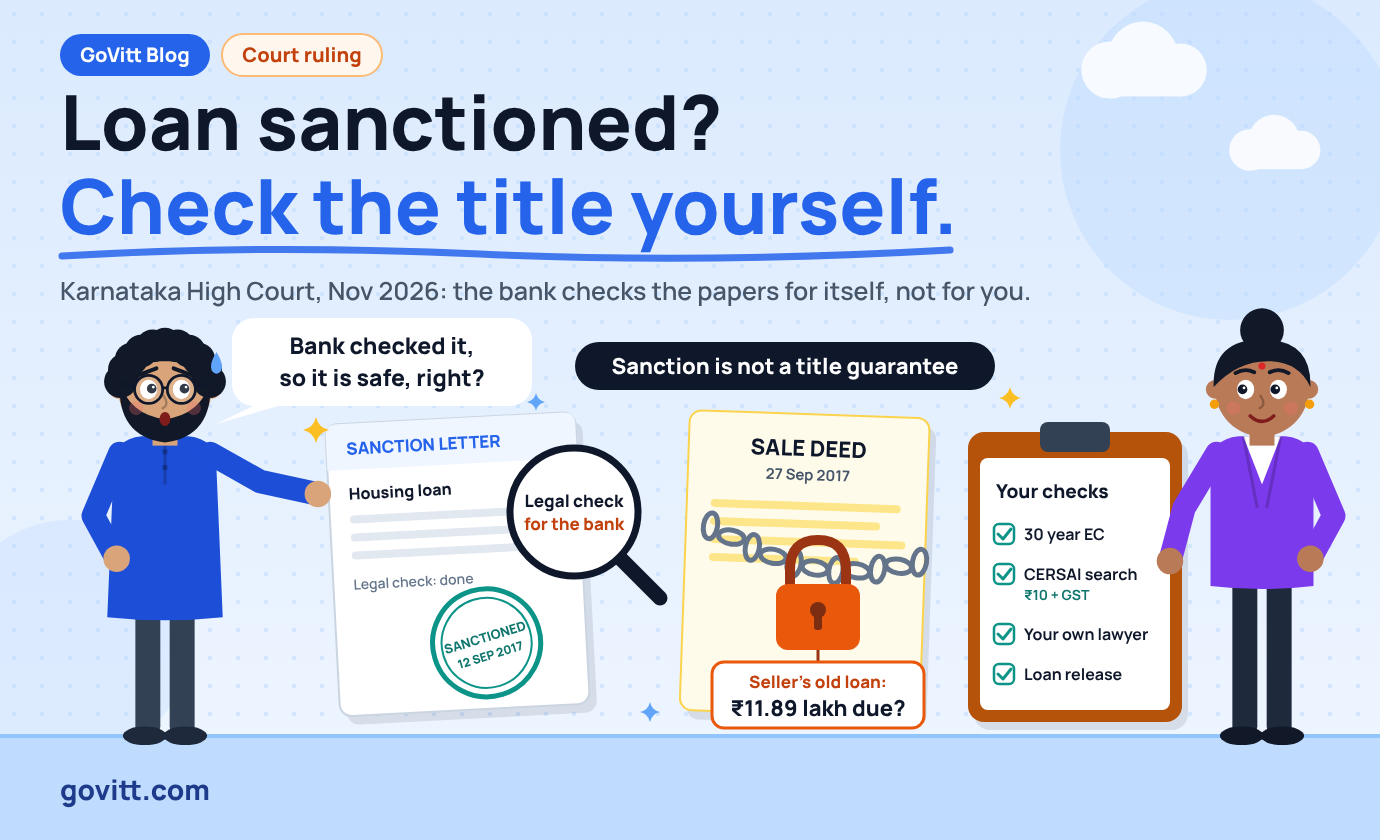
Your bank's legal verification for home loan approval protects the bank. It doesn't certify the title to you, and the Karnataka High Court has now said so in a Bengaluru case reported on 12 November 2026. A flat buyer got an HDFC Bank housing loan in September 2017, after the bank's legal department went through the papers. The seller had an SBI home loan on the same flat, with ₹11.89 lakh outstanding at the start of that year. After the sale, SBI started recovery, saying its money was still due. The buyer went to the police and named HDFC Bank. The court quashed the cheating case against the bank, holding that its scrutiny "does not, by itself, amount to a certification of title".
The short version: a loan sanction tells you the bank is willing to hold that flat as security. Whether the seller can pass you a clean title is your job. The court said the buyer has to do independent due diligence, and the bank's check can't stand in for it.
Below: what happened, what the court decided, what it left open, a September ruling from the same judge, and the seller-loan papers I'd insist on before paying a rupee.
See your real payoff date in 60 seconds
Banks calculate remaining EMIs by simple subtraction. See your actual payoff date and discover how much interest a balance transfer can save.
What happened
These are the facts as LiveLaw Biz reported them. I haven't read the order itself.
| Date | What happened |
|---|---|
| 11 January 2017 | The seller's SBI home loan on the flat has ₹11.89 lakh outstanding |
| 2 August 2017 | SBI issues a certificate saying it holds the original sale deed and some encumbrance certificates |
| 7 August 2017 | The buyer signs an agreement for sale with the seller |
| 12 September 2017 | HDFC Bank sanctions the buyer's housing loan after its legal department reviews the documents |
| 27 September 2017 | The seller executes the sale deed in the buyer's favour |
| After the sale (date not reported) | SBI starts recovery under the SARFAESI Act, saying the seller's loan is still outstanding. The record also refers to a discharge deed said to have been executed by SBI |
| Later | On the buyer's complaint, Cubbon Park police register a cheating case under Sections 420 and 34 of the IPC, with HDFC Bank among the accused |
| 2025 | HDFC Bank files Criminal Petition No. 8395 of 2025 to quash it |
| Reported 12 November 2026 | Justice Suraj Govindaraj quashes the case against HDFC Bank. The case against the other accused continues |
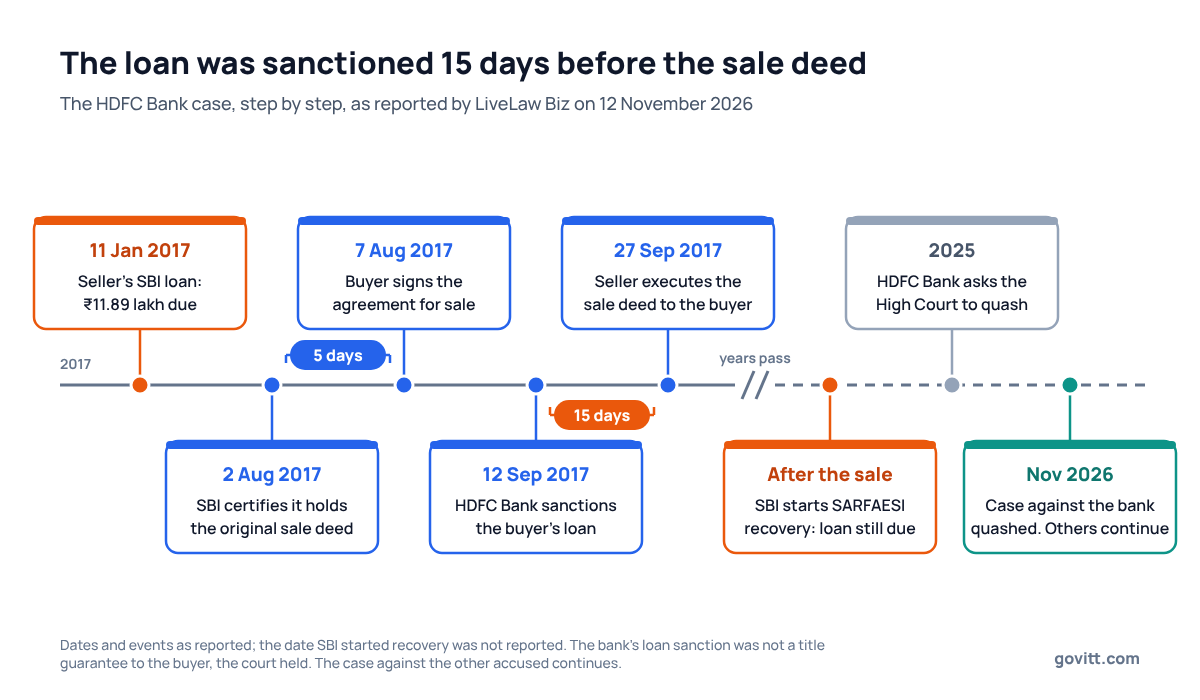
The SBI loan was on paper from the start. SBI's certificate that it held the original sale deed is dated five days before the agreement was signed, and the loan was sanctioned 15 days before the sale deed. Whether that old loan was really closed, and what the discharge deed is worth, is what's still being fought over. The court left that to the case against the other parties.
What the court decided
In my words, from the report:
- The bank's check was for the bank. Its legal department reviewed the papers to judge the flat as security for its own loan. That review is not a title certificate handed to the buyer.
- It can't replace your own check. The court said a buyer has to do independent legal due diligence, and pointed to caveat emptor: the buyer has to check the seller's title before going ahead.
- No promise, no cheating. The court found nothing showing HDFC Bank had agreed to certify or guarantee the title, or told the buyer to rely only on its scrutiny. It found no dishonest inducement and no arrangement with the seller or SBI. Without those, sanctioning a loan after reading documents can't make out cheating under Section 420.
- Only the case against the bank was quashed. Continuing it against HDFC Bank would abuse the process of law, the court said. The investigation against the others goes on, and the court said its remarks shouldn't sway it.
What it doesn't say
Read it narrowly. Four limits:
- It doesn't say banks can lend blind. In February 2026, Justice M Nagaprasanna, hearing a different case, asked a bank how it had lent ₹2 crore against a property that allegedly didn't exist, and why its own officials weren't in the FIR. Courts still expect banks to check. This ruling only says the check belongs to the bank.
- It's about a criminal case. The question was whether the bank cheated the buyer. The court didn't decide whether anyone owes the buyer money in a civil suit or a consumer complaint. It said the disputes over the old loan, the discharge, who held the originals and the recovery should be judged on what each party did.
- A written promise could change things. The reasoning rests on there being no agreement or representation that the bank would vouch for the title. The report says the duty of due diligence sits with the buyer unless an agreement provides otherwise.
- The seller isn't off the hook. Under Section 55 of the Transfer of Property Act, a seller has to disclose material defects in the title and, unless the sale is made subject to an encumbrance, discharge it. A buyer's remedy usually starts with the seller, not the lender. Ask a property lawyer how that applies to your facts.
The same judge, in September, the other way round
On 25 September 2026, Justice Suraj Govindaraj quashed a criminal case SBI had filed against a homebuyer, Pritesh Bari. He had a ₹39.92 lakh housing loan under a tripartite agreement with SBI and a builder. The builder didn't finish the project, sold the flat to someone else and didn't repay SBI. The court held that an unpaid loan, or a deal that collapsed, isn't by itself a crime, and noted the agreement had put repayment on the builder.
Put the two orders side by side. When a property deal fails, this court is sending banks and buyers alike away from the police and back to civil remedies. For you as a buyer, that means two things:
- An FIR after the sale is a weak shield. Your protection is the paperwork you insist on before the sale.
- Your loan doesn't vanish when the title does. In the Bari case, the buyer was still shown as the borrower on a flat he never got. A home loan is your personal debt and the flat is only the security, so if the title fails, the EMI keeps running. Put your loan into the EMI calculator and ask how many months of that EMI you could carry while a title dispute drags on.
What a bank's legal check is, and what it isn't
When you take a loan, a bank-empanelled advocate goes through the title papers and writes a legal scrutiny report, a title opinion for the lender. PropNewz describes it as tracing ownership over 13 to 30 years and checking the encumbrance certificate (EC) and dues. It also says the report is prepared for the bank's protection and may not be shared unless you ask.
| Question | The bank's legal scrutiny report | Your own advocate's title opinion |
|---|---|---|
| Written for | The bank | You |
| The question it answers | Can the bank rely on this property as security? | Can this seller pass you a clean, marketable title? |
| How far back | 13 to 30 years, per a property guide. Banks commonly ask for a 13 year EC | About 30 years, the period title lawyers and guides work to |
| Do you see it | Only if you ask, and the bank may say no | Yes, it's addressed to you |
A cash buyer gets no bank check at all. For them, their own advocate's report is the only one there is.
Where this case went wrong: the seller's old loan
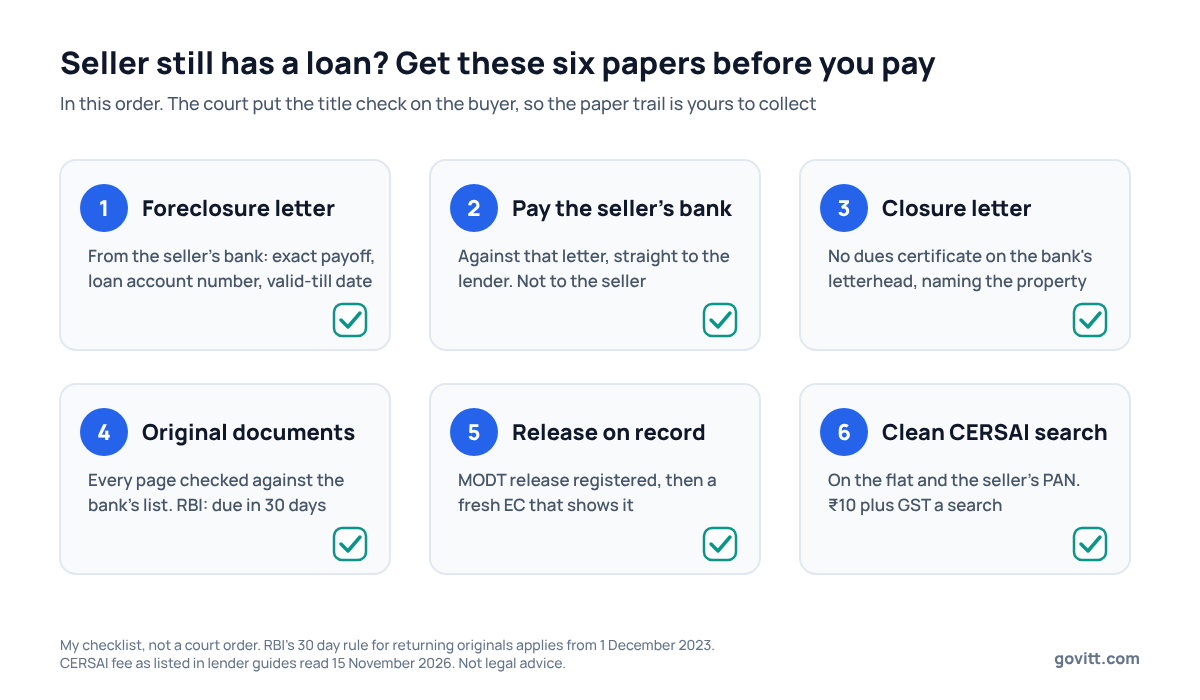
Buying a resale flat with the seller's loan still running is common, and it's the setup in this case. It works when the old loan is closed and the release is on record before, or at, the sale. These are the papers I'd want, in this order:
- Foreclosure letter from the seller's bank. The exact payoff amount, the loan account number and the date it's valid till.
- Payment straight to the seller's bank. Your money or your loan, paid to the seller's lender against that letter, not to the seller. Ask your own lender to pay it that way.
- Closure letter or no dues certificate. On the bank's letterhead, naming the account and the property.
- The original title documents, with the bank's list. Check every page against the list. Under RBI rules in force since 1 December 2023, a lender must return the originals within 30 days of full repayment, or pay the borrower ₹5,000 for each day of delay it causes. The borrower is the seller, so write the handover into your deal.
- The release on record. In Karnataka, the lender registers a memorandum of deposit of title deeds (MODT) at the sub-registrar. Make sure the release is registered too, then pull a fresh EC and check it shows. An old mortgage still sitting on the EC because a release was never registered is one of the usual Bengaluru hold-ups. More in MODT charges in Karnataka.
- A clean CERSAI search. CERSAI is the central registry where banks and NBFCs file the charges they hold. Anyone can run a public search on the property, or on the seller's PAN, for ₹10 plus GST. The old bank's charge should show as closed.
If the payoff and the registration have to happen on the same day, get the seller's bank to confirm in writing, to your lender, the payoff amount and the handover of the originals before you sign. The same closing papers come up when you switch banks, and my balance transfer documents post lists what to collect from the old lender.
The checks that stay yours, whatever the bank says
| Check | Where | What it catches |
|---|---|---|
| Encumbrance certificate for 30 years | Kaveri 2.0, the registration department's portal | Registered sales, mortgages and releases on the property |
| CERSAI public search | The CERSAI portal, no login needed | Charges filed by banks and NBFCs on the property or the owner's PAN |
| Khata | e-Aasthi, for the Greater Bengaluru Authority | A or B khata, final or draft, and in whose name |
| Title opinion | Your own advocate | Breaks in the 30 year chain, missing heirs, partitions, court cases |
| Seller's loan papers | The seller's bank | Whether the old loan is closed and the originals released |
Two of these overlap on purpose. PropNewz points out that an equitable mortgage made by depositing title deeds can sit on a property without showing on the EC, and CERSAI is where lenders file those charges. Run both. A clean CERSAI report on its own rules out one risk, an undisclosed bank charge, and nothing else. The khata rules are in buying a resale flat in Bengaluru: check the khata before you check the EMI.
My read is that the same logic carries over to a builder project a bank has approved: the approval tells you the bank will lend there, not that it vouches for your flat. I covered what that approval does tell you in bank-approved projects in Bengaluru: why APF matters before you book.
What I'd do before paying the token
- Ask the seller straight out about the loan. Which bank, how much, and the latest statement. If they hedge, that's your answer.
- Pull the EC yourself, for 30 years. Don't work from the seller's copy.
- Run CERSAI on the property and on the seller's PAN. It's ₹10 plus GST a search.
- Hire your own advocate, not the bank's panel advocate. Get the title opinion in writing, addressed to you.
- Ask your bank for its legal scrutiny report and compare the two. If they disagree, you've found the problem before it cost you anything.
- Close the seller's loan the right way. The six papers above. Make the token refundable if the title or the release falls through.
- Keep one file. Sanction letter, both legal reports, the closure letter, the release, the EC and the CERSAI report. If something surfaces years later, that file is your case.
For the other Bengaluru papers that stall a loan, like the khata, the plan and the occupancy certificate, start with home loan in Bangalore: which banks lend easiest here, and the local paperwork that trips people up. If it's a plot, see which Bengaluru layouts banks will actually lend on.
FAQ
Is legal verification for a home loan a guarantee that the title is clear? No. The Karnataka High Court held, in an order reported on 12 November 2026, that a bank's scrutiny of the papers before sanctioning a housing loan isn't, by itself, a certification of title to the buyer. The check protects the bank's security. You still need your own advocate's title opinion.
Does the bank verify property documents before a home loan? Yes. A bank-empanelled advocate reviews the title documents and the EC and gives the bank a legal scrutiny report, tracing ownership over roughly 13 to 30 years. It's written for the bank, and you may only see it if you ask.
Can I file a case against the bank if the title turns out to be defective? Not a cheating case on the loan sanction alone, going by this ruling. The court found no promise to guarantee the title and no dishonest intent, and quashed the FIR against HDFC Bank. It didn't decide civil or consumer claims. Speak to a lawyer about your facts, and look at the seller's obligations first.
What should I check if the seller still has a home loan on the flat? Get the foreclosure letter, pay the seller's bank directly, and collect the closure letter, the original documents with the bank's list, a registered release and a fresh EC. Then run a CERSAI search to confirm the old charge is closed.
What is a CERSAI search and how much does it cost? CERSAI is the central registry of the security interests banks and NBFCs file. Any buyer can run a public search on a property, or on the owner's PAN, for ₹10 plus GST, per lender guides read on 15 November 2026. It adds to the EC. It doesn't replace a title check.
Buying a resale flat with the seller's loan still running? Talk to an advisor (free, WhatsApp) with the seller's bank and the amount still due. We'll tell you which closure papers to get before you pay, and match your loan to a lender on our panel. GoVitt compares 50+ banks and charges you 0% commission.
The case facts and holdings are as reported by LiveLaw Biz on 12 November 2026. I did not read the court's order, and the report does not give the judgment date. The Pritesh Bari order (25 September 2026) is as reported by Verdictum, LiveLaw and Outlook Money, and the February 2026 remarks are from LiveLaw's report of 25 February 2026. The CERSAI fee is as listed in Kotak Mahindra Bank and Godrej Capital guides read on 15 November 2026; check the portal before you pay. Title search periods come from property guides, not a bank's policy. This is general information, not legal advice. Have a property lawyer check the title and the seller's loan closure for your flat before you pay.
Ready to take the next step?
Find out your loan options and check your eligibility with GoVitt today.