
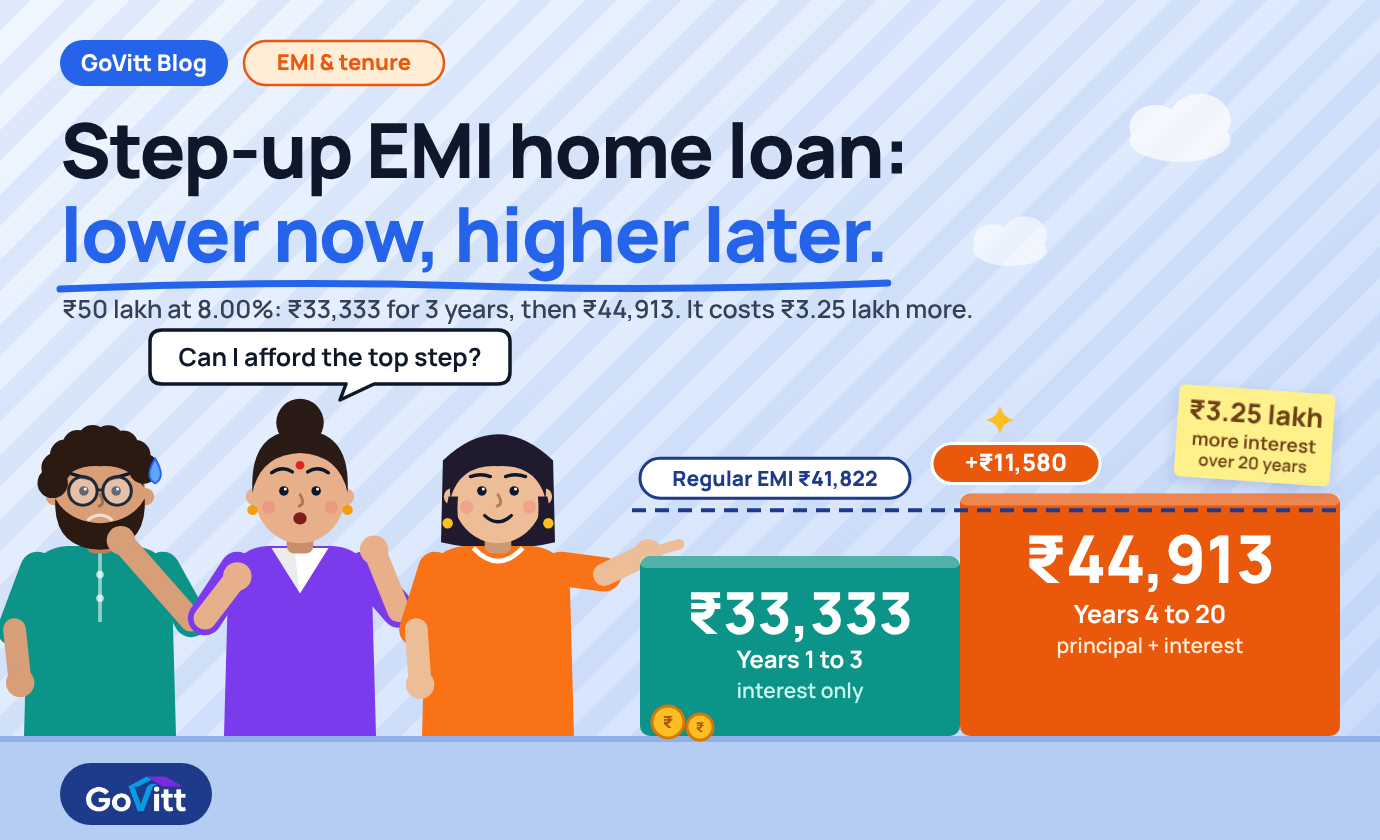
A step up EMI home loan lowers what you pay for the first few years and raises it later. On ₹50 lakh at 8.00% over 20 years, an interest-only start for 3 years cuts your payment from ₹41,822 to ₹33,333, which is ₹8,489 a month. Then it jumps to ₹44,913 for the other 17 years, which is ₹11,580 more than the first payment. You pay ₹3.25 lakh more interest in total.
My view: it works for one kind of borrower, a salaried person whose pay is certain to rise, who doesn't use the extra borrowing it offers. For everyone else it is a more expensive loan with a lower first EMI. Below: what the lenders actually publish, what the numbers do, what the extra 20% eligibility really demands from your pay, and who I'd say yes to.
First, the honest part
- No lender publishes a step percentage. SBI and ICICI describe interest-only starts. Neither gives a "5% a year" schedule. My gradual step-up cases below are illustrations, labelled as such.
See your real payoff date in 60 seconds
Banks calculate remaining EMIs by simple subtraction. See your actual payoff date and discover how much interest a balance transfer can save.
- ICICI's page is rough. It has leftover editorial notes and a blank answer. I used only what ICICI states about the product.
- SBI's Flexipay page is thin. It gives no moratorium length, no step schedule and no rate. The 3 to 5 years of interest-only comes from a 2016 news report.
- I couldn't find a current HDFC Bank step-up page.
- The rate of 8.00% is mine, for round numbers. It isn't any lender's quote.
Everything from lender pages was read on 7 November 2026. RBI raised the repo rate to 5.50% on 7 October, and the next decision is on 4 December.
The short answer
A step-up loan helps only if your take-home pay rises by more than the jump in the EMI, and only if you don't use it to borrow more. If you take the extra 20% eligibility, your take-home has to grow about 9% a year for 3 years. If you borrow the same amount and just want breathing room, you pay ₹3.25 lakh extra interest to postpone about ₹3.06 lakh of payments. Ask for the full schedule in writing first.
Two kinds of step-up
Interest-only first, then full EMI. This is what ICICI describes. For the first 3 to 5 years you pay only the interest, so the balance doesn't fall. Then you pay principal and interest on whatever tenure remains. SBI's wording for Flexipay starts the same way but adds that the "moderated EMIs" are "stepped-up during the subsequent years", so it may be a mix of both shapes. I can't tell from its page.
A gradual yearly rise. The EMI starts low and rises each year, say 5%. Business Today (10 August 2023) describes this as an EMI set at approval to match your expected income growth, with total interest that may be higher. It names no lender. I haven't found a lender that publishes one, so I use it only to show the shape.
What ICICI and SBI say
| ICICI Bank Step Up | SBI Flexipay | |
|---|---|---|
| Structure | Interest-only for 3 to 5 years (up to 3 for a resale or completed property), then principal and interest | Interest-only (pre-EMI) moratorium, then "moderated EMIs" that are "stepped-up during the subsequent years" |
| Length of the interest-only period | 3 to 5 years | Not on the page. Press in 2016 said 3 to 5 years |
| Extra eligibility | Up to 20% higher | "20% higher home loan eligibility" |
| Who qualifies | Salaried at "select corporates identified by ICICI Bank", age 40 or less, income of at least ₹30,000 a month (FAQ: it "may vary") | Salaried only, resident, age 21 to 45 |
| Maximum tenure | 20 years | 30 years |
| Loan size | Up to ₹3 crore | Not on the page |
| Rate and charges | Same as a standard ICICI home loan | Not on the page |
| Not allowed | An existing loan, or converting after sanction. New loans and balance transfers only | Not stated |
| Prepayment | Not stated | No penalty, per the page |
Sources: ICICI Bank Step Up page and FAQ; SBI home loans site, Flexipay; both read 7 November 2026. The 2016 report is Business Standard/PTI of 1 February 2016, which said interest-only for 3 to 5 years for "young working professionals", with no change in rate or loan-to-value, and which SBI declined to call a teaser loan.
SBI Flexipay home loan
The SBI Flexipay home loan is the one people search for, and the one I can say least about. SBI's page says it is for salaried residents aged 21 to 45, offers "20% higher home loan eligibility", and starts with an interest-only moratorium before EMIs that step up. A festive offer waives 50% of the processing fee (minimum ₹5,000 plus GST) until 31 December 2026. It says no prepayment penalty.
It does not say how long the moratorium lasts, what the steps are, or what rate applies. I'd treat the figures in this post as the shape of an interest-only product and not as SBI's terms. If you are considering it, ask SBI for the full repayment schedule in writing, before you apply. SBI's general rate and fee story is in SBI home loan interest rate (October 2026).
What an interest-only start costs
₹50 lakh at 8.00% over 20 years (the whole loan is 20 years, including the interest-only years):
| Regular EMI | Interest-only for 3 years | Interest-only for 5 years | |
|---|---|---|---|
| Payment at the start | ₹41,822 | ₹33,333 | ₹33,333 |
| Payment after the step | ₹41,822 | ₹44,913 for 204 months | ₹47,783 for 180 months |
| Jump at the step | None | ₹11,580 (34.7%) | ₹14,449 (43.3%) |
| Total interest | ₹50.37 lakh | ₹53.62 lakh | ₹56.01 lakh |
| Extra interest vs regular | None | ₹3.25 lakh | ₹5.64 lakh |
The first row is the pitch. The jump row is the bill. Interest-only costs more because the balance doesn't fall for the first 3 years, so the same ₹50 lakh earns interest for longer.
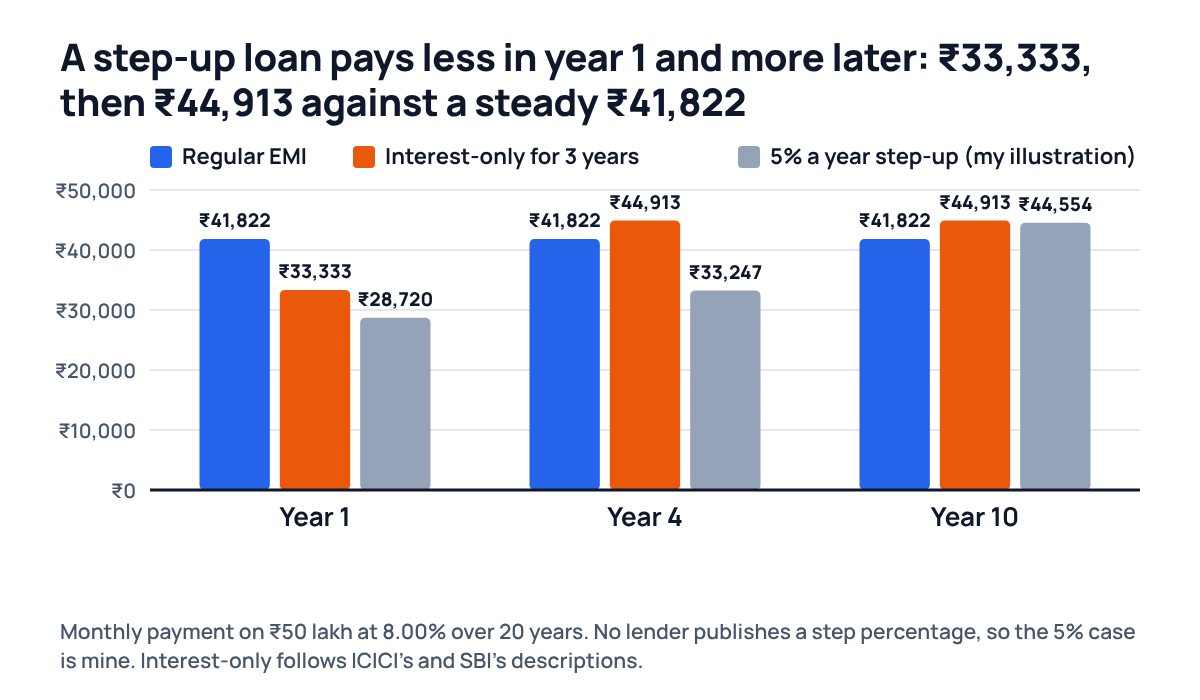
One more way to see it. The 3-year start saves ₹8,489 a month, which is ₹3.06 lakh of payments you postpone. You pay ₹3.25 lakh more interest for the postponement. So roughly, you are borrowing ₹3.06 lakh from the bank for 17 years. If you have a better use for that ₹3.06 lakh in year 1 to 3, fine. If you don't, you're paying interest for nothing.
A gradual step-up: an illustration
To show the other shape, I modelled an EMI that starts low and rises by a fixed percentage each year on the same ₹50 lakh at 8.00% over 20 years. No lender publishes these percentages. I picked them.
| Step per year | First EMI | Last-year EMI | Total interest | Extra vs regular | Peak balance |
|---|---|---|---|---|---|
| 5% | ₹28,720 | ₹72,573 | ₹63.96 lakh | ₹13.58 lakh | ₹51,42,957 |
| 8% | ₹22,325 | ₹96,347 | ₹72.60 lakh | ₹22.22 lakh | ₹56,23,844 |
| 10% | ₹18,681 | ₹1,14,248 | ₹78.39 lakh | ₹28.02 lakh | ₹60,28,419 |
The first EMI is below ₹33,333, the interest due in month 1, in all three. That means your loan grows. This is called negative amortisation: you pay, and you owe more. At 5%, the balance rises to ₹50,57,439 after year 1 and peaks at ₹51,42,957 in year 4, when your payment is ₹33,247. It falls back below ₹50 lakh only in year 8. The step-up crosses the regular ₹41,822 EMI in year 9, at ₹42,432. Eight years of owing more than you borrowed is a long time.
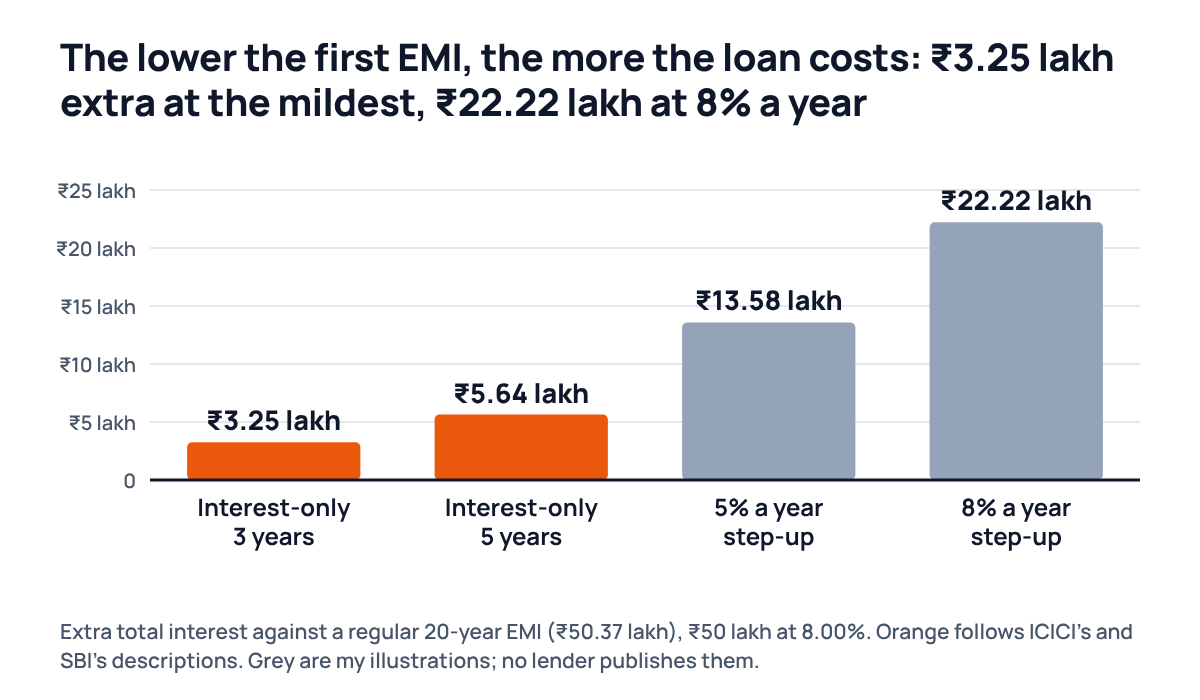
The more it starts below the regular EMI, the more it costs later. At 8% a year, the extra interest is ₹22.22 lakh, which is 44% of the loan amount.
The 20% extra eligibility is the trap
Both products advertise "up to 20% higher" eligibility. Here is what it asks of you. Suppose your income supports a regular ₹50 lakh loan at a 50% fixed obligation to income ratio (my assumption). Your EMI is ₹41,822, so your take-home is ₹83,644. With the extra 20%, you could borrow ₹60 lakh.
On ₹60 lakh at 8.00% with a 3-year interest-only start:
- You pay ₹40,000 a month for 36 months, which is 47.8% of your take-home.
- Then the EMI becomes ₹53,895 for 204 months. Total interest is ₹64.35 lakh.
- To keep the 50% ratio at that EMI, your take-home needs to be ₹1,07,791. That is 28.9% higher than today, or about 8.8% a year for 3 years.
With a 5-year start, it's ₹60 lakh, ₹40,000 for 60 months, then ₹57,339 for 180 months, with total interest ₹67.21 lakh and a required take-home of ₹1,14,678, which is 37.1% higher, or 6.5% a year for 5 years.
What your EMI share looks like after the step, depending on how your take-home grows (₹60 lakh, 3-year start, EMI ₹53,895, today's take-home ₹83,644):
| Take-home growth a year | Take-home after 3 years | EMI as a share of take-home |
|---|---|---|
| 0% | ₹83,644 | 64.4% |
| 5% | ₹96,828 | 55.7% |
| 8% | ₹1,05,367 | 51.2% |
| 10% | ₹1,11,330 | 48.4% |
You need about 9% a year to get back under half. If you are in a job where that is written into the contract, the product fits. If it's a hope, it's a risk. How banks work out what you can borrow is in home loan eligibility: the 7 checks. My advice: don't use the 20%. Take the step-up, if at all, on the loan you can already afford.
A rate rise lands on a small payment
ICICI says its Step Up loan carries the same rates and charges as a standard home loan, so if your rate floats, RBI's path matters. If your rate goes from 8.00% to 8.25% during the interest-only years, the interest-only payment goes from ₹33,333 to ₹34,375, which is ₹1,042 more. The 17-year EMI at 8.25% is ₹45,661, against ₹44,913 at 8.00%. Neither is a shock. The point is that you have no cushion: your payment is already close to your limit when the step arrives.
Does a step-up save tax?
Not beyond what a normal loan does. Under Section 22 of the Income-tax Act, 2025, which replaced Section 24(b), the interest deduction on a self-occupied house is capped at ₹2 lakh a year per person, old regime only. Year-1 interest is ₹4,00,000 on an interest-only ₹50 lakh and ₹3,96,181 on a regular loan. Both are over the cap, so the extra interest buys no extra deduction. At the cap, the tax saved is ₹62,400 at 31.2%. Business Today (10 August 2023) says step-up brings "more tax savings under Section 24". That's out of date, and the cap makes it untrue here. The rules after a move are in tax benefits after a home loan balance transfer. Ask your CA for yours.
Who should take one, and who should not
I'd say yes if all of these are true:
- You are salaried, within the age limits (ICICI: 40 or under, SBI: 21 to 45) and at a company the lender accepts.
- Your pay is certain to rise: a contract, a pay scale or a confirmed step, not a hope.
- You borrow the amount you can already afford. You ignore the 20% extra.
- You have a real use for the lower payment in years 1 to 3 (for example, you're paying rent and an under-construction EMI together).
I'd say no if:
- You are self-employed or have uneven income. Both products are for salaried borrowers.
- You'd use the extra 20% to buy a bigger flat.
- You'd rather prepay as pay rises. That does the same job without the extra interest.
- You're buying under construction: you already have a pre-EMI phase. See pre-EMI or full EMI on your under-construction flat.
Cheaper ways to get the same relief
- A longer tenure. On ₹50 lakh at 8.00%, a 25-year loan has an EMI of ₹38,591, which is ₹3,231 a month lower than the 20-year one. It costs ₹65.77 lakh in interest, ₹15.40 lakh more, if you never prepay.
- A longer tenure plus prepayment. A floating-rate loan carries no prepayment charge for individuals. You can take the longer tenure now, and prepay as your pay rises. That is a step-up you control. How to choose between a lower EMI and a shorter tenure is in part-prepaying your home loan.
What I'd do this week
- Ask the lender for the full repayment schedule in writing: length of the interest-only years, the first full EMI, the tenure left and the rate reset.
- Write your own pay forecast and test it against the table above.
- Skip the extra 20%.
- Check the conditions: employer list, age, minimum income, and whether the interest-only years count inside the maximum tenure.
- Run the numbers in the EMI calculator for a regular loan, a longer tenure and your prepayment plan.
- Compare a plain home loan from other banks, because a lower first EMI is not a lower cost.
FAQ
What is a step up EMI home loan? A loan whose payment starts low and rises later. In the products ICICI and SBI describe, you pay only interest for the first few years, then full EMIs on the remaining tenure. On ₹50 lakh at 8.00%, a 3-year start means ₹33,333 a month, then ₹44,913.
What is the SBI Flexipay home loan? SBI's product for salaried residents aged 21 to 45, with "20% higher home loan eligibility" and an interest-only start followed by stepped-up EMIs. Its page doesn't give the length of the start, the steps or the rate. Ask SBI for the schedule in writing.
Is a step-up EMI home loan cheaper? No. It has a lower first payment and a higher total cost. On ₹50 lakh at 8.00%, a 3-year interest-only start adds ₹3.25 lakh of interest and a 5-year start adds ₹5.64 lakh.
Who is eligible for the ICICI Step Up home loan? Per ICICI's page: salaried employees of select corporates it identifies, aged 40 or less, with income of at least ₹30,000 a month (the FAQ says this may vary), for new home loans and balance transfers. Existing loans can't be converted.
Does a step-up EMI save tax? No more than a normal loan. The self-occupied interest deduction is capped at ₹2 lakh a year per person under Section 22, old regime only, and year-1 interest exceeds that either way.
What if my income doesn't rise? Then the step hurts. On ₹60 lakh with a 3-year start, the EMI jumps to ₹53,895, which is 64.4% of a take-home that hasn't grown from ₹83,644. Prepay or refinance early if you can, and ask the lender what its options are before you sign.
Want to test your own numbers? Use the EMI calculator to compare a regular loan, a longer tenure and a prepayment plan. GoVitt compares 50+ banks and charges you 0% commission.
Lender terms are as published on the ICICI Bank and SBI pages read on 7 November 2026, with press reports labelled by date. No lender publishes a gradual step percentage, so the 5%, 8% and 10% cases are my illustrations. EMIs use the standard monthly reducing balance method, rounded to the nearest rupee, on ₹50 lakh at 8.00% over 20 years unless stated. The 8.00% rate and the 50% obligation ratio are my assumptions, not any lender's quote. Tax lines assume the old regime and a self-occupied house. Your property, income and lender will differ. This is general information, not tax or financial advice. Check your sanction letter and ask for every figure in writing.
| Image | Where | Alt text |
|---|---|---|
| Caption | govitt-cover-step-up-emi-home-loan.png(1380x840) | Cover / main image |
Illustration with the headline 'Step-up EMI home loan: lower now, higher later.' beside a staircase of two blocks: a teal block reading ₹33,333, Years 1 to 3, interest only, and a taller orange block reading ₹44,913, Years 4 to 20, principal plus interest, with a dashed line for the regular EMI of ₹41,822, a pill reading +₹11,580 and a yellow note reading ₹3.25 lakh more interest over 20 years. A worried man with curly hair, glasses and a beard rests a hand on his chin, a woman with a bun and a bindi in a purple blazer asks 'Can I afford the top step?', and a bob-haired advisor in an orange top points at the stairs.
On ₹50 lakh at 8.00%, a 3-year interest-only start cuts the payment to ₹33,333. Then it jumps to ₹44,913 and costs ₹3.25 lakh more interest.
govitt-chart-step-up-payment-path.png
IMAGE 1, after the interest-only table
Grouped bar chart of the monthly payment on ₹50 lakh at 8.00% over 20 years in years 1, 4 and 10. A regular EMI is ₹41,822 each year. Interest-only for 3 years is ₹33,333 in year 1 and ₹44,913 in years 4 and 10. A 5% a year step-up, which is my illustration, is ₹28,720 in year 1, ₹33,247 in year 4 and ₹44,554 in year 10.
A step-up loan pays less in year 1 and more later. The 5% step-up is my illustration, because no lender publishes one.
govitt-chart-step-up-extra-interest.png
IMAGE 2, after the gradual step-up table
Bar chart of extra total interest against a regular 20-year loan on ₹50 lakh at 8.00%: ₹3.25 lakh for a 3-year interest-only start, ₹5.64 lakh for a 5-year interest-only start, ₹13.58 lakh for a 5% a year step-up and ₹22.22 lakh for an 8% a year step-up. The two step-up cases are illustrations.
The lower the first EMI, the more the loan costs: from ₹3.25 lakh extra to ₹22.22 lakh.
Ready to take the next step?
Find out your loan options and check your eligibility with GoVitt today.