
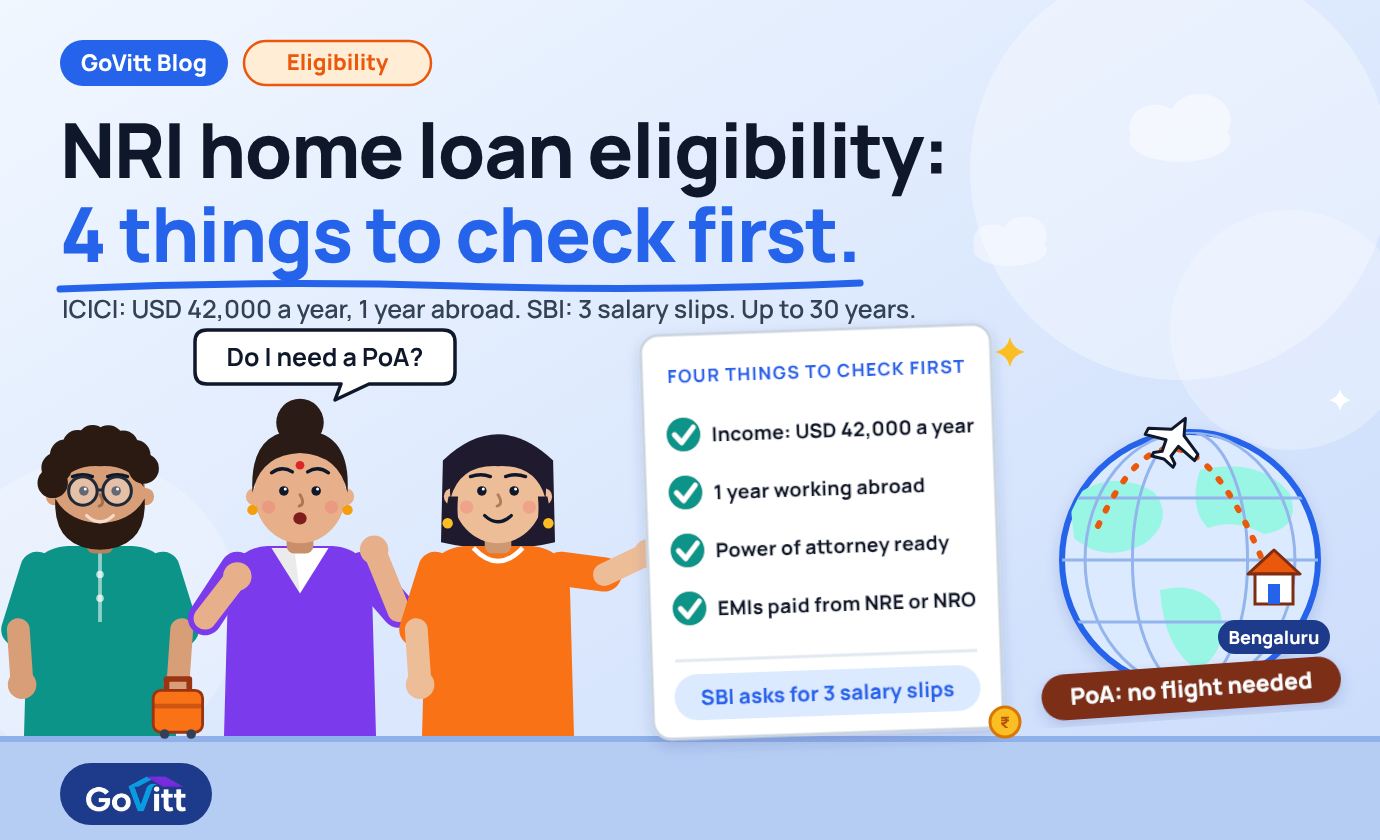
NRI home loan eligibility is set lender by lender, and the lenders' pages don't agree. ICICI Bank asks for at least 1 year of salaried employment abroad and an income of USD 42,000 a year (AED 84,000 in the Gulf). SBI takes NRIs from age 18 to 70 and asks for 3 months of salary slips. ICICI and SBI say tenure up to 30 years, HDFC Bank says up to 20. None of the four lenders I read prints an NRI-only interest rate.
You can get a home loan in India as an NRI. The hard parts are the paper trail from abroad, a power of attorney that the bank accepts, and paying every EMI from the right account. Below: who counts and what you can buy, the eligibility and document lists side by side, what the EMI looks like on ₹1 crore, how money moves, and what I'd do this week.
First, the honest part
I read these pages on 7 November 2026 unless dated. Five limits:
See your real payoff date in 60 seconds
Banks calculate remaining EMIs by simple subtraction. See your actual payoff date and discover how much interest a balance transfer can save.
- The bank pages are thin and disagree. Tenure: ICICI and SBI up to 30 years, HDFC Bank up to 20, and Kotak says "usually 5 to 15". Documents: ICICI wants 1 salary slip, SBI wants 3.
- There is no NRI-only rate card on any page I read. SBI's "7.50% onwards, w.e.f. 15.10.2026" is its general rate. HDFC Bank's 8.50% for a score of 800 and above is undated and may not be for NRIs. Kotak says NRI rates are "usually higher" than the resident rate "from 7.70%", on a page with a disclaimer that says it was accurate as of July 2025.
- RBI's own site blocked automated reading. I read a third-party copy of the 2018 FEMA regulation and a TaxGuru copy of the 2016 RBI Master Direction. The 2016 one may have been replaced since.
- I haven't verified the NRI tax rules. More on that below.
- Rates move. RBI raised the repo rate to 5.50% on 7 October, and the next decision is on 4 December.
The short answer
Check four things before you pick a lender: the minimum income in your currency, the years you've worked abroad, whether the lender will take a power of attorney for disbursement, and whether your EMIs can go out of an NRE or NRO account. If a lender can't answer all four in writing, don't apply there. The loan itself is the easy part.
Home loan for NRI in India: who counts and what you can buy
Who counts. SBI says NRIs or PIOs. FEMA's regulation of 17 December 2018 (G.S.R. 1213(E)) covers NRIs and OCIs. HDFC Bank cites the FEMA test of 182 days of stay in India to decide residency. Banks and housing finance companies can both lend. Regulation 7 lets an authorised dealer (a bank) lend to an NRI or OCI to acquire residential accommodation, and lets a registered NBFC or housing finance institution do the same.
What you can buy. HDFC Bank says NRIs and OCIs cannot buy agricultural land, plantation property or farm houses. The 2018 regulation lists "real estate activity or construction of farm houses" as a restricted end use. Citizens of Pakistan, Bangladesh, Sri Lanka, Afghanistan, Iran, Nepal and Bhutan need RBI permission, per HDFC's page. So the loan is for a residential flat or house.
Does it matter if you buy in Bengaluru? The property checks are the same as for a resident: khata, layout approval and the builder's bank approvals. I covered them in which Bengaluru layouts banks will lend on and buying a resale flat: check the khata before the EMI.
NRI home loan eligibility: lender by lender
| ICICI Bank | SBI | HDFC Bank |
|---|---|---|
| Age | 21 to 65, or retirement at maturity | 18 to 70 |
| Not on the pages I read | Experience abroad | Salaried: 1 year employed overseas. Self-employed: 3 years in the current business |
| Not stated | Not stated | Minimum income a year |
| USD 42,000 (US and others), AED 84,000 (GCC), USD 24,000 (Merchant Navy) | Not stated | Not stated |
| Tenure | Up to 30 years | Up to 30 years |
| Up to 20 years | Loan size | Not stated |
| Minimum ₹15 lakh | "Typically" 75% to 90% of property cost | Co-applicant |
| NRIs and residents can both be co-applicants | Not stated | All co-owners must be co-applicants |
| EMI account | NRE or NRO only | Not stated |
| NRE or NRO only, for EMIs and your own contribution | Power of attorney | Allows disbursement without a visit |
| Not stated | A relative in India as PoA is recommended | Prepayment |
| No penalty on floating rate | Not stated | Not stated |
| Extras | PAN is mandatory | Overdraft available. Interest concession for women. 50% processing-fee waiver (minimum ₹5,000 plus GST) to 31 December 2026 |
| Fixed options for 2 or 3 years, then adjustable | Sources: ICICI Bank NRI home loan page; SBI NRI home loan page on homeloans.sbi.bank.in; HDFC Bank NRI home loan pages. All read 7 November 2026. | Kotak adds more, but it is the bank's own article (13 April 2026, with a disclaimer saying accurate as of July 2025): lenders may ask for a graduate degree and a resident co-applicant, and NRI tenure is usually 5 to 15 years. Treat that as a claim about "lenders", not as Kotak's own rules. |
Three things to read out of this. The only published income floor is ICICI's, and it is in dollars or dirhams. A resident co-applicant makes sense when your own paper is weak: how a joint application raises what you can borrow is in joint home loan: benefits, eligibility and tax advantages. And your score matters here as it does for residents: the minimum CIBIL score for a home loan. ICICI mentions an overseas credit report where applicable, and I couldn't find how the other lenders treat a score if you have none in India.
NRI home loan documents
| Salaried | Self-employed |
|---|---|
| ICICI Bank | 1 month's salary slip; 3 months of overseas bank statements; overseas credit report if applicable (not older than 45 days, from listed countries); PAN |
2 years of audited profit and loss statements and ITR; 6 months of overseas statements; business documents
SBI
Valid work permit; employment contract; last 3 months' salary slips; last 6 months' bank statement showing salary credit; last year's acknowledged ITR (not for Middle East NRIs and Merchant Navy); 6 months of overseas statements
2 years of audited or CA-certified balance sheet and profit and loss; 2 years of ITR (not for Middle East NRIs); 6 months of overseas statements
HDFC Bank
I found no document list on the pages I read
I found no document list on the pages I read
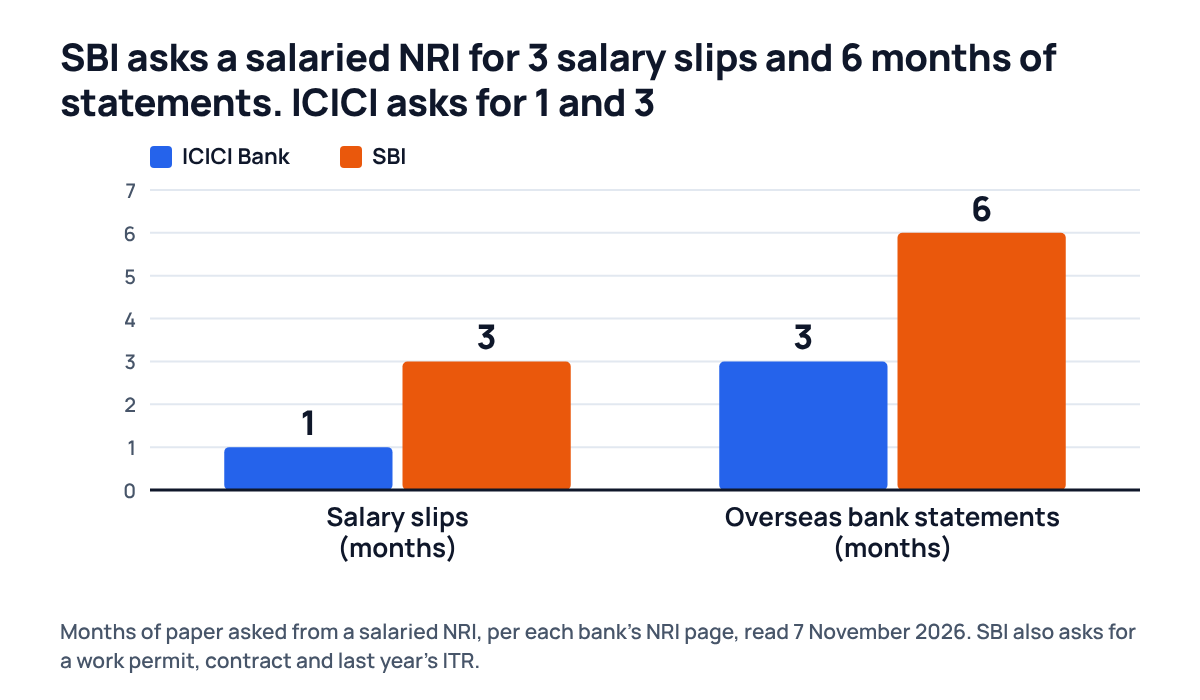
The lists don't match. ICICI asks for 1 month of salary slips and 3 months of statements. SBI asks for 3 and 6. Collect the longer set before you apply to either, so you aren't sent back for a month of paper. These lists cover you, the borrower. The property papers are the same as a resident's. If you are self-employed abroad, the logic of what a lender wants to see is in can self-employed people get home loans easily. A general view of what lenders check is in home loan eligibility: the 7 checks banks run.
What the rate and EMI look like
I couldn't find an NRI-only rate at any of these lenders. So the rates below are round figures I picked, 8.0%, 8.5% and 9.0%. They are not quotes. Use them to see how tenure and rate change the EMI on ₹1 crore.
| ₹1 crore at 8.5% | EMI | Income needed (at a 50% income ratio) | Total interest |
|---|---|---|---|
| 15 years | ₹98,474 | ₹1,96,948 | ₹77.25 lakh |
| 20 years | ₹86,782 | ₹1,73,565 | ₹108.28 lakh |
| 30 years | ₹76,891 | ₹1,53,783 | ₹176.81 lakh |
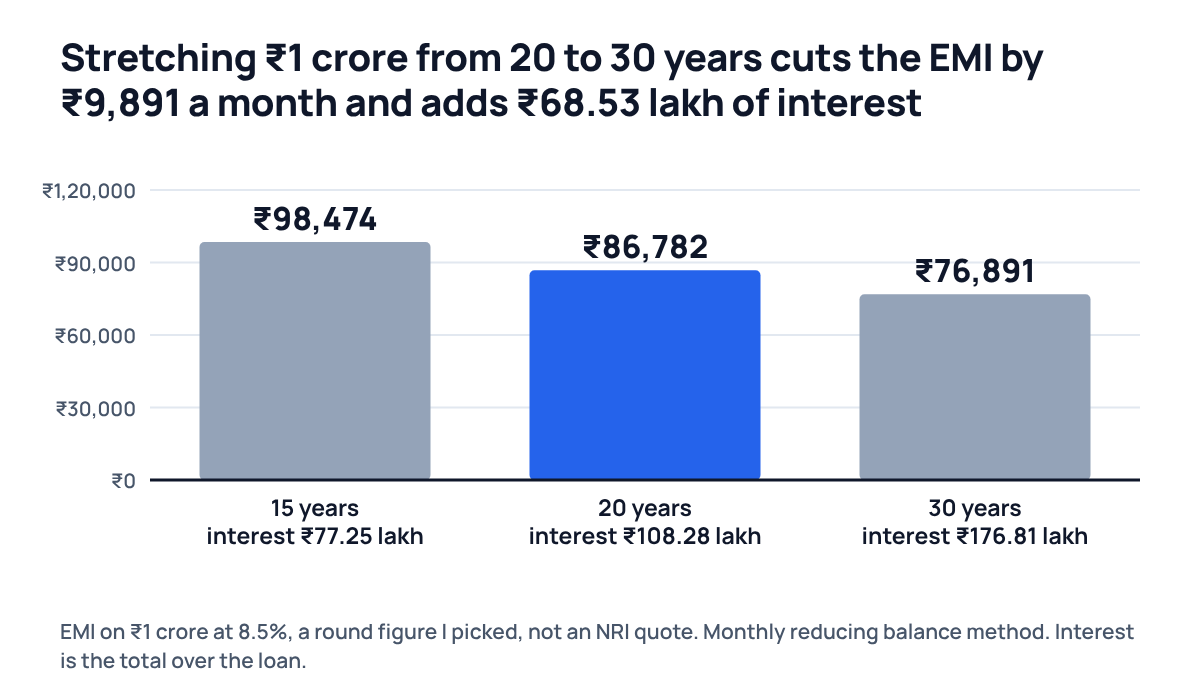
The 50% income ratio is my assumption. Lenders use their own. Three points:
- Tenure is the biggest lever. Going from 20 to 30 years cuts the EMI by ₹9,891 a month and adds ₹68.53 lakh of interest. The 30-year option is on ICICI's and SBI's pages, not on HDFC's.
- The rate moves it less than you'd think per step. On ₹1 crore over 20 years, the EMI is ₹83,644 at 8.0%, ₹86,782 at 8.5% and ₹89,973 at 9.0%. Each 0.5% adds about ₹3,100 to ₹3,200 a month.
- Your EMI is in rupees and your pay is not. If the rupee strengthens against your currency, the same EMI costs you more of your salary.
On ₹75 lakh over 20 years at 8.5%, the EMI is ₹65,087. EMI per ₹1 lakh at 8.5% is ₹985 over 15 years, ₹868 over 20 and ₹769 over 30.
Money in, money out
ICICI, HDFC Bank and Kotak all say EMIs must come through an NRE or NRO account. HDFC Bank says that includes your own contribution towards the property. The RBI Master Direction of 1 January 2016, as I read it on TaxGuru, goes further, and it may have been replaced:
- Housing loans to NRIs are at par with residents on amount, margin and repayment period.
- Repayment can come from remittances, NRE, FCNR(B) or NRO accounts, rent from the property, or a relative's account in India.
- The loan is not credited to an NRE or FCNR(B) account.
- An equitable mortgage is required.
The bank pages are stricter than that 2016 text. If a relative in India wants to pay your EMI, ask the lender in writing whether it will accept it. Don't assume.
Power of attorney
You will probably need one, unless you can fly in for the signing. ICICI says a PoA allows disbursement without a visit. HDFC Bank recommends a relative in India as the PoA. The detail comes from Kotak's PoA page (16 June 2026, with the same July 2025 disclaimer):
- The PoA must be notarised and attested by the Indian Embassy in the country where you live.
- It must be stamped at the District Registrar within 90 days of arrival in India.
- Most lenders prefer a Special PoA for a defined purpose.
- The holder must be a resident Indian.
- A general PoA alone cannot be used to sell the property.
I haven't verified Karnataka's own stamping and registration rules for a PoA. Ask the lender's legal team for its format before you get one drawn up abroad, and ask your lawyer in Bengaluru.
What about tax?
I haven't checked how Section 22 of the Income-tax Act, 2025 (the interest deduction that replaced Section 24(b)) applies to non-residents, or what TDS and reporting would apply to rent or a later sale. So I'm not going to guess. Ask a CA who files NRI returns before you count on any deduction in your numbers.
What I'd do this week
- Get each lender's NRI sheet in writing: rate, fee, tenure, loan-to-value, document list, PoA format and EMI account rules.
- Check the four things: your income against the floor in your currency, the years abroad, the PoA, and the EMI account.
- Open or confirm your NRE or NRO account and plan how the EMI and your own contribution will flow.
- Collect the longer paper set: 3 months of slips, 6 months of statements, work permit, contract and last year's ITR if filed.
- Pick the PoA holder (a resident you trust) and the type, before the lender's lawyers ask.
- Confirm the property is residential and not a farm house or agricultural land.
- Ask a CA who does NRI returns about the tax.
FAQ
What is the NRI home loan eligibility? It depends on the lender. ICICI Bank asks for age 21 to 65, 1 year of salaried work abroad (or 3 years in your own business) and an income of at least USD 42,000 a year (AED 84,000 for the Gulf). SBI takes ages 18 to 70 and a minimum loan of ₹15 lakh. HDFC Bank's pages gave me no age or income figure.
What documents does an NRI need for a home loan in India? Salary slips (1 month at ICICI, 3 at SBI), overseas bank statements (3 months at ICICI, 6 at SBI), a work permit and contract at SBI, an ITR where required and PAN. Self-employed NRIs add 2 years of audited accounts. Collect the longer set first.
What is the interest rate on an NRI home loan? I found no NRI-only rate card. SBI shows 7.50% onwards (w.e.f. 15 October 2026) as its general rate. Kotak says NRI rates are usually higher than the resident rate. Ask the lender for the quoted rate in writing.
Can an NRI repay a home loan from a foreign account? Not directly, per the bank pages: ICICI, HDFC Bank and Kotak say EMIs must go through an NRE or NRO account. The 2016 RBI direction I read allows more sources, including a relative's account, but it may be superseded. Ask the lender.
Do I need a power of attorney for an NRI home loan? Usually, unless you can be in India for the signing. ICICI says it allows disbursement without a visit, and HDFC Bank recommends a relative as PoA. Kotak says it should be notarised, attested by the Indian Embassy and stamped within 90 days of arrival.
Can an NRI use a home loan to buy agricultural land or a farm house? No. HDFC Bank says NRIs and OCIs cannot buy agricultural land, plantation property or farm houses, and the 2018 FEMA regulation lists construction of farm houses as a restricted end use.
Not sure which lender fits your profile? Talk to an advisor (free, WhatsApp) and tell us your country, income and property. GoVitt compares 50+ banks and charges you 0% commission.
Lender terms are as published on the ICICI Bank, SBI and HDFC Bank NRI pages read on 7 November 2026. Kotak statements are the bank's own, from articles with a disclaimer saying accurate as of July 2025. The RBI Master Direction of 1 January 2016 was read second-hand and may have been replaced. The FEMA regulation of 17 December 2018 was read from a copy. The 8.0%, 8.5% and 9.0% rates and the 50% income ratio are my assumptions, not any lender's quote. EMIs use the standard monthly reducing balance method, rounded to the nearest rupee. I have not verified the NRI tax position. This is general information, not tax, legal or financial advice. Check the lender's sanction letter and ask for every figure in writing.
| Image | Where | Alt text |
|---|---|---|
| Caption | govitt-cover-nri-home-loan-eligibility.png(1380x840) | Cover / main image |
Illustration with the headline 'NRI home loan eligibility: 4 things to check first.' beside a checklist card with four ticks, Income: USD 42,000 a year, 1 year working abroad, Power of attorney ready and EMIs paid from NRE or NRO, and a pill reading SBI asks for 3 salary slips, plus a globe with a dotted flight path from a plane to a house tagged Bengaluru and a label reading PoA: no flight needed. A smiling man with curly hair, glasses and a beard stands beside an orange suitcase, a woman with a bun and a bindi in a purple blazer asks 'Do I need a PoA?', and a bob-haired advisor in an orange top points at the checklist.
ICICI asks for USD 42,000 a year and 1 year abroad. SBI asks for 3 salary slips. Both go up to 30 years.
govitt-chart-nri-paper-months.png
IMAGE 1, after the documents table
Grouped bar chart of the months of paper asked from a salaried NRI. Salary slips: ICICI Bank 1 month and SBI 3 months. Overseas bank statements: ICICI Bank 3 months and SBI 6 months.
SBI asks for 3 salary slips and 6 months of statements. ICICI asks for 1 and 3.
govitt-chart-nri-emi-by-tenure.png
IMAGE 2, after the EMI table
Bar chart of the EMI on ₹1 crore at 8.5%: ₹98,474 over 15 years with total interest of ₹77.25 lakh, ₹86,782 over 20 years with ₹108.28 lakh of interest and ₹76,891 over 30 years with ₹176.81 lakh of interest.
Stretching ₹1 crore from 20 to 30 years cuts the EMI by ₹9,891 a month and adds ₹68.53 lakh of interest.
Ready to take the next step?
Find out your loan options and check your eligibility with GoVitt today.