
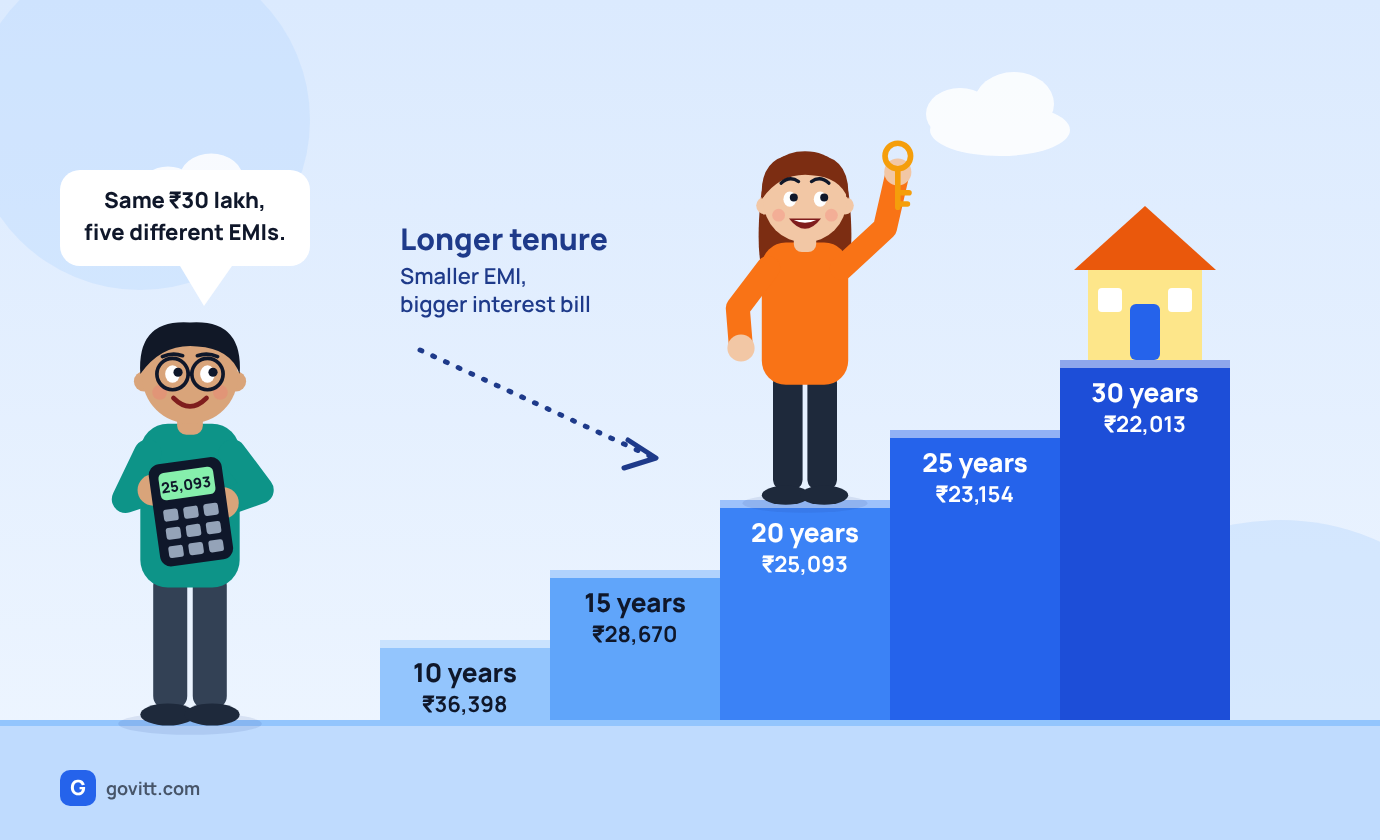
The ₹30 lakh home loan EMI is ₹25,093 a month over 20 years at 8%. Stretch it to 30 years and the EMI falls to ₹22,013. But your total interest jumps from ₹30.22 lakh to ₹49.25 lakh.
That's the whole trade-off in two numbers. And ₹30 lakh is a special number in RBI's rules too: it's the largest loan a bank can fund at 90% of the property value. Borrow ₹1 lakh more and the money you put in more than doubles. I've worked that out further down.
See your real payoff date in 60 seconds
Banks calculate remaining EMIs by simple subtraction. See your actual payoff date and discover how much interest a balance transfer can save.
First, the full tables for every rate from 7% to 10% and every tenure from 10 to 30 years, the interest you'll pay on each, and the take-home salary banks will want to see before they approve you.
For context, as of 22 October 2026 the lowest published home loan rates start at about 7.15% (LIC Housing Finance, for a CIBIL score of 825 and above), 7.50% (SBI) and 8.00% (HDFC Bank), after RBI raised the repo rate to 5.50% on 7 October. At 7.15%, the 20 year EMI on ₹30 lakh is ₹23,530. Most good profiles will land between 7.50% and 9.00%.
Quick answer: ₹30 lakh home loan EMI for 20 years
| Interest rate | EMI | Total interest | Total you pay back |
|---|---|---|---|
| 7.50% | ₹24,168 | ₹28.00 lakh | ₹58.00 lakh |
| 8.00% | ₹25,093 | ₹30.22 lakh | ₹60.22 lakh |
| 8.50% | ₹26,035 | ₹32.48 lakh | ₹62.48 lakh |
| 9.00% | ₹26,992 | ₹34.78 lakh | ₹64.78 lakh |
₹30 lakh home loan EMI at every rate and tenure
| Rate | 10 years | 15 years | 20 years | 25 years | 30 years |
|---|---|---|---|---|---|
| 7.00% | ₹34,833 | ₹26,965 | ₹23,259 | ₹21,203 | ₹19,959 |
| 7.50% | ₹35,611 | ₹27,810 | ₹24,168 | ₹22,170 | ₹20,976 |
| 8.00% | ₹36,398 | ₹28,670 | ₹25,093 | ₹23,154 | ₹22,013 |
| 8.50% | ₹37,196 | ₹29,542 | ₹26,035 | ₹24,157 | ₹23,067 |
| 9.00% | ₹38,003 | ₹30,428 | ₹26,992 | ₹25,176 | ₹24,139 |
| 9.50% | ₹38,819 | ₹31,327 | ₹27,964 | ₹26,211 | ₹25,226 |
| 10.00% | ₹39,645 | ₹32,238 | ₹28,951 | ₹27,261 | ₹26,327 |
Every 1% on the rate moves the 20 year EMI by roughly ₹1,800 to ₹2,000 a month. Going from 8% to 9% costs ₹1,899 a month, or ₹4.56 lakh over the loan. That's why your credit score matters as much as the tenure you pick.
Total interest on ₹30 lakh at every rate and tenure
| Rate | 10 years | 15 years | 20 years | 25 years | 30 years |
|---|---|---|---|---|---|
| 7.00% | ₹11.80 lakh | ₹18.54 lakh | ₹25.82 lakh | ₹33.61 lakh | ₹41.85 lakh |
| 7.50% | ₹12.73 lakh | ₹20.06 lakh | ₹28.00 lakh | ₹36.51 lakh | ₹45.51 lakh |
| 8.00% | ₹13.68 lakh | ₹21.61 lakh | ₹30.22 lakh | ₹39.46 lakh | ₹49.25 lakh |
| 8.50% | ₹14.64 lakh | ₹23.18 lakh | ₹32.48 lakh | ₹42.47 lakh | ₹53.04 lakh |
| 9.00% | ₹15.60 lakh | ₹24.77 lakh | ₹34.78 lakh | ₹45.53 lakh | ₹56.90 lakh |
| 9.50% | ₹16.58 lakh | ₹26.39 lakh | ₹37.11 lakh | ₹48.63 lakh | ₹60.81 lakh |
| 10.00% | ₹17.57 lakh | ₹28.03 lakh | ₹39.48 lakh | ₹51.78 lakh | ₹64.78 lakh |
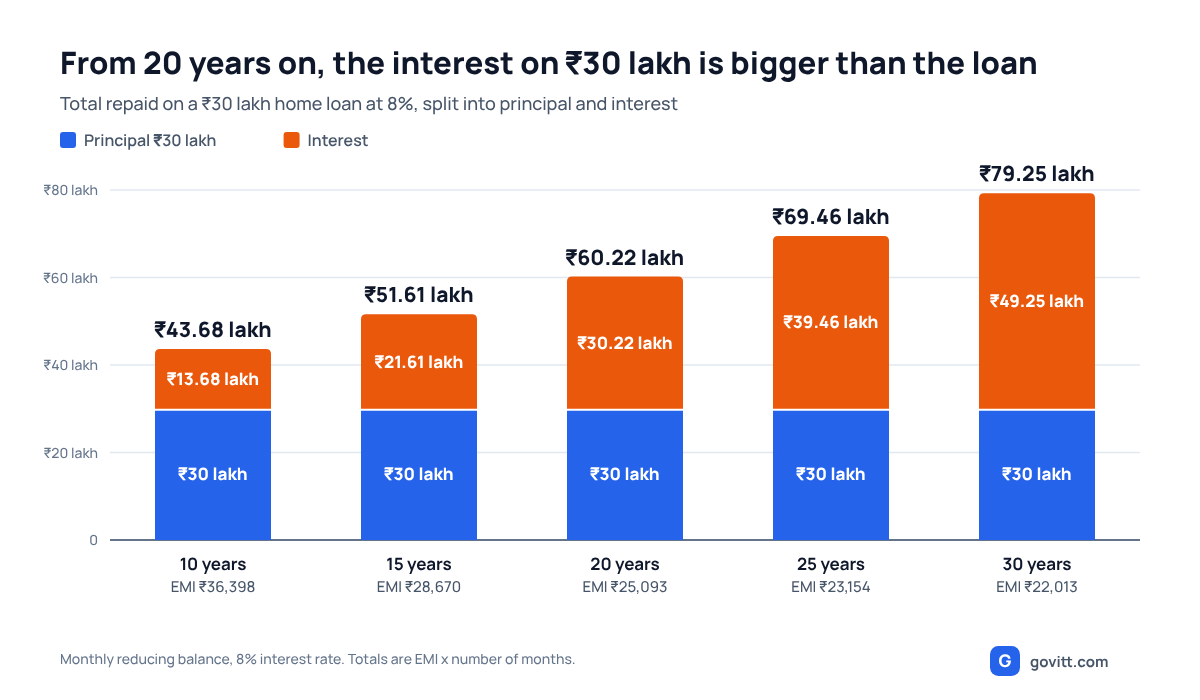
Look at the 20 year column and beyond. At 8% you pay ₹30.22 lakh in interest on a ₹30 lakh loan over 20 years, which is already more than you borrowed. At 30 years it's ₹49.25 lakh. The EMI is the number everyone checks. The total interest is the one that actually decides what the house costs you. I've written more on that in everyone checks the EMI, almost nobody checks the number that matters.
Salary required for a ₹30 lakh home loan
Banks don't look at the loan amount first. They look at how much of your take-home pay goes into EMIs. That's called FOIR (fixed obligations to income ratio). For most salaried borrowers, banks allow roughly 40% to 55%, with higher earners getting more room.
At 50% FOIR and no other loans, here's the net monthly take-home you'd need:
| Rate | 10 years | 15 years | 20 years | 25 years | 30 years |
|---|---|---|---|---|---|
| 7.50% | ₹71,300 | ₹55,700 | ₹48,400 | ₹44,400 | ₹42,000 |
| 8.00% | ₹72,800 | ₹57,400 | ₹50,200 | ₹46,400 | ₹44,100 |
| 8.50% | ₹74,400 | ₹59,100 | ₹52,100 | ₹48,400 | ₹46,200 |
Two things change this a lot:
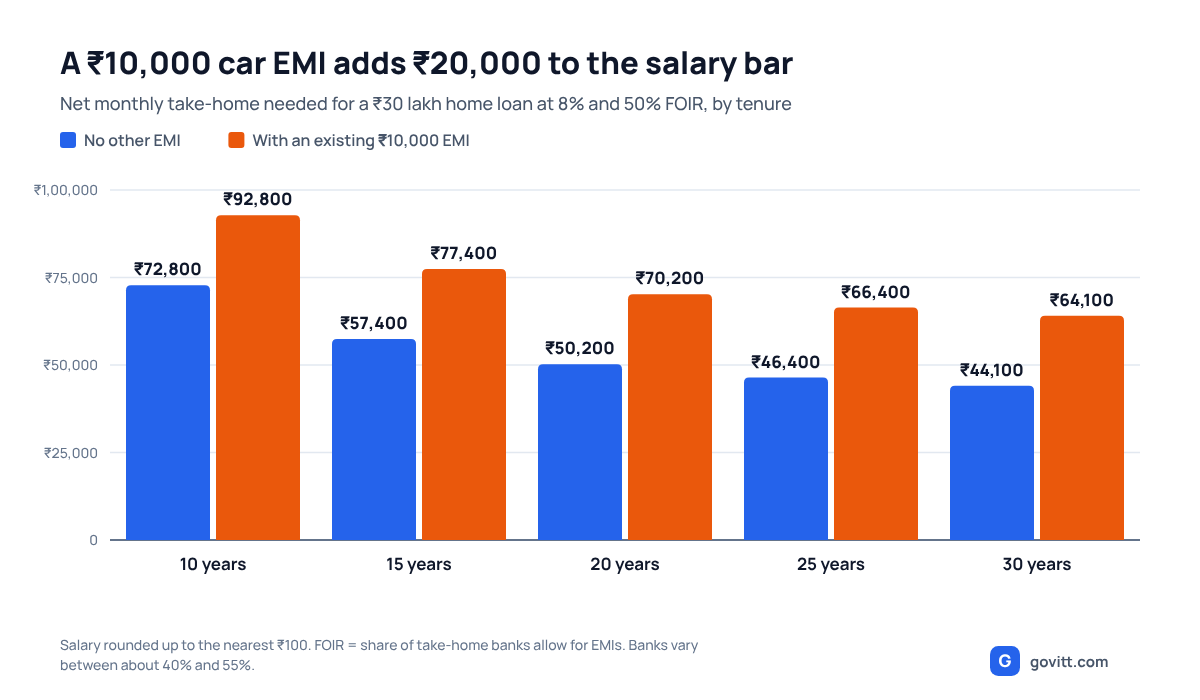
- Existing EMIs. A ₹10,000 car loan EMI pushes the take-home needed for a 20 year loan at 8% from ₹50,200 to ₹70,200.
- A co-applicant. Banks add a spouse's income, so two salaries of ₹26,000 can qualify where one can't.
Just because a bank approves 50% doesn't mean you should take it. I'd keep total EMIs at 35% to 40% of take-home so one bad month doesn't break you. The full method, with salary bands from ₹50,000 to ₹2 lakh, is in how much home loan can I actually get on my salary. Looking at a bigger loan? The same tables for ₹50 lakh are in ₹50 lakh home loan EMI, and for any other amount there's the home loan EMI per lakh table.
20, 25 or 30 years? What each one really costs
At 8%:
| Switch | EMI drops by | Extra interest you pay |
|---|---|---|
| 10 years to 20 years | ₹11,305 a month | ₹16.55 lakh |
| 20 years to 25 years | ₹1,939 a month | ₹9.24 lakh |
| 20 years to 30 years | ₹3,080 a month | ₹19.02 lakh |
Going from 20 to 30 years saves ₹3,080 a month but costs ₹19.02 lakh. That's a bad deal if you can afford the 20 year EMI.
But there's a smarter way to use the long tenure. Take 30 years on paper and pay like it's 20. At 8%, a 30 year EMI is ₹22,013. Add ₹3,000 a month as prepayment and the loan closes in about 20 years, saving ₹18.74 lakh in interest. Banks can't charge you for prepaying a floating rate home loan, so you get the safety of a lower required EMI and the cost of a shorter loan. If money gets tight, you drop back to ₹22,013 without asking anyone.
One limit: most banks cap tenure so the loan ends by your retirement age. If you're 40, a 30 year loan may not be on the table.
Why ₹30 lakh is a line in RBI's rules
RBI caps what a bank can lend as a share of the property's value. The cap is 90% for loans up to ₹30 lakh, and 80% for loans between ₹30 lakh and ₹75 lakh. So a ₹30 lakh loan needs a property worth at least ₹33.33 lakh, with ₹3.33 lakh or more from your own pocket. Stamp duty and registration come on top, and banks don't fund those.
Now look at one lakh higher. A ₹31 lakh loan falls in the 80% band, so it needs a property worth at least ₹38.75 lakh and ₹7.75 lakh of your own money. That extra ₹1 lakh of loan costs you ₹4.42 lakh more from your own pocket.
Here's how it plays out at different property values (RBI's ceilings, and banks can lend less):
| Property value | Most a bank can lend | Your own money |
|---|---|---|
| ₹30 lakh | ₹27 lakh | ₹3 lakh |
| ₹33.33 lakh | ₹30 lakh | ₹3.33 lakh |
| ₹35 lakh | ₹30 lakh | ₹5 lakh |
| ₹37.5 lakh | ₹30 lakh | ₹7.5 lakh |
| ₹40 lakh | ₹32 lakh | ₹8 lakh |
Between ₹33.33 lakh and ₹37.5 lakh of property value, the most you can borrow stays at ₹30 lakh, so every extra lakh on the price is a lakh of your own money. If you're eyeing a flat around ₹35 lakh, don't plan on a ₹31 lakh loan.
What I'd do before applying
- Pick the EMI first, not the loan amount. Decide what you can pay comfortably, then work back.
- Check your CIBIL score. At 750 and above you're in the best rate bands. Below that, a few months of cleanup can save more than any negotiation.
- Close small loans first. Every ₹5,000 of existing EMI cuts a 20 year loan you qualify for by about ₹6 lakh. On a ₹30 lakh loan, that's a fifth of the whole amount.
- Take the longest tenure you're offered, then prepay. Flexibility is cheap. A forced high EMI isn't.
- Compare at least three lenders. A 0.50% gap on ₹30 lakh over 20 years is about ₹2.26 lakh.
- Mind the ₹30 lakh line when you pick the property. Borrowing ₹31 lakh instead of ₹30 lakh can more than double your down payment.
FAQ
What is the EMI for a ₹30 lakh home loan for 20 years? At 8%, the EMI is ₹25,093 a month. At 7.50% it's ₹24,168, at 8.50% it's ₹26,035, and at 9% it's ₹26,992.
What is the EMI for a ₹30 lakh home loan for 30 years? At 8%, it's ₹22,013 a month, and you'll pay ₹49.25 lakh in interest over the loan. At 7.50% it's ₹20,976 and at 8.50% it's ₹23,067.
What salary is required for a ₹30 lakh home loan? At 8% for 20 years and a 50% FOIR, you'd need about ₹50,200 in net monthly take-home with no other loans. Over 30 years, it drops to about ₹44,100. Existing EMIs push it up, and a co-applicant's income can bring it down.
Can I get a ₹30 lakh home loan on a ₹40,000 salary? Not on your own. At 50% FOIR, ₹40,000 take-home supports roughly ₹23.9 lakh over 20 years or ₹27.3 lakh over 30 years at 8%. On ₹50,000 it's about ₹29.9 lakh over 20 years or ₹34.1 lakh over 30 years. Adding a co-applicant's income is the usual way to close the gap.
How much down payment do I need for a ₹30 lakh home loan? At least 10% of the property value, because RBI allows up to 90% for loans of ₹30 lakh or less. That means a property of ₹33.33 lakh or more and ₹3.33 lakh or more of your own money, plus stamp duty and registration. Above ₹30 lakh the cap drops to 80%.
Is a 30 year home loan better than 20 years? Only if you use the lower EMI as a safety net and prepay. Paying the 30 year EMI as scheduled costs ₹19.02 lakh more interest than 20 years at 8%. Prepaying ₹3,000 a month on top brings it back to about 20 years.
Run your own numbers. Use the EMI calculator to plug in your rate, tenure and prepayments. When you're ready, GoVitt compares 50+ banks for you at 0% commission.
EMIs use the standard monthly reducing balance method and are rounded to the nearest rupee. Salary figures are rounded up to the nearest ₹100. Rate references are as of 22 October 2026. Loan to value figures are RBI's ceilings, and your lender may lend less. Your actual rate depends on your credit profile and lender.
Ready to take the next step?
Find out your loan options and check your eligibility with GoVitt today.