
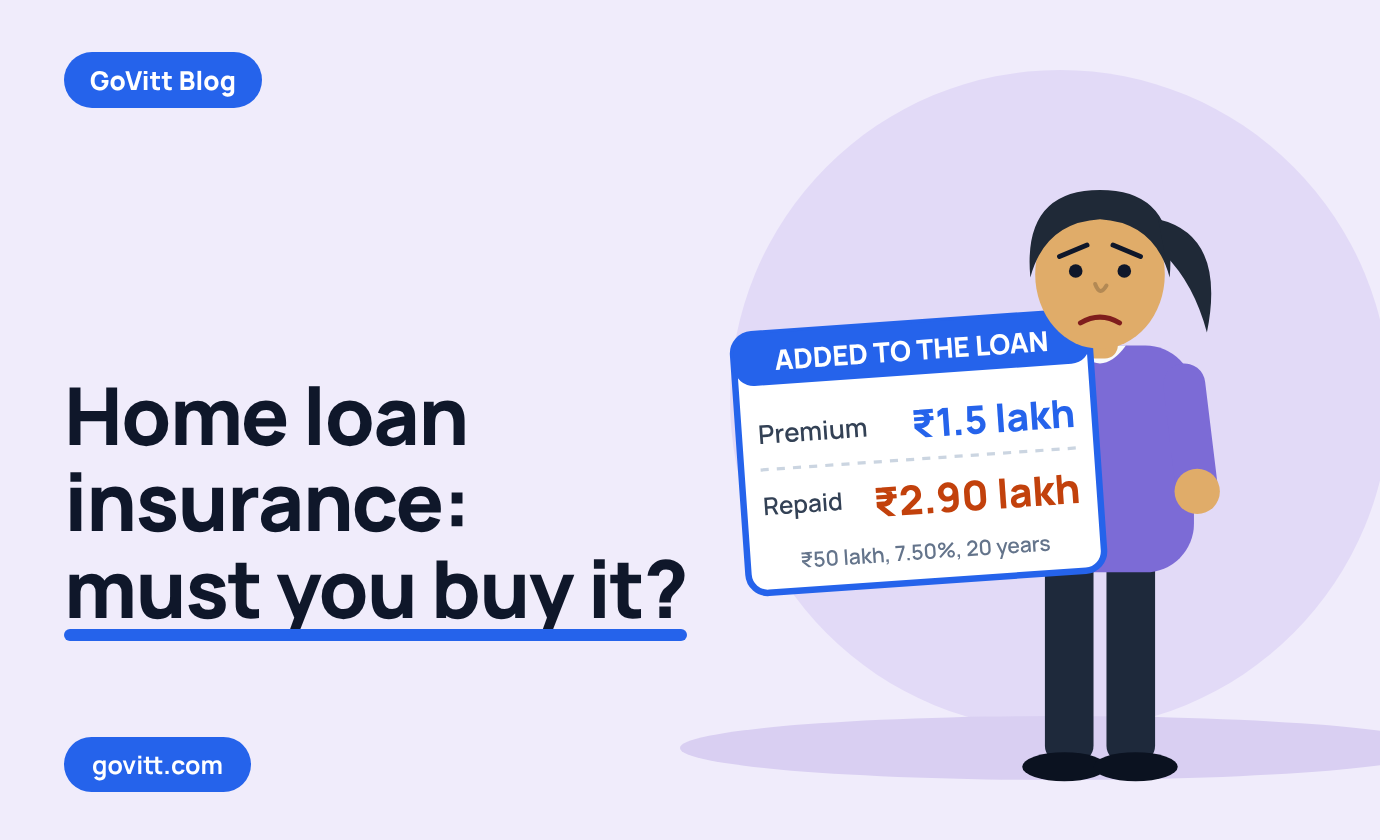
Is home loan insurance mandatory? A lender can still ask for cover. But from 1 January 2027, going by two published readings of RBI's new directions, it may not force you to buy its own insurer's policy, and it may not slip the premium into your loan without your explicit consent. I could not open RBI's own text, so this post is a careful reading of other people's reading, and I say where that matters. The number that matters to you is the premium. A ₹1.5 lakh premium added to a ₹50 lakh loan at 7.50% adds ₹1,208 a month and ₹2,89,920 over 20 years. That is 1.93 times the premium.
The short version
Don't treat any insurance tick box as part of the loan. Ask in writing whether the cover is compulsory, who the insurer is, whether you can buy the cover elsewhere, what the premium is, and whether it is added to your loan. From 1 January 2027, as reported, the answers should be: not compulsory unless it is a genuine safeguard, yes you may buy it elsewhere, and added to your loan only if you agree to that separately. Until then, nothing I read says the old practice has stopped. And if a premium has been financed, remember that it earns interest like the rest of your loan: ₹2,89,920 paid back on ₹1,50,000.
What I could and couldn't read
RBI's own circulars sit on rbidocs.rbi.org.in. Both PDFs I tried returned a human-verification page instead of the document, and a law firm's copy wouldn't load. So I read two commentary articles in full:
See your real payoff date in 60 seconds
Banks calculate remaining EMIs by simple subtraction. See your actual payoff date and discover how much interest a balance transfer can save.
- RealCostIQ, "Can your bank force home-loan insurance on you?" (published 10 October 2026, updated 21 October), on the insurance and consent directions.
- TaxUpdate.in, by CA Adityavikram Banka (published 7 August 2026, modified 28 September), on the recovery directions.
Both say they describe the circulars and don't reproduce them. So every quote below is the article's wording, not RBI's, and I have left paragraph numbers out. Before you rely on a clause, open the circular for your lender type. RealCostIQ lists them as RBI/2026-27/115 for commercial banks through RBI/2026-27/124 for housing finance companies. I couldn't verify that list either.
What the rules say, as reported
| Point | What the commentary says |
|---|---|
| When | Effective 1 January 2027. Not in force before that |
| Who | Commercial banks, small finance banks, NBFCs and housing finance companies, among other lender types |
| Bundling | "A bank may not compulsorily bundle any third-party product or service with its own product" (RealCostIQ's wording) |
| The exception | Where the cover is a genuine risk mitigant, you must be free to buy it from any provider |
| Consent | A product is sold only with your explicit consent, and the default setting must be "no" |
| Paying for it from the loan | The lender "may not use the customer's loan facility to fund the purchase of any product or service". RealCostIQ reads this as needing your separate explicit consent before a premium is added to the loan |
| Default ticks | "Loan protection insurance added by default during a loan application" appears in an illustrative list of dark patterns |
| If you are mis-sold | Complain within 30 days of getting the signed terms where no other regulator's timeline applies. The lender must "refund the full amount the customer paid for the product" and compensate losses under its Board approved policy |
| Records | Consent records are kept for a year after the contract ends |
One official page I did read myself is RBI's key facts statement circular of 15 April 2024, which applies to loans sanctioned from 1 October 2024. It says charges collected for third parties, such as insurance, count in the annual percentage rate and are shown separately. So today the premium should already be visible in the paper you sign.
What the commentary says the rules don't do
RealCostIQ found no rule that returns the unused part of a premium when you prepay, foreclose or transfer your loan. It cites IRDAI's master circular of 12 June 2024 for a 30 day free look period, and for the credit-life term not running longer than the loan. I haven't read that circular. If the article is right, the new directions protect how the product is sold. They don't say what happens to the premium afterwards. And I couldn't tell from either article whether the directions touch loans sanctioned before 1 January 2027, so ask your lender.
What a premium added to the loan really costs
Take ₹50 lakh over 20 years and add a single premium to the loan at the loan's own rate. Every figure here is an illustration. I read no insurer's price.
| Loan rate | Premium added | EMI goes up by | Extra paid over 20 years | Of which interest | Times the premium |
|---|---|---|---|---|---|
| 7.50% | ₹1 lakh | ₹805 | ₹1,93,200 | ₹93,200 | 1.93 |
| 7.50% | ₹1.5 lakh | ₹1,208 | ₹2,89,920 | ₹1,39,920 | 1.93 |
| 7.50% | ₹2 lakh | ₹1,611 | ₹3,86,640 | ₹1,86,640 | 1.93 |
| 7.50% | ₹3 lakh | ₹2,416 | ₹5,79,840 | ₹2,79,840 | 1.93 |
| 8.75% | ₹1 lakh | ₹883 | ₹2,11,920 | ₹1,11,920 | 2.12 |
| 8.75% | ₹1.5 lakh | ₹1,325 | ₹3,18,000 | ₹1,68,000 | 2.12 |
| 8.75% | ₹2 lakh | ₹1,767 | ₹4,24,080 | ₹2,24,080 | 2.12 |
| 8.75% | ₹3 lakh | ₹2,651 | ₹6,36,240 | ₹3,36,240 | 2.12 |
The cost is 1.93 times the premium at 7.50% and 2.12 times at 8.75%. RealCostIQ's own example (₹50 lakh at 9% for 20 years, ₹1.5 lakh financed) takes the EMI from ₹44,986 to ₹46,336. I get the same two EMIs.
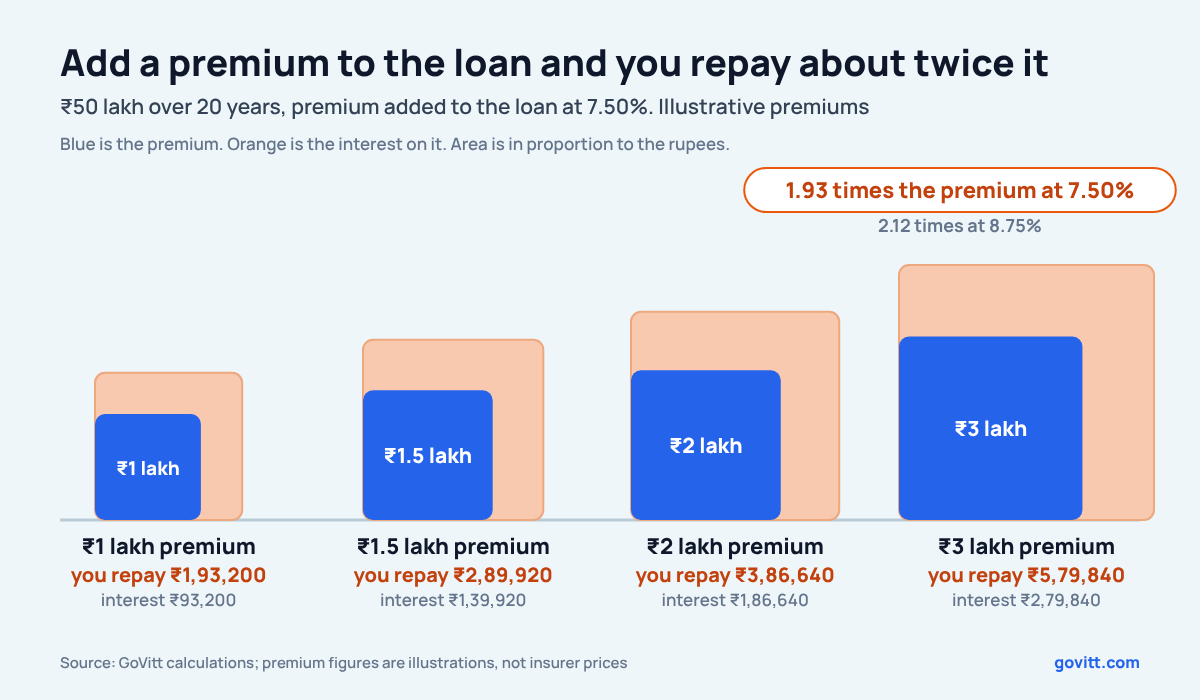
A premium paid out of your pocket in year one costs you the premium. The same premium added to the loan costs you about twice that. If you have to take cover and the lender says the premium can be paid separately, do that when you can. I wrote about what the cover is and who it pays in home loan insurance: if something happens to you, who actually pays the bank.
If you prepay or transfer: what happens to the premium?
I couldn't find an answer, so here is a picture of what is at stake. The table spreads a ₹1.5 lakh single premium evenly over a 20 year term. That is a straight line, not a refund formula. A real policy may price the cover very differently, and the commentary I read found no rule that gives any of it back.
| When the loan ends or moves | Premium used up | Premium unused |
|---|---|---|
| After 3 years | ₹22,500 | ₹1,27,500 |
| After 5 years | ₹37,500 | ₹1,12,500 |
| After 10 years | ₹75,000 | ₹75,000 |
If you move the loan in year 5 and nobody refunds the unused part, ₹1,12,500 of a ₹1.5 lakh premium has bought you nothing more. Put the refund terms on your list before you move. They are one of the seven lines in my quote checklist, and when a balance transfer is not worth it is what to read if the numbers are close.
A financed premium eats the saving you moved for
Say you transfer ₹50 lakh from 8.75% to 7.50%. The EMI goes from ₹44,186 to ₹40,280, a saving of ₹3,906 a month. Now add a premium to the new loan:
| Premium added | EMI goes up by | Share of your ₹3,906 saving it eats |
|---|---|---|
| ₹1 lakh | ₹805 | 21% |
| ₹1.5 lakh | ₹1,208 | 31% |
| ₹2 lakh | ₹1,611 | 41% |
| ₹3 lakh | ₹2,416 | 62% |
A ₹1 lakh premium takes a fifth of what you moved for. A ₹3 lakh premium takes 62%.
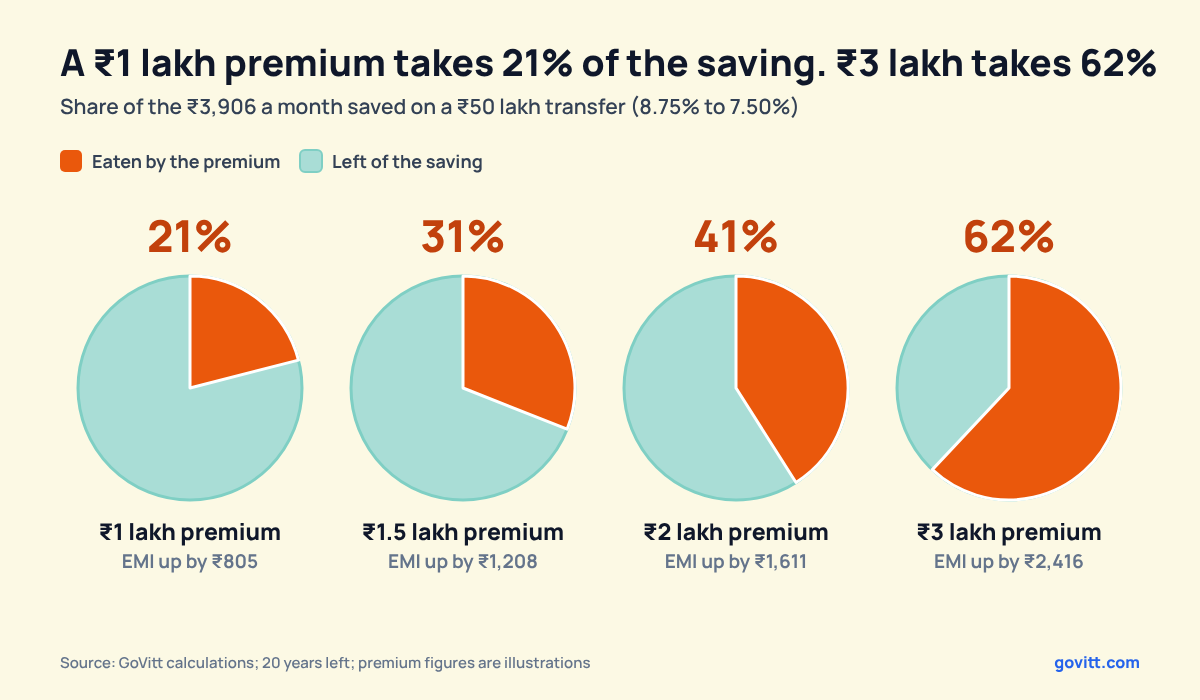
That is why I put the premium on the same line as the rate when I compare quotes. A quote at 7.40% with a financed premium can be worse than a plain 7.50%.
A 0.05% discount against a premium
Bank of Baroda's rate page, read on 24 November through a summary, adds 0.05% to the rate if you don't take its credit insurance. I couldn't re-read it today, so check it. If that is how it works, here are the numbers on ₹50 lakh over 20 years. At 7.40% the EMI is ₹39,974. At 7.45% it is ₹40,127. The 0.05% is worth ₹153 a month, or ₹36,720 over the 20 years.
A premium added to the loan costs about ₹803 a month for every ₹1 lakh at 7.45%. So the 0.05% pays for a financed premium of about ₹19,065 and no more. Above that, the discount costs you more than it saves. I wrote up the bank's rate and its flat takeover fee in the Bank of Baroda post.
Same date, a second set of rules
TaxUpdate.in describes nine more circulars, dated 6 August 2026, that also take effect on 1 January 2027. They are about recovery, not insurance. As the article reports them, a lender's contact and visits are allowed only between 08:00 and 19:00 unless you have asked or agreed otherwise. The agency must give at least one day's prior notice before its first visit to you. Calls are recorded and kept for six months. I haven't read those circulars either, so open the one for your lender if you want the detail.
What I'd do
- Before 1 January, read every tick box. The new rules aren't in force yet. If a form has insurance pre-selected, untick it and ask if it is compulsory.
- Ask five things in writing: is the cover compulsory, who is the insurer, can I buy it elsewhere, what is the premium, and is it added to my loan.
- Say no to a financed premium if you can pay it separately. It costs about twice as much.
- If you already have a financed premium, ask for the refund terms on part payment and on closure, in writing. Then decide whether prepaying changes the picture. My view on prepaying a floating rate loan is that the bank can't charge you for it.
- If you're transferring, make the new lender's quote show the premium as its own line, not inside the EMI. The transfer process is where these lines get lost.
- After 1 January, if you were pushed, write to the lender's grievance channel within 30 days of getting the signed terms, and keep your copy of the form. That is the window the commentary reports.
FAQ
Is home loan insurance mandatory in India? A lender can still ask for cover as a risk safeguard. As reported, from 1 January 2027 it can't force you to buy its own insurer's product, and where cover is asked for you must be free to buy it from any provider. I couldn't read RBI's text, so check it before you rely on this.
Can a bank add the insurance premium to my home loan? As reported, only with your separate explicit consent from 1 January 2027, and a default tick for it counts as a dark pattern. Whatever the rules, a financed premium costs you interest: on ₹1.5 lakh at 7.50% for 20 years it is ₹1,39,920.
Can I buy home loan insurance from outside the bank? That is what the "free to buy from any provider" line is for. The lender can still ask for suitable cover. Get quotes and compare the cover, the term and the refund terms.
Do I get the premium back if I prepay or transfer my home loan? I couldn't find a rule that says so, and RealCostIQ found none either. Ask the insurer and the lender in writing before you close or move the loan.
When do RBI's new rules on insurance and consent start? On 1 January 2027, per both articles I read. They also say the directions cover commercial banks, small finance banks, NBFCs and housing finance companies. Check the circular for your lender.
Comparing quotes with and without insurance? Run the Payoff & Transfer Calculator with the premium added to the loan and then without it. GoVitt compares 50+ banks and charges you 0% commission.
This post is based on two commentary articles about RBI's directions, not on RBI's own text, which I could not open. Quotes are the articles' wording. Rules can change and your lender's terms govern your loan. Premium figures are illustrations on ₹50 lakh over 20 years, with the premium added to the loan at its own rate. EMIs use the standard monthly reducing balance method, rounded to the nearest rupee. The unused premium table is a straight line illustration, not a refund formula. This is general information, not financial, legal or tax advice, and I am not
Ready to take the next step?
Find out your loan options and check your eligibility with GoVitt today.